
Usama Al Shahmani
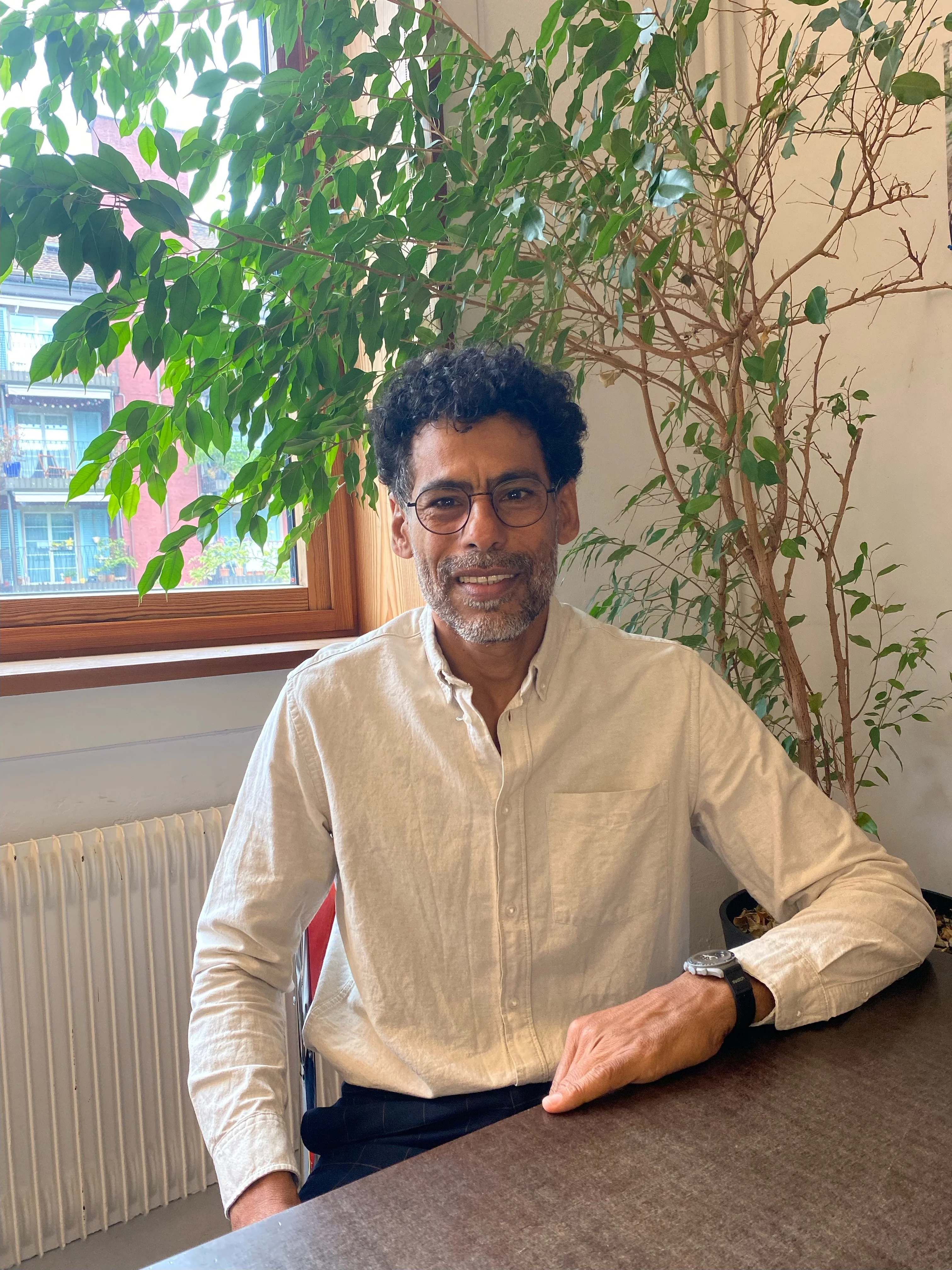
Image from Wikipedia
Image from Wikipedia
Usama Al Shahmani
Between Baghdad and Lake Constance: The Writer Who Gives a Voice to the Other
Usama Al Shahmani, born in Baghdad in 1971 and raised in Qalat Sukar (Nasiriyya Province), is one of the most impressive voices in contemporary literature in the German-speaking world. His music career does not exist – his instrument is language. As a writer, poet, and translator, he weaves together exile experiences, memories, and nature observation into a poetic prose that resonates with readers far beyond Switzerland. Since fleeing Iraq in 2002, Al Shahmani has lived and written in Switzerland, where he has established himself with great stage presence at readings and discussions as a wise, quiet, and unwavering chronicler of flight, arrival, and artistic development.
Biography: From Southern Iraq to Switzerland – Flight, Arrival, New Beginning
Growing up in Qalat Sukar, Al Shahmani studied the Arabic language and modern Arabic literature before political persecution forced him into exile. In 2002, he left Iraq and found a new home in Switzerland, where he gradually anchored himself in the literary scene. Central experiences of his arrival – the confrontation with a foreign bureaucracy, the silence of language in exile, the need for belonging – condense in his work into narrative motifs of high emotional intensity. In Frauenfeld and German-speaking Switzerland, nature experiences and hikes shaped him, becoming not just a backdrop in his books, but a methodological principle of self-affirmation.
Breakthrough: “In Exile, the Trees Speak Arabic” (2018)
His literary breakthrough came in 2018 with the novel “In Exile, the Trees Speak Arabic.” The book, published by Zürcher Limmat Verlag, has received multiple awards and was nominated for the “Favorite Book of the Swiss Book Trade.” The success was based on an unmistakable blend of autobiographical storytelling, precise observation of Swiss contemporary life, and poetic condensation. Critics highlighted the delicate yet relentless way in which Al Shahmani shaped language loss, trauma, and nature experience into a composition of memory, composition, and arrangement – literature as a counterpoint to silence.
Works and Thematic Scope: From Healing Language to Space of Remembrance
Following his debut, 2020 saw the release of “In Falling, the Pen Learns to Fly,” a novel that Swiss media described as a homage to the healing power of storytelling. In 2022, “The Bird Does Not Doubt the Place to Which It Flies” was published, a poetic novel about flight, identity, and the search for a place jointly carried by memory and present. In this work, Al Shahmani unfolds a narrative architecture that is episodically composed, utilizes refrain motifs, and often assumes the quiet pace of walking – a literary arrangement in which images of nature, internal monologues, and dialogues with the landscape intertwine.
Language, Style, and Poetics: Nature as Resonant Space of Exile
His prose is characterized by finely crafted imagery that understands nature not merely as a metaphor, but as a resonant space of exile. Recurring motifs – trees, wind, river landscapes – act as counterparts probing answers to questions of guilt, loss, and hope. Formally, Al Shahmani prefers a clear sentence structure with lyrical condensations; passages function like thoughtfully composed stanzas, where pauses are as significant as the words. This poetic ecology makes his texts relevant to debates on migration and memory culture, without sacrificing their literary core to the primacy of political statements.
Translator and Cultural Mediator
In addition to his own writing, Al Shahmani has established himself as a translator of German-language works into Arabic, including texts by Thomas Hürlimann (“Fräulein Stark”), Peter Heine (“Der Islam”), and Friedrich Schleiermacher (“On Religion”). This translation work not only showcases his expertise in linguistic fine-tuning but also reflects a dual cultural positioning. As a bridge builder between Arabic and German-language literature, he expands the canon of both reading cultures and strengthens literary circulation across language and national borders.
Critical Reception and Awards
His books have received multiple awards and have been translated into several languages, including French and Italian. Reviews in quality media recognize the accuracy with which Al Shahmani immunizes the lives of refugees against stereotypes. His narrative economy is particularly highlighted: he arranges fragments of memory, dialogues, and images of nature in such a way that an internal dramaturgy unfolds, which manages to touch without pathos. His repeated presence at literary festivals, radio formats, and stages in the German-speaking world underscores his authority as a voice of a literary Switzerland that takes migration seriously as an aesthetic substance.
Between Literature and Stage: Adaptation and Performance
An adaptation for the stage of “The Bird Does Not Doubt the Place to Which It Flies” was created in collaboration with the MAXIM Theater in Zurich. This opening to the performative arts demonstrates Al Shahmani’s conscious expansion of his artistic development: texts leave the book and seek resonance in the space, in the chorus of voices, in music, light, and movement. Readings and discussions, such as at the Frankfurt Book Fair, shape his stage presence and bring his poetic world directly to the audience.
Current Projects and New Publications (2025–2026)
In 2025, the poetry anthology “A Silk Thread to Dreams,” curated by Al Shahmani, was released, bringing together fifty poems from the Limmat Verlag program and making the multilingualism of Swiss poetry visible. Also in 2025, he published the novel “In the Depth of the Tigris Sleeps a Song.” This work explores a chapter of Iraqi history, intertwining the Middle Eastern conflict, European colonial history, and the traumas of the 20th century into a narrative flow where private memory and collective past converge. Readings, discussion evenings, and festival appearances in autumn 2025 testify to the ongoing relevance of his themes and his adaptability as an author.
Historical Context: Exile Literature, Memory, and Swiss Present
In the context of German-speaking exile literature, Al Shahmani connects poetic introspection with sociocultural precision. His books align with texts that understand arrival in Switzerland not merely as an integration story, but as a poetic process: language is learned anew, grammar and landscape become co-authors. This perspective relates to traditions of migration literature, yet updates them with a nature-centered poetics whose quiet radicality lies in inscribing comfort, grief, and resistance into the topography of forests, rivers, and paths.
Themes and Motifs: Guilt, Silence, Shared Present
Al Shahmani repeatedly grapples with the feelings of guilt among survivors, the silence following experiences of violence, and the difficult reclamation of one’s own voice. The body of the narrator moves through forests and along riverbanks; in movement, memory is re-organized. Instead of linear narratives, a cyclical storytelling dominates with quiet crescendos, in which nature responds to inner tensions like a string instrument. This approach fosters closeness without indiscretion and opens spaces where readers can locate their own experiences of loss and new belonging.
Reception in the German-speaking World: Media, Stages, Communities
Portraits in radio and press, invitations to festivals, and translations testify to Al Shahmani's growing literary networks. Discussion formats addressing exile, human rights, and language sharpen his profile as a trustworthy voice, one that literarily explores the complexities of biographical ruptures. Notably, his books consistently mediate between documentary accuracy and poetic freedom – an expertise that solidifies his authority in literary and cultural-political debates.
Conclusion: Why You Should Read and Experience Usama Al Shahmani Live
Usama Al Shahmani makes the foreign speak. His novels and essays transform the experience of exile into literature that comforts and stirs without ever being didactic. Those who attend his readings experience a stage presence that transforms calm into resonance: words fall, align themselves, and continue onward – like wanderers finding their rhythm. In a time when origin, identity, and belonging are negotiated globally, Al Shahmani provides the poetic depth that transforms debates into stories. Highly recommended to read him – and to hear him at a reading, where his sentences, like river flows, resonate long after.
Official Channels of Usama Al Shahmani:
- Instagram: No official profile found
- Facebook: No official profile found
- YouTube: No official profile found
- Spotify: No official profile found
- TikTok: No official profile found
Sources:
- Wikipedia (DE) – Usama Al Shahmani
- Wikipedia (EN) – Usama Al Shahmani
- Limmat Verlag – Author Page Usama Al Shahmani
- SRF – Author Portrait Usama Al Shahmani
- SWI swissinfo – From Exiled Author to Swiss Writer
- MAXIM Theater Zurich – Stage Adaptation “The Bird Does Not Doubt the Place to Which It Flies”
- Frankfurt Book Fair – Reading “In the Depth of the Tigris Sleeps a Song”
- WOZ – Review “In the Depth of the Tigris Sleeps a Song”
- Deutschlandfunk – Review “In the Depth of the Tigris Sleeps a Song” (PDF)
- Qantara.de – Portrait and Interview
- Wikipedia: Image and Text Source