
Rudolf Haegele
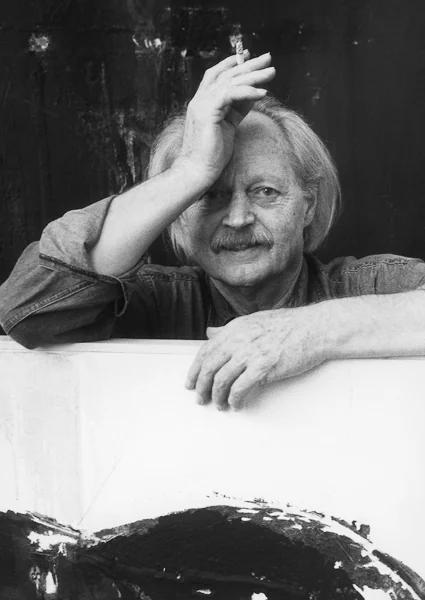
Image from Wikipedia
Image from Wikipedia
Rudolf Haegele – Painter, Creator of Stained Glass, Professor: A Life Dedicated to Contemporary Art
From the End of War to Artistic Revolt: The Lively Life of Rudolf Haegele
Rudolf Walter Haegele, born on April 21, 1926, in Schömberg near Rottweil and died on June 27, 1998, in Remseck, is considered one of the influential painters and university teachers in the post-war art scene of southern Germany. Marked early by World War II, he found his medium of resistance and renewal in painting after 1945. His artistic development took him from the Stuttgart Academy through a formative scholarship in Paris to a professorship at the State Academy of Fine Arts Stuttgart, where he shaped and inspired generations of artists. His oeuvre combines gestural abstract painting, dense material images, and striking glass works for sacred and public spaces.
Haegele did not have a music career – his stage was the canvas, the glass wall, the pictorial space. Especially in his presence as a professor and exhibition artist, an artistic development manifested that transformed personal experience, existential themes, and art historical knowledge into powerful compositions. His work demonstrates how abstraction, myth, and history merge into a distinctive visual language in concentrated arrangements.
Biography: Education, Influences, Calling
After his schooling and military service, Haegele began his studies at the Stuttgart Academy of Fine Arts in 1946, among others under Fritz Steisslinger and Hermann Sohn. In 1949, the Louis-Gindraux Scholarship allowed him a significant stay in Paris, where the raw materiality of Jean Dubuffet's work and the existentialist philosophy of Albert Camus sharpened his artistic stance. Back in Stuttgart, he continued his studies with Rudolf Yelin in 1951/52 and then worked as a freelance artist with an active exhibition schedule both domestically and internationally. In 1965, he was appointed to the Stuttgart Academy to take over the chair in painting from Heinrich Wildemann; he shaped the department of fine arts there until 1992. In 1968, he became the chairman of the Stuttgart Secession. These stations mark a continuous professional development that solidifies his authority in the art scene and makes his work visible well beyond Stuttgart. Sources confirm that in parallel, he realized numerous stained glass windows in southern Germany – a second, technically independent level of his oeuvre. ([de.wikipedia.org](https://de.wikipedia.org/wiki/Rudolf_Haegele))
Artistic Development: Gesture, Material, Myth
Haegele's painting condenses gestural applications, layering, and superimpositions into compositions that resemble palimpsestic pictorial spaces – layers, traces, corrections. Works such as Palimpsest (Landscape Letter) (1980) or Fresco Remnants (1988) illustrate his affinity for the “written” quality of color: overpainting as a memory, structure as a trace of time. In the 1980s and 1990s, his work opens up between abstract color spaces and representational-mythological symbols – Ariadne (1997), Winged Being (Nike) (1996), or Torso Physognomy (Head of Medusa) (1993) link ancient pictorial motifs with existential symbolism. This phase of work emphasizes not only the dramatic structure of his images but also the sonic quality of color, density, and texture, which can be described as “compositional” in terms of pictorial architecture. ([de.wikipedia.org](https://de.wikipedia.org/wiki/Rudolf_Haegele))
Glass Works as an Independent Level of Art
In addition to the canvas, glass works emerge as a second supporting pillar in Haegele's art – in a figurative sense of his oeuvre overview. Glass and concrete glass windows in Stuttgart-Weilimdorf (1957), Marburg (1959), Münchingen (1961), Bregenz (1966), Pfullingen (1972), and Leutkirch (1972) showcase his mastery of light, color, and architectural space. These works demand precise arrangement that takes into account the inherent logic of material and light management. They anchor Haegele in the tradition of 20th-century stained glass art and demonstrate his technical expertise beyond easel painting. ([de.wikipedia.org](https://de.wikipedia.org/wiki/Rudolf_Haegele))
Teaching and Impact: A Class That Makes Exhibition History
As a professor, Haegele fosters a vibrant studio climate that encourages artistic independence. Even as early as the 1970s, academy communications document the active exhibition work of his class – an indication of his pedagogical impact. Notable biographies touched by his teaching include Dorothee Ziegler, who worked as a master student in his painting class in the late 1960s. In later artist biographies from the southern German area, Haegele is repeatedly mentioned as a formative teaching figure. His role in the Stuttgart art scene strengthens the connection between the academy, exhibition practice, and public perception. ([de.wikipedia.org](https://de.wikipedia.org/wiki/Rudolf_Haegele))
Work Groups and Key Images: From “Torso” to “Ariadne”
Important milestones in his artistic development include Torso (1964) – a compressed body-image between abstraction and figuration –, Prometheus II (1973) – a cipher for creative energy and resistance –, and Hohenasperg (In memoriam C. F. D. Schubart) (1990) – a work that translates historical memory into painterly topography. In the 1990s, mythological and landscape motifs consolidate (Witness Mountain, Figure, Source of a River [Yangtze], Lofoten II), before works such as Ariadne (1997) connect the late work with narrative threads. This range illustrates how Haegele combines formal research, material history, and subjective experience into a coherent artistic signature. ([de.wikipedia.org](https://de.wikipedia.org/wiki/Rudolf_Haegele))
Material, Techniques, Production: Pictorial Spaces as Experiential Spaces
Haegele's images are created from layers: pigment, binder, chalk, sand, paper, fabric – each material expands the vocabulary of the surface. This tactile understanding of painting aims at experiential spaces where the gaze reads touchingly and reveals the memory of color. In the production of these images, composition and improvisation work together: firmly set axes and color edges stand next to eruptive gestures, controlled transparencies next to opaque blocks. The technical expertise is also evident in the glass works, where the arrangement of light – similar to the sonic balance in a score – directs the visual dramaturgy. ([de.wikipedia.org](https://de.wikipedia.org/wiki/Rudolf_Haegele))
Reception and Authority: Critical Voices and Institutions
Art criticism highlights Haegele's stance as an artistic revolt – a painting that shapes a constructive visual language from personal experience. Institutional exhibition formats from his professorship in Baden-Baden or Stuttgart underscore the significance of his work in the context of southwestern German art after 1945. Even beyond his death, his work remains present: galleries showcase key canvases from the 1970s to the 1990s, including Palimpsest cycles and mythologically charged compositions that continue to resonate in the art market and curated group exhibitions. This visibility serves as an indicator of his authority in the canon of regional modernity. ([de.wikipedia.org](https://de.wikipedia.org/wiki/Rudolf_Haegele))
Current Visibility: Gallery Presence and Collector Context
The ongoing presence in galleries carries Haegele's visual language into the present. Galerie Cyprian Brenner showcases a series of major works – from the Palimpsest paintings to figurative allusions to large-format canvases from the 1990s. Such selection catalogs not only provide insights into phases of his work but also offer collectors art historical contextualization. Moreover, works regularly appear in benefit and themed auctions, thus extending the reception into civic contexts. ([galerie-cyprian-brenner.de](https://www.galerie-cyprian-brenner.de/kuenstler/haegele-rudolf?utm_source=openai))
Context: Post-War Art in Southwest Germany
Haegele's artistic development occurs in dialogue with post-war modernity in southwestern Germany. Between abstraction and figuration, myth and material, he emphasizes a visual ethic that connects experience and responsibility. In the Stuttgart academy tradition – supported by teaching figures, colleagues, and the Secession – he develops a body of work that does not merely illustrate the “inner landscape” of the post-war period but makes it structurally tangible. His glass works link modernity and liturgy, situating his art in public space – a contribution to visual culture that extends beyond gallery spaces. ([de.wikipedia.org](https://de.wikipedia.org/wiki/Rudolf_Haegele))
Catalogue of Works at a Glance: Selection and Works in Space
A condensed selection of works shows the arc from the early Torso (1964) to Prometheus II (1973), Palimpsest (Landscape Letter) (1980), Fresco Remnants (1988), Hohenasperg (1990), and Ariadne (1997). In parallel, glass works in Stuttgart-Weilimdorf (1957), Marburg (1959), Münchingen (1961), Bregenz (1966), Pfullingen (1972), and Leutkirch (1972) mark the topographical scope of his art. Individual works are held in collections and are mediated through galleries; photographic documents of his work are also accessible through image archives and Commons. For further contextualization, it is worthwhile to look at exhibition catalogs such as “Images from Three Decades 1958–1988.” ([de.wikipedia.org](https://de.wikipedia.org/wiki/Rudolf_Haegele))
Conclusion: Why Rudolf Haegele is Fascinating Today
Rudolf Haegele connects artistic experience with formal expertise and institutional authority. His painting negotiates history, myth, and the physical presence of color with a trustworthiness based on precise technique, reflected visual ethics, and documented exhibition practice. Those who view his images experience pictorial spaces that not only tell stories but breathe – layers in which time, memory, and possibility overlap. Haegele remains intriguing because his art does not provide simple answers but takes seeing itself radically seriously. Recommendation: Experience the works in person – in light, in space, in changing perspectives. Only there do composition, arrangement, and production unfold their full power.
Official Channels of Rudolf Haegele:
- Instagram: No official profile found
- Facebook: No official profile found
- YouTube: No official profile found
- Spotify: No official profile found
- TikTok: No official profile found
Sources:
- Wikipedia – Rudolf Haegele
- Website about Rudolf Haegele – Biography, Works, Texts
- LEO-BW – Biography Directory: Haegele, Rudolf
- Galerie Cyprian Brenner – Rudolf Haegele (Works, Exhibitions)
- University Library Heidelberg – “Rudolf Haegele: Images from Three Decades 1958–1988”
- Wikimedia Commons – Rudolf Haegele (Image)
- Wikipedia: Image and text source
Upcoming Events
Exhibition: Rudolf Haegele (1926–1998) on the 100th Birthday
Exhibition: Rudolf Haegele (1926-1998) for His 100th Birthday
Rudolf Haegele (1926-1998) for his 100th Birthday - Integration into Time
Rudolf Haegele (1926-1998) for his 100th Birthday - Insertion into Time
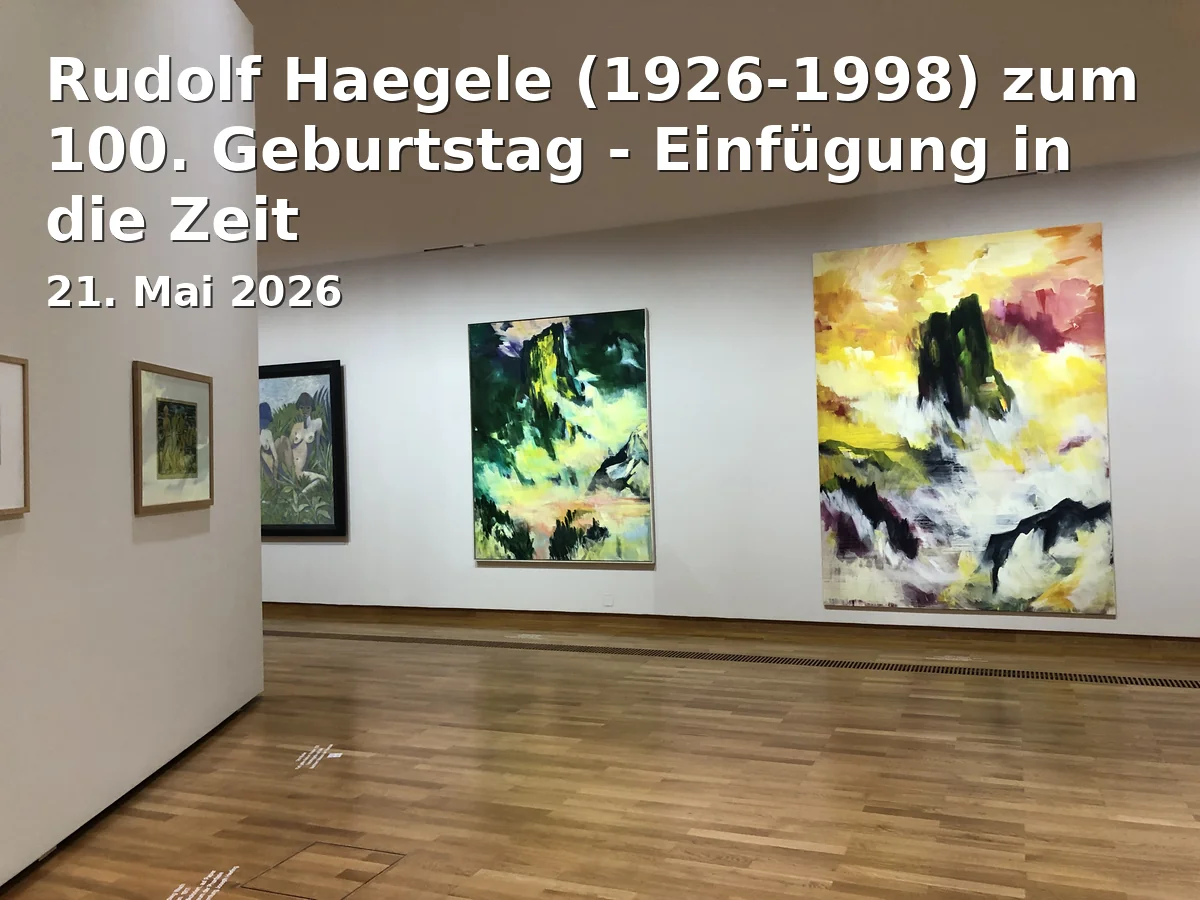
Rudolf Haegele (1926-1998) for his 100th Birthday - Integration into Time
Rudolf Haegele (1926-1998) for his 100th Birthday - Insertion into Time
Rudolf Haegele (1926-1998) for his 100th Birthday - Insertion into Time
Rudolf Haegele (1926-1998) for his 100th birthday - Insertion into Time
Rudolf Haegele (1926-1998) for the 100th Birthday - Insertion into Time