
Janosch

Image from Wikipedia
Image from Wikipedia
Janosch – The Inventor of the Tiger Duck and Poet of Childhood
An artist who shaped generations and preserved wonder
Janosch, born Horst Eckert (born March 11, 1931, in Hindenburg/Upper Silesia, now Zabrze), is one of the most influential German-speaking illustrators and children’s book authors of today. His world of Tiger, Bear, and the legendary Tiger Duck has become a part of the collective memory of many childhoods – in books, on screens, and on stages. After spending his early years in a textile factory, a brief study at an art academy, and choosing a free artist's life, he developed a distinctive style: quietly subversive, humorous, and comforting. Since the 1980s, the artist has lived on Tenerife – a retreat from which he nonetheless continually engages with German-speaking culture.
Janosch's artistic development can be read as a journey to the essence of storytelling: concise language, clear composition, seductively simple characters that carry existential themes. “Oh, how beautiful is Panama,” “Post for the Tiger,” and “I’ll make you healthy, said the Bear” have long become archetypes of the modern picture book. The books are published in dozens of languages; adaptations for film and television, collector's editions, exhibitions, and gallery editions attest to the unbroken resonance.
Biography: From Upper Silesia to Tenerife – a life path between shadow and light
Janosch grew up in Upper Silesia in an atmosphere of religious strictness and familial hardship – biographical experiences that later resurfaced in his adult books and interviews. After fleeing to West Germany, he initially worked in a textile factory before moving to Munich in 1953, where he briefly studied at the Academy of Fine Arts. The music careers of many contemporaries were foreign to him; he developed his “stage presence” on paper: as a draftsman, storyteller, and satirical observer. In 1960, his first children’s book was published, and on the advice of the publisher, he adopted the pseudonym “Janosch” – an artistic rebirth that set the course.
By the end of the 1970s, over 100 children's books had been created. In the early 1980s, he moved to Tenerife. This change of residence marks less a retreat than a radical concentration: from a distance, he unfolded a poetic world that fosters closeness. His biography documents, alongside the rich book production, exhibitions, etchings, and free graphics – a body of work that combines illustration, literature, and visual art.
Breakthrough and Popularity: Tiger, Bear, and the Tiger Duck
With “Oh, how beautiful is Panama,” Janosch achieved the breakthrough in 1979 that permanently linked his name with an attitude of friendship, freedom, and curiosity. The little Bear and the little Tiger seek happiness – and ultimately discover that it begins at home. This narrative economy, paired with iconographic clarity (the Tiger Duck as a rolling, silent mascot), quickly became a trademark. The stories were adapted for television in “Janosch’s Dream Hour”; from the mid-1980s, they shaped the early evening programming of many childhoods and opened the work to an even broader audience.
Meanwhile, production professionalized: new editions, high-quality collector's volumes, merchandising, and a growing presence in museums and galleries. The “stage presence” of his characters extended into theater, opera and musical adaptations, as well as audio drama and film productions. The Tiger Duck never merely remained a character but became a symbol of a wise, gently anarchic worldview.
Overview of Works (Discography in the figurative sense): Books, Films, Editions
Although Janosch is not a musician, his work possesses a sort of “discography” of picture and story albums: titles that are repeatedly issued anew, quoted, and adapted like hits. Central are the cycles around Tiger and Bear (“Oh, how beautiful is Panama,” “Post for the Tiger,” “I’ll make you healthy, said the Bear”) as well as stories for adults that illuminate biographical shadows with gentle irony. This “album” is supplemented by TV series such as “Janosch’s Dream Hour,” feature films (including “Oh, how beautiful is Panama,” 2006), and editions of etchings and graphics circulating in galleries in the German-speaking world.
In terms of production aesthetics, Janosch combines reduced line work with warm color tones; in the “composition” of the pages, close and distant views, stillness and movement, alternate. Linguistically, he works with refrains and motifs like in pop music: recurring phrases, running gags, recognizable characters – a principle that supports children’s reception and offers subtle layers to adults.
Style and Artistic Development: The Poetry of Simplicity, Depth without Pathos
Janosch's handwriting can be described as a balance of naivety and wisdom. In the imagery, a loose stroke dominates, often watercolored, with deliberately left open edges. Compositional white spaces create pauses for breath; the “arrangements” of the figures guide the eye towards relationships rather than action. The texts resonate in their brevity – like song lines one carries with them. This “sound design” of the language, this economy of storytelling, shapes the artistic development from the early, still rough books to mature, distilled stories.
Existential themes repeatedly emerge: home and wanderlust, illness and healing, fear and courage, friendship and self-efficacy. Instead of moralizing finger-wagging, Janosch offers open spaces where children are allowed to feel and think. Humor protects, tenderness heals, the Tiger Duck rolls silently along – an arrangement that has not aged over decades.
Reception, Awards, and Cultural Location
Critics have recognized Janosch for decades as a renewer of the German-language picture book: his laconic tone, poetic condensation, and graphic independence, the press summarizes, form a rare unity. In 1979, he received the German Youth Literature Prize (category Picture Book) for “Oh, how beautiful is Panama” – a milestone that solidified his authority in the field of children's and youth literature. Awards, international exhibitions, and a consistently strong readership have culturally anchored the brand “Janosch.”
This authority stems from experience and the scope of his work: numerous books, translations into many languages, recurring retrospectives, and work presentations. Media resonance for milestone anniversaries (90th, 95th birthday) demonstrates how present his characters have remained in everyday culture. His influence extends into television shows (including “Janosch’s Dream Hour,” “Tiger Duck Club”), theater, and musical theater – a crossover that attests to the relevance of his oeuvre beyond the picture book.
Adaptations: From “Janosch’s Dream Hour” to the Feature Film
The transfer from book to moving image was achieved early and sustainably. “Janosch’s Dream Hour” (mid/late 1980s) bundled episodes of the best-known stories; the switch in medium preserved tone and attitude. In 2006, the film adaptation of “Oh, how beautiful is Panama” followed, along with further adaptations and reinterpretations. The fact that these productions continue to be reissued, streamed, or collected as DVD boxes demonstrates the ongoing demand for the iconic imagery and comforting life philosophy.
From a media-historical perspective, Janosch is thus a pioneer of transmedial children’s entertainment in the German-speaking world: characters with high recognition value, clear dramatic arcs, strong themes – ideal prerequisites for television, cinema, audio plays, and stage. The “production” of his worlds works in different formats without losing literary origins.
Current Projects, Editions, and Anniversaries (2024–2026)
Even in advanced age, Janosch remains visible: galleries in the German-speaking world continue to present graphics, etchings, and prints; a current art catalog for 2024 documents motifs between classics and newer works. Parallel media reports on his 95th birthday in March 2026 illuminate his life's work and position the Tiger Duck as a cultural constant of the Federal Republic. Publishers keep the backlist present, new editions are released with carefully updated designs, and institutions of children's and youth culture program readings, exhibitions, and family formats around Tiger and Bear.
The “artistic development” in this late phase manifests less in new cycles than in curated retrospectives, high-quality editions, and contextualizations: interviews, work biographies, collection presentations. For collectors, galleries offer limited prints; for families, shops and publishers provide lovingly produced products – always focusing on quality and the unmistakable imagery.
Influence and Legacy: Why Janosch Endures
Janosch has renewed the poetics of the picture book by taking childhood seriously rather than trivializing it – and thereby creating lightness. His “composition” of minimalist language, iconic characters, and existential themes has unfolded a cultural depth effect that reaches far beyond children's rooms. Pedagogy, psychology, and cultural criticism cite his characters as examples of resilience, friendship, and empathy; designers, illustrators, and authors cite his reduction and color dramaturgy as a reference point.
Across generations, the stories function as shared “songs” of a cultural repertoire: parents read them to children, grandparents recall television moments, museums preserve originals. Janosch thus remains less a brand than a feeling – a promise that curiosity and friendship are stronger than fear and confinement.
Conclusion: The Quiet Power of the Tiger Duck – and Why You Should Experience Janosch
What makes Janosch so special? His books are both gentle and subversive, simple and clever, playful and wise. They connect artistic precision with poetic openness, addressing children directly and providing adults with a mirror. Those who see his images in the original sense feel the materiality of line and color; those who read the stories aloud hear their rhythm. This makes every encounter – whether in the book, in the cinema, in an exhibition, or in collections – an experience.
The call: Experience Janosch live – in exhibitions, readings, special screenings in cinemas, or through shared storytelling. These encounters show why the Tiger Duck continues to roll: because it carries an attitude that comforts, liberates, and connects.
Official Channels of Janosch:
- Instagram: No official profile found
- Facebook: No official profile found
- YouTube: No official profile found
- Spotify: No official profile found
- TikTok: No official profile found
Sources:
- Wikipedia – Janosch
- Frankfurter Allgemeine Zeitung – Janosch turns 90
- DIE ZEIT – Janosch turns 80: The Prisoner of the Tiger Duck
- t-online – Janosch turns 95 (2026)
- Janosch.de – VITA (Janosch film & medien AG)
- Janosch-Kunst.de – Catalog 2024
- Janosch-Kunst.de – Exhibition Dates
- Wikipedia – Janosch’s Dream Hour
- Wikipedia – Oh, how beautiful is Panama (Film, 2006)
- Wikipedia – Oh, how beautiful is Panama (Book/Adaptations)
- Verlagsgruppe Oetinger – Tiger and Bear (Program)
- Stadtbibliothek Nürnberg – German Youth Literature Prize (Chrono, 1979)
- Wikipedia: Image and text source
Upcoming Events
Janosch Vernissage and Exhibition in Darmstadt
Come, Let’s Find a Treasure
JANOSCH - Oh How Beautiful Is Panama
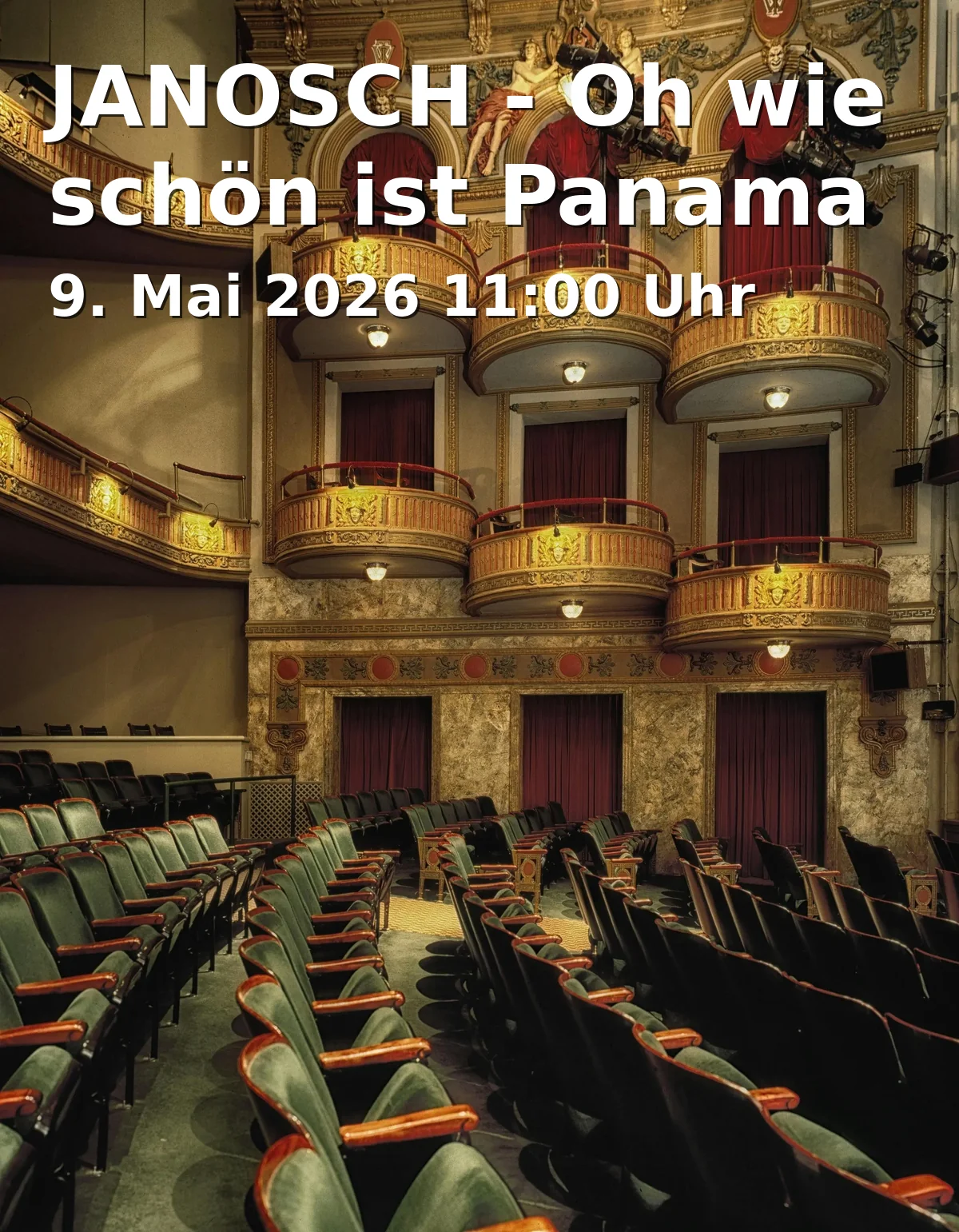
JANOSCH - Oh how beautiful is Panama
JANOSCH - Oh how beautiful is Panama
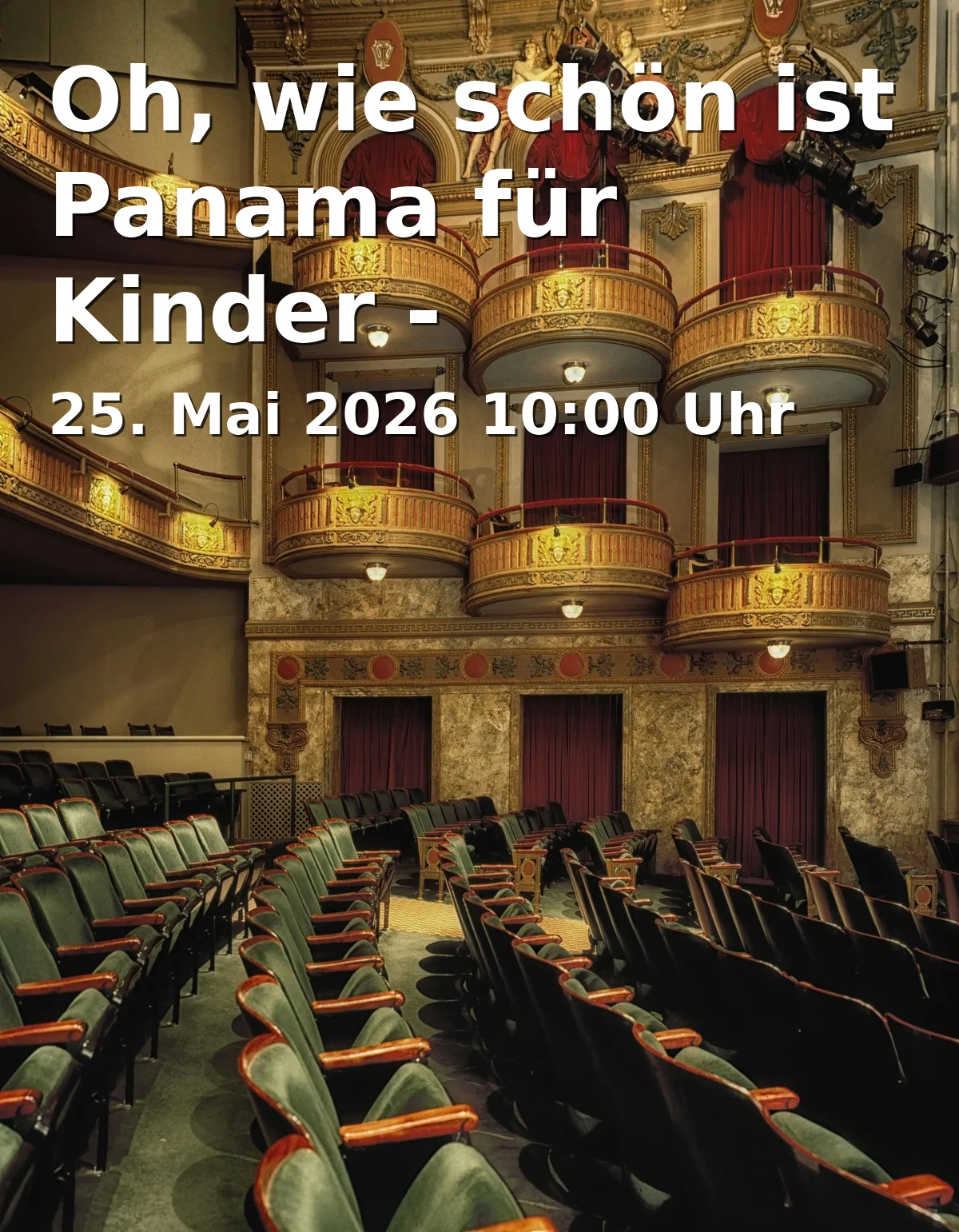
Oh, how beautiful is Panama for children - Munich 2026
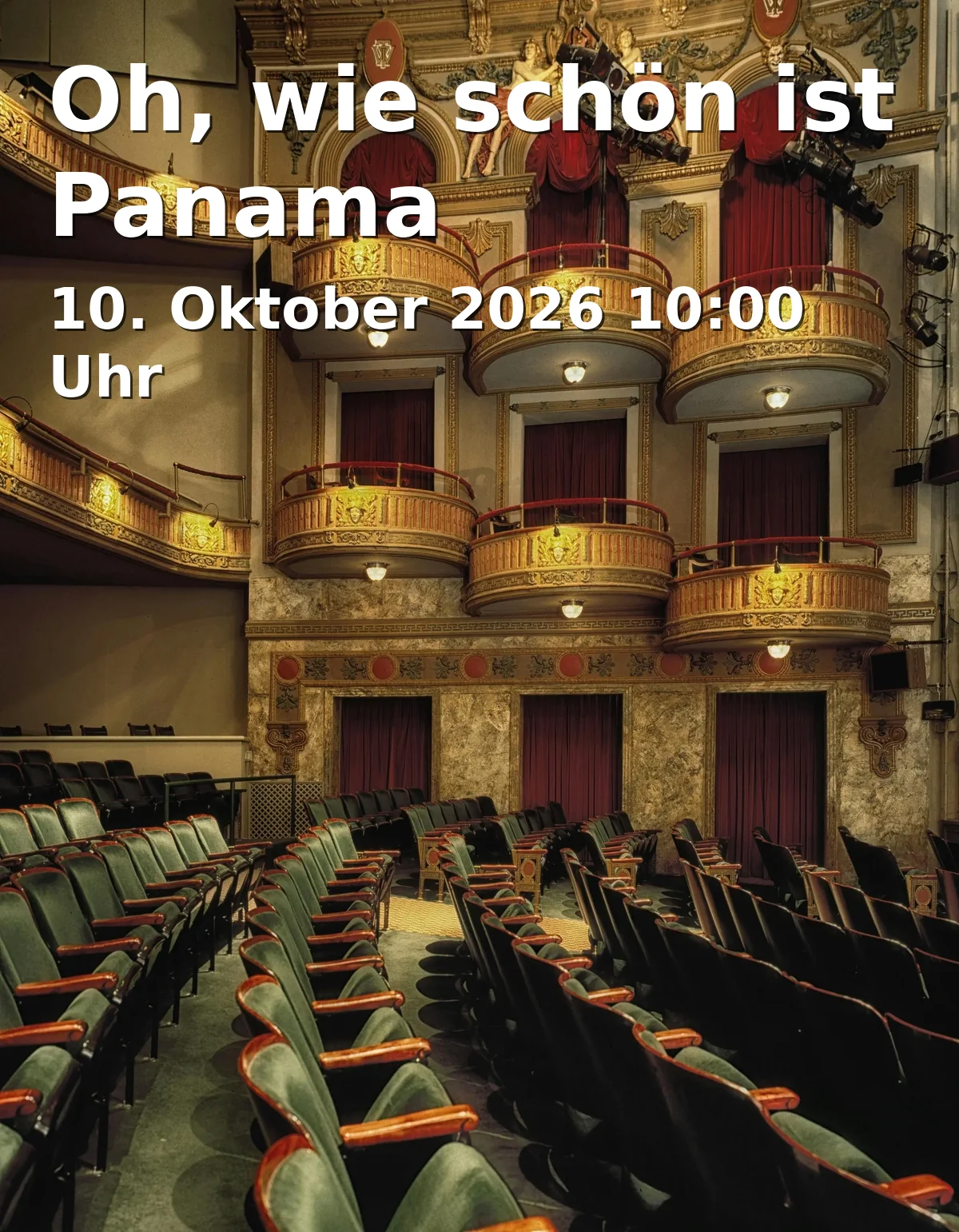
Oh, how beautiful is Panama
Oh how beautiful is Panama