
Hans Sachs
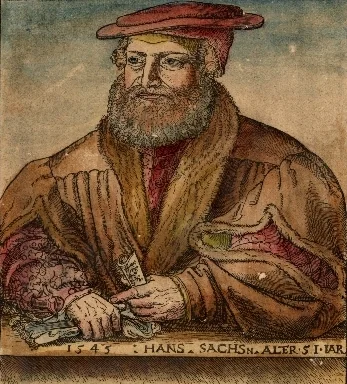
Image from Wikipedia
Image from Wikipedia
Hans Sachs – the great master singer between craftsmanship, Reformation, and stage art
A German classic with immense linguistic power and cultural radiance
Hans Sachs (* November 5, 1494 in Nuremberg; † January 19, 1576 in the same place) is considered one of the most influential German poets of the Early Modern Period. The Nuremberg shoemaker, epigrammatist, master singer, and playwright combined craftsmanship and art into an exceptional musical career in a cultural sense: he was not a court star, but a master from bourgeois everyday life, whose texts, songs, and Carnival plays have impacted generations. His significance ranges from the master singer tradition to the history of reception in opera, literature, and musical theater. ([de.wikipedia.org](https://de.wikipedia.org/wiki/Hans_Sachs?utm_source=openai))
Biography: Nuremberg as the center of life and artistic origin
Hans Sachs was born in Nuremberg and died there as well. The city was not only his home but also the resonance chamber of his work: here he early on encountered urban culture, religious debates, and forms of bourgeois education. After attending Latin school, he began an apprenticeship as a shoemaker in 1509 and subsequently embarked on the typical journeyman's travels, which exposed him to various singing schools and artistic circles. ([lernhelfer.de](https://www.lernhelfer.de/schuelerlexikon/musik/artikel/hans-sachs?utm_source=openai))
This blend of practical work and poetic discipline significantly shaped his artistic development. Sachs was not an isolated scholar but a productive urban artist who wrote and composed from the experience of craftsmanship. It was precisely this groundedness that made his language so direct, vivid, and relatable to a wide audience. In German cultural history, he is thus perceived as one of the most renowned voices of master singing. ([universalis.fr](https://www.universalis.fr/encyclopedie/hans-sachs/?utm_source=openai))
The breakthrough: master singing, epigrammatic poetry, and a unique voice
His actual breakthrough did not lie in a single hit, but in the extraordinary productivity and popularity of his entire oeuvre. Britannica describes Sachs as outstanding in popularity, scope, and aesthetic-religious influence; he became a leading figure of master singing and bourgeois literature during the Reformation. His epigrammatic poetry combined morality, keen observation, and stylistic precision, while his songs and plays transformed everyday conflicts into pointed artistic expressions. ([britannica.com](https://www.britannica.com/biography/Hans-Sachs?utm_source=openai))
Particularly effective were his Carnival plays and dramatic texts, which employed clear characterizations, social typification, and lively language. Treccani highlights that Sachs’ creative energy was especially evident in popular comedy and Carnival plays; works such as The Wandering Scholar in Paradise or The Devil with the Old Woman remain remarkable for their linguistic concreteness and the dynamics of their situations. Thus, Sachs shaped an art that entertained, commented on, and ordered. ([treccani.it](https://www.treccani.it/enciclopedia/hans-sachs/?utm_source=openai))
Musical development: between song art, text, and public performance
As a master singer, Hans Sachs stood in a tradition where text, melody, and formal discipline were closely intertwined. His role involved not only composing but also working precisely with established musical-poetic forms. The combination of language, rhythm, and melodic structure grants his work a culturally significant position: it shows how closely music, literature, and urban public life were intertwined in the Early Modern Period. ([britannica.com](https://www.britannica.com/biography/Hans-Sachs?utm_source=openai))
Even though Hans Sachs did not leave a "discography" in the modern sense, his legacy as a song poet is remarkably extensive. Recent Renaissance interests have contributed to the renewed attention toward his songs; Britannica explicitly notes that revived interest in Renaissance music has helped revive his songs. As a result, Sachs lives on today not so much as a chart artist, but as a historically significant author of musical forms. ([britannica.com](https://www.britannica.com/biography/Hans-Sachs?utm_source=openai))
Works, themes, and attitude: the power of the bourgeois perspective
Hans Sachs wrote with a keen eye on the order of his time. In his texts, secular, spiritual, and professional classes appear as typified figures, often with memorable, characterizing verses. The German-language Wikipedia emphasizes that he thus transferred well-known representations into the class structure of his era while developing enormous productivity; he is regarded as the most talented and famous of the master singers. ([de.wikipedia.org](https://de.wikipedia.org/wiki/Hans_Sachs?utm_source=openai))
His work is closely associated with the Reformation period, during which religious and societal upheaval set the tone. For this reason, Sachs’ writing possesses a dual quality: it is both morally argumentative and sensually theatrical. His texts convey not just ideas but situations, conflicts, and social tensions. This mix of stance and representation endows his oeuvre with cultural influence far beyond his era. ([britannica.com](https://www.britannica.com/biography/Hans-Sachs?utm_source=openai))
Stage presence, aftereffect, and cultural influence
Sachs’ afterlife is extraordinarily strong. Several sources point out that he remains present on stage to this day: some of his plays are still performed today, and the rediscovery of Renaissance music has brought his songs back into public consciousness. His figure became particularly influential through Richard Wagner's opera The Master Singers of Nuremberg, in which Sachs appears as a central figure and is monumentalized both literarily and musically. ([britannica.com](https://www.britannica.com/biography/Hans-Sachs?utm_source=openai))
This cultural influence makes Hans Sachs a key figure in German music and theater history. He represents an art form where craftsmanship, public life, and poetic discipline form a unity. His relevance lies not only in historical significance but also in serving as a role model for future generations who saw in master singing a model of ordered, craft-precise, and socially charged art. ([britannica.com](https://www.britannica.com/biography/Hans-Sachs?utm_source=openai))
Current projects and publications: historical relevance rather than present-day tour
As a historical figure, Hans Sachs had no new albums, singles, or tours planned for 2024 or 2025. Today's relevance lies rather in editions, scholarly processing, performances, and the ongoing reception of his texts and songs. This finding makes him particularly interesting for music lovers: his work is not a fleeting release but a cultural archive of German song and theater history. ([britannica.com](https://www.britannica.com/biography/Hans-Sachs?utm_source=openai))
Discography, reception, and rank in music history
A classic discography in the modern sense does not exist for Hans Sachs; his legacy consists of poems, songs, Carnival plays, and dramatic texts. For critical reception, it is crucial that he was extraordinarily popular during his lifetime and was later both admired and condescendingly judged. Treccani describes that after his death, he sometimes fell out of favor when "learned" poetry disparaged the "unrefined shoemaker." This tension is part of his reception history and explains why he has been repeatedly reinterpreted. ([treccani.it](https://www.treccani.it/enciclopedia/hans-sachs/?utm_source=openai))
Britannica and other reference works likewise emphasize his rank as a master singer, poet, and playwright. His most significant "hit single" from today's perspective is not a single title, but the lasting impact of his entire body of work on opera, literature, and historical musical practices. Therein lies his cultural authority: Hans Sachs is a name that artfully transcends the boundaries between music, poetry, and theater. ([britannica.com](https://www.britannica.com/biography/Hans-Sachs?utm_source=openai))
Voices of fans
No official profile found.
Conclusion: Why Hans Sachs fascinates to this day
Hans Sachs is intriguing because he shaped great art from everyday life. His musical career in a historical sense illustrates how a craftsman, master singer, and playwright could become a formative voice of German culture. Those interested in music history, song traditions, the Reformation period, and the roots of German-language musical theater will find in Sachs an author of immense depth and radiance. His works are worth rediscovering, both on stage and in literary study. ([britannica.com](https://www.britannica.com/biography/Hans-Sachs?utm_source=openai))
His legacy is compelling through linguistic power, social observation, and formal mastery. For this reason, Hans Sachs remains a name that should not only be read but also experienced anew in performance culture. Anyone wishing to understand the connection between music, poetry, and theater in their historical original form should definitely discover this master singer live in a production or reading. ([britannica.com](https://www.britannica.com/biography/Hans-Sachs?utm_source=openai))
Official channels of Hans Sachs:
- Instagram: no official profile found
- Facebook: no official profile found
- YouTube: no official profile found
- Spotify: no official profile found
- TikTok: no official profile found
Sources:
- Wikipedia - Hans Sachs
- Britannica - Hans Sachs
- Treccani - Hans Sachs
- Encyclopedia.com - Hans Sachs
- University of Giessen - Program booklet on Hans Sachs
- Wikipedia: Image and text source