
Arcadi Volodos
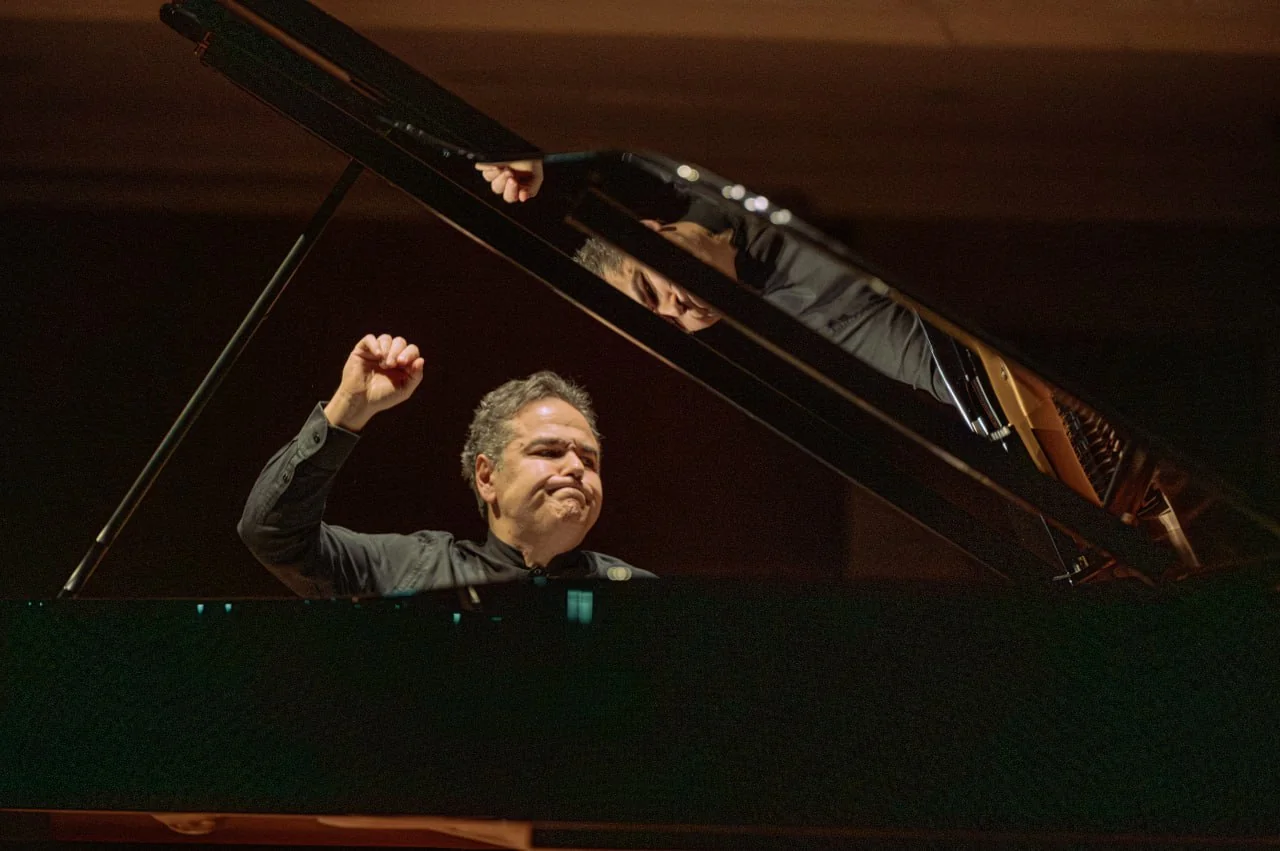
Image from Wikipedia
Image from Wikipedia
Arcadi Volodos – Master of Poetic Piano Sound
A Life Between Virtuosity and Introspection
Arcadi Volodos, born in 1972 in Leningrad, has been one of the defining pianists of his generation since the 1990s. His music career began in an unusual way: he first studied singing and conducting before seriously dedicating himself to the piano from 1987 onwards. These detours have significantly influenced his artistic development – his playing combines orchestral thinking, rich tonal design, and a stage presence that is both focused and magnetic. He first gained international recognition with technically breathtaking transcriptions and paraphrases; today, he is regarded as a benchmark interpreter of Schubert, Schumann, Brahms, and Mompou.
Volodos epitomizes pianistic narratives that are not merely dazzling, but tell a story. He shapes shades, balances weights in touch, and with the finest agogics, opens spaces for silence. Those who experience him in concert feel the consequence of this artistic approach: each phrase serves a larger musical arc, and every nuance is placed with intention. This creates a blend of poetry and precision that shapes his discography and concerts worldwide.
Early Years and Education: From the Conductor's Stand to Piano Poetry
The biographical peculiarity – first voice and gesture, then keys – explains much about Volodos' sound ideal. Educated at the St. Petersburg and later at the Moscow Conservatory, he refined his technique and stylistic range in Paris and Madrid, among others, with Galina Jegiasarowa. His later focus on tone colors, voice leading, and the quasi-orchestral structure of his interpretations is rooted in the thinking of a musician who understands composition, conducting, sound balance, and piano articulation as an organic whole.
After avoiding competitions, he shaped his career through recitals and invitations to leading venues. This choice reflects artistic autonomy: instead of conforming to competition aesthetics, he developed a profile based on depth of repertoire, interpretative responsibility, and an unwavering will to find his own voice.
Breakthrough and International Career: Wigmore Hall, Carnegie Hall, World Stages
His breakthrough came in 1996 with a celebrated debut at Wigmore Hall, followed by rapid invitations to major concert halls. His early New York debut and close connection to Sony Classical were also crucial: the live recital from Carnegie Hall became a calling card for his pianistic character – brilliant technique in the service of form, color, and narrative power. At the same time, a series of recordings began that freed him from the labeling of a pure virtuoso and made the poet at the piano visible.
World tours took him to the Berlin Philharmonic, the Royal Concertgebouw Orchestra, the Staatskapelle Dresden, the New York Philharmonic, Munich Philharmonic, Israel Philharmonic, and many more. Conductors such as Ozawa, Mehta, Levine, Chailly, and Gergiev stood by his side as he shaped Tchaikovsky op. 23 and Rachmaninoff op. 30 with orchestral brilliance – always with a focus on lyrical lines, inner coherence, and architectural clarity.
Repertoire Focus: From Liszt and Rachmaninoff to Schubert, Schumann, Brahms, and Mompou
His early fame as a transcriber – for instance, with sparkling Volodos arrangements of Rachmaninoff and Horowitz paraphrases – opened doors. However, his artistic focus soon shifted to works in which piano sound, silence, and inner tension weigh more heavily than external brilliance. Schubert's great sonatas (D.894, D.959, D.960), Schumann's sound fantasies (Fantaisie in C major op. 17, Davidsbündlertänze op. 6, Kinderszenen op. 15), and Brahms’ late intermezzos now form core areas of his oeuvre. Mompou holds a special place: Volodos unfolded his “Musica callada” and miniatures with a delicacy that set standards and won international awards.
This artistic development demonstrates a deep understanding of the semantics of sound color. Instead of displaying virtuosity demonstratively, he uses its resources to make breath, suspended states, and harmonic subtleties audible. Readings emerge that understand Schubert as a soul drama and Mompou as a world of concentrated visions – interpretatively daring, yet never seeking mere effect.
Discography: Recordings with Reference Status
The discography of Arcadi Volodos consistently documents this development. “Volodos in Vienna” (Live at the Musikverein) and “Volodos – Live at Carnegie Hall” mark the early phase where virtuosity and narrative intelligence merge. With “Volodos plays Liszt,” he expanded the horizons of Liszt interpretation beyond mere brilliance – tonal plasticity, character delineation, and form awareness take center stage.
Pioneering was “Volodos plays Mompou” (2013): a milestone in the reception of Mompou, which received the Gramophone Award and further accolades. “Volodos plays Brahms” (2017) provided a deeply grounded view of the late piano pieces; the compelling blend of introspection and structural clarity convinced critics broadly. With “Volodos plays Schubert” (2019) – including the Sonata D.959 – he solidified his reputation as a Schubert interpreter with rare sensitivity to color and architectural calm.
The live recordings with the Berlin Philharmonic – Rachmaninoff No. 3 and Tchaikovsky No. 1 – showcase a Volodos who does not merely shine in the grand romantic concert repertoire but organizes dramatic processes on a large scale. Overall, the discography charts a clear line: from the sparkling virtuoso to the sound poet, who translates orchestral dimensions to the concert grand register through micro-agogics, voicing, and pedaling.
Critical Reception: From "Piano Poet" to Benchmark Narrator
International critics regularly describe Volodos as a “poet at the piano.” British, German, Spanish, Italian, and American critics refer to his sensitivity to nuances, his ability to sustain large arcs of tension over extended forms, and his sovereign control of tone. In Salzburg, Paris, Milan, Geneva, Oviedo, and Florence, his recent Schubert performances have been celebrated as exemplary for an art of listening, breathing, and condensation – a narrative art that, according to reviewers, “begins within” before unfolding outward.
The awards underscore his authority: Gramophone Awards for the Carnegie recital and the Mompou recording, ECHO Prize, Edison Classical Award, and Diapason d’Or reflect the conceptual coherence of the projects. The press often emphasizes how consciously Volodos maintains the balance between control and release – a pianist's ethos that aims for long-term impact and substance.
Current Projects and Concert Activities 2024–2026
In recent seasons, Volodos has intensified his focus on Schubert/Schumann in recitals across Europe. Programs featuring B major D.960, A major D.959, as well as Schumann's Davidsbündlertänze op. 6 and selected Kinderszenen op. 15 have shaped renowned concert halls and festivals. Numerous reviews from 2024/2025 praised the maturity of these interpretations, which combine structural clarity, tonal fantasy, and tense calm.
For 2026, major concert evenings are announced as part of international festivals and at leading venues. In addition, a new album focusing on Schubert and Schumann is at the center of interest – a project that consolidates his sharpened sound poetics in the studio over the past years. The concerts of this season showcase his repertoire profile in nuanced breadth and underscore his position as a reference pianist for the romantic piano repertoire.
Style, Technique, and Production Aesthetics: Sound Architecture instead of Effect
Volodos’ expertise is evident in his confident handling of tone production, polyphony, and sound balance. In production, he relies on natural spatiality, breathing tempo relations, and a refined relationship between direct attack core and enveloping resonance. The compositions do not appear as a sequence of numbers, but as a dramaturgy of sound spaces – carefully arranged, contrasting, and emotionally focused.
His stylistic competence ranges from the highly virtuosic rhetoric of the 19th century to the microscopically precise inner articulation in late Brahms pieces or Mompou's aphoristic brevity. The key is the inner logic of phrasing: colors modulate meaning, weights shift perspectives, and the agogics breathe with the harmonic progression. The result is an artistic authority based on years of stage experience, a trained ear, and a reflective conception of sound.
Cultural Influence and Artistic Responsibility
Beyond short-term trends, Volodos defends an idea of music-making that demands time, listening, and commitment. In an era of constant acceleration, his playing stands for attentiveness and concentration. His approach serves as an exemplar: it reminds us that interpretation is an exploratory act – an approach to the inner essence of compositions that cannot be delegated to surface allure or routines.
His influence on younger generations of pianists lies less in external virtuosity than in the ideal of “speaking sound.” Those who listen to Volodos encounter an aesthetic that encompasses transcriptions and grand forms as well as the intimate form of character pieces – thus re-measuring the breadth of the piano universe. The repertoire is not worked through, but freshly interrogated.
Voices of the Fans
The reactions from fans clearly show: Arcadi Volodos captivates audiences worldwide. On Facebook, listeners praise his “colorful, breathing Schubert interpretations,” which “fluctuate between fragile silence and eruptive drama.” On YouTube, comments celebrate his “unheard control of tone” and the “gestural intensity” that allows even complex structures to flow naturally. On Spotify playlists, his Mompou regularly appears as “late night music” – music that does not seek to impress but resonates long after listening.
Conclusion: Why You Should Experience Arcadi Volodos Live
Arcadi Volodos represents an interpretative ethos aimed at essence: sound, time, meaning. His concerts are both a laboratory and a ritual – places where pianism becomes narrative art. Anyone who wishes to understand the romantic repertoire not as sentiment but as serious sound architecture will find in Volodos a protagonist of rare consistency. His discography attests to this attitude, but in the concert hall, it unfolds its maximum impact: the sound breathes, the form rises, the silence speaks.
Especially in the current programs featuring Schubert and Schumann, Volodos combines analytical clarity with emotional authenticity. He does not play "over" the pieces, but "within" them – opening spaces where music touches us existentially. A pressing appeal: Listen to him live. Who hears the piano afterwards, hears it differently.
Official Channels of Arcadi Volodos:
- Instagram: No official profile found
- Facebook: https://www.facebook.com/VolodosOfficial/
- YouTube: https://www.youtube.com/channel/UCboIKC5jx4fUBq_77t837Vw
- Spotify: https://open.spotify.com/artist/2DG9aIMzcln3w7SIVGGnmg
- TikTok: No official profile found
Sources:
- Arcadi Volodos – Official Website
- Sony Classical – Artist Page and Releases
- Sony Classical – Volodos plays Mompou (Release Info)
- Apple Music – Volodos plays Mompou (Album Page)
- The Boston Globe – Review “Volodos plays Mompou”, 30.08.2013
- Presto Music – Volodos plays Mompou (including Gramophone mention)
- Apple Music Classical – Volodos: Live at Carnegie Hall
- World Master Pianists – Biography (PDF, including social links)
- Elbphilharmonie Hamburg – Program Announcement 29.05.2026
- Tonhalle Zurich – Recital Announcement (Program Text)
- Opera PLUS – Concert Review (Prague, Nov. 2025)
- The New Criterion – “A pianist and his Schubert”, 2025
- BroadwayWorld Classical – Album Announcement (Schubert/Schumann), 13.03.2026
- Wikipedia (DE) – Arcadi Volodos
- Wikipedia (EN) – Arcadi Volodos