
Anton Pawlowitsch Tschechow
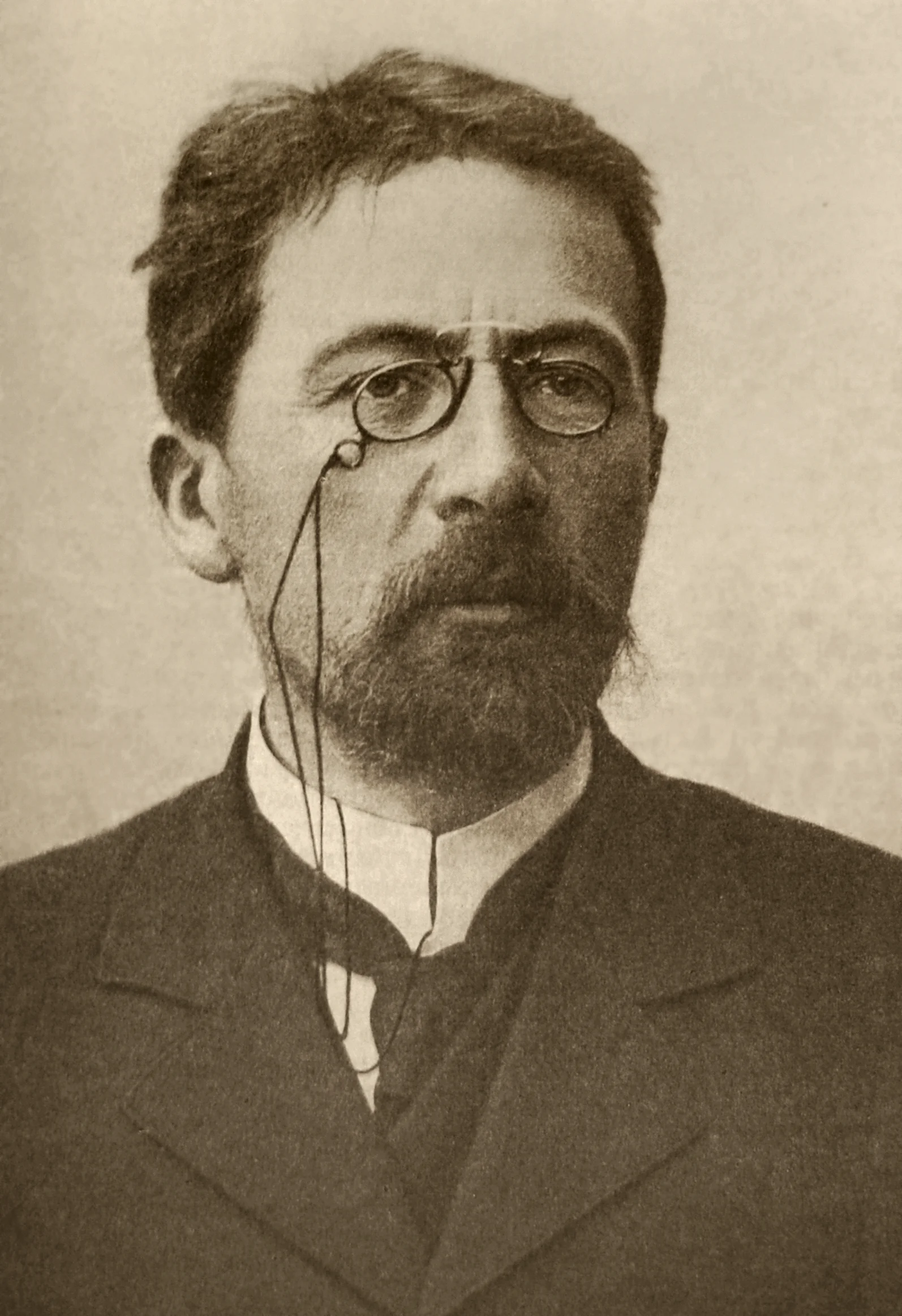
Image from Wikipedia
Image from Wikipedia
Anton Pavlovich Chekhov – Playwright of the Quiet Revolution
An artist who renewed the theater and perfected the short story
Anton Pavlovich Chekhov shaped modern storytelling with his keen observational skills, psychological accuracy, and a subtle yet enduring dramaturgy. He did not have a musical career – Chekhov was a writer and a physician – yet his stage presence as a playwright and the artistic development of his plays resonate to this day: directors, actors, and ensembles around the world draw upon his composition of scenes, his precise arrangement of dialogues, and his sense of subtext. Born on January 29, 1860, in Taganrog and died on July 15, 1904, in Badenweiler, he left behind a body of work that convinces with humanistic warmth, laconic humor, and a new form of dramatic realism.
Childhood, Education, and Dual Calling
Growing up in modest circumstances in Taganrog, Chekhov came from a petty-bourgeois family in southern Russia. His early experiences with economic hardships and social hierarchy sharpened his eye for the nuances of human relationships. He studied medicine in Moscow and became a doctor in 1884 – a profession he largely practiced on a voluntary basis. Concurrently, his musical career began in a metaphorical sense: the continuous “chamber music” of prose, short forms with precise tonal control. Between 1880 and 1903, he wrote over 600 works – stories, novellas, one-act plays, and major dramas – whose compositional balance between comedy and tragedy set a precedent. His artistic development evolved from the feuilletonistic wit of his early years to a poetics based on laconicism, allusion, and atmospheric density.
The Path to Theater: From Short Form to the Big Stage
From early one-act plays such as The Bear or Wedding Morning emerged a distinctive dramaturgy: pointed situations that do not escalate through loud effects but develop through subtle shifts in character relationships. Chekhov transferred this compositional technique into his major works – The Seagull, Uncle Vanya, Three Sisters, The Cherry Orchard – revolutionizing the theatrical sound of his time. What appears as casual conversation follows a precise arrangement of pauses, subtexts, and lines of sight. The stage presence of his characters arises from undertones: missed opportunities, longing, and the interplay of memory and the present.
Breakthrough and Collaboration with the Moscow Art Theatre
The premiere of The Seagull in 1896 in St. Petersburg was initially a failure. However, in 1898, the newly founded Moscow Art Theatre under Konstantin Stanislavski and Vladimir Nemirovich-Danchenko revived The Seagull – a triumph that elevated Chekhov's musicality of dialogue and his subtle irony to a world-class level. This production marked a turning point in theater history and initiated a long-term collaboration: Uncle Vanya, Three Sisters, and The Cherry Orchard became signature works of the ensemble and cornerstones of modern theater. The combination of Stanislavski's system – the precise psychophysical work on the "inner sound" of a role – and Chekhov's subtext economy created a new standard for realistic performance and direction.
Poetics, Subtext, and the Technique of Allusion
Chekhov's expertise as a storyteller and playwright is reflected in his masterful control over composition, rhythm, and the dramaturgical placement of motifs. His name is still synonymous with the principle of narrative necessity, often popularly paraphrased as "Chekhov's Gun": an introduced motif should develop a functional effect later on. In his plays, this fulfillment often occurs in an unremarkable way, almost anti-mimetic – as a psychological shift, not as a flashy climax. This style analysis explains why his texts demand a particularly nuanced production: direction and acting must make the quiet architecture of the scenes audible and visible without exaggeration.
Main Works and Artistic Development
The dramas The Seagull (written in 1895, premiered in 1896), Uncle Vanya, Three Sisters (1901), and The Cherry Orchard (1904) form the heart of his stage discography in a metaphorical sense. In them, he sketches generational conflicts, provincial life, unfulfilled love, and the quiet eros of art and work. Concurrently, he produced stories that shaped the genre of the modern short story: The Lady with the Dog, The Steppe, A Boring Story, and many other texts in which the cultural influence of everyday scenes and the precision of observation become a poetic signature. The production of his prose shows the same ambition as his plays: formal economy, psychological depth, and an arrangement of glances, gestures, and sentences that orchestrates internal movements.
Style Analysis: Realism, "Quiet" Tragedy, and the Timing of Pauses
Chekhov's dramaturgy favors the open, the ambiguous, the ongoing murmur of life. His understanding of genre transcends clichés: comedies with tragic undertones, tragedies without cannon thunder. His production relies on pauses as a musical means; silence becomes an instrument. The characters appear not as theses but as breathing humans, whose desires, routines, and injuries become audible in the arrangement of everyday life. The result: A theater of empathy that takes the audience's experience seriously and makes them co-composers of meaning.
Reception, Impact, and the School of the Art Theater
The critical reception recognized Chekhov early on as a renewer. The Moscow productions established a quality standard that set trends internationally. His influence touches acting, directing scripts, and text comprehension in the 20th century. The subtle re-evaluation of dramatic event logic – shifting away from spectacle towards internal processes – inspired many authors of modern drama. Chekhov's authority thus rests not only on canonical titles but on a changed perception of stage, role, and audience.
Biographical Milestones: Medical Career, Travel, Final Years
His medical experience shaped his precise knowledge of physical and mental states – a knowledge that brings his characters to life. The journey to Sakhalin signifies social responsibility and documentary interest. In the 1890s, he moved between Moscow, the estate Melikhovo, and the mild climate of Crimea to address his tuberculosis. His marriage to actress Olga Knipper intertwined personal and professional life – she also shaped Chekhov's roles in world and first performances at the Art Theatre. Chekhov died in Badenweiler in 1904; however, his work remains vivacious.
Discography in a Metaphorical Sense: Stage and Prose Works as Canon
Anyone wishing to overview Chekhov's "discography" of dramas will find in The Seagull, Uncle Vanya, Three Sisters, and The Cherry Orchard those four "main albums" that stand in repertoires worldwide. This canon is supplemented by earlier works such as Ivanov, Platonov, and one-act plays such as The Bear. In prose, The Lady with the Dog, The Steppe, The Death of a Government Clerk, or A Boring Story mark central positions. There are no chart successes in the literal sense, but the international performance and reading practices, the multitude of new translations and productions, as well as adaptations for film, ballet, and radio play attest to the enduring resonance of his art.
Cultural Influence: From Stanislavski to the Present
The Art Theater connected Chekhov's texts with a new aesthetic of acting – a school that later also shaped Western theater. Directing scripts of the 20th and 21st centuries work with his understanding of subtext, his subtle surface irony, and the rhythm of the unsaid. Universities, theaters, and festivals regularly dedicate series and focus programs to Chekhov; new translations and editorial projects maintain the text's legacy. The theater of allusion he invented remains a touchstone for ensemble culture, for vocal leading in the chorus of characters, and for the art of precise pausing.
Current Projects and Ongoing Presence
Long after his death, Chekhov remains contemporary art: theaters worldwide are bringing his plays to the stage in new interpretations; film and literary enterprises are relying on new translations and editions. A notable example is the large-scale translation project of his early stories by a literary foundation, which has an annotated, comprehensive edition in preparation or publication. Such undertakings connect editorial philology with mediation and demonstrate that Chekhov's work is not only preserved but actively rethought.
Why Read and Perform Chekhov Today?
Because his composition of small gestures has a universal impact. Because he treats characters seriously and imbues them with a human dignity that remains comprehensible across epochs. Because his arrangement of space, time, and memory is a poetics of the present: quiet, precise, open. And because the productions of his plays allow artists to test the nuanced interplay of voice, body, and gaze at the highest level – a school of truthfulness and attention.
Conclusion: The Power of Subtlety
Chekhov made the quieter sounds audible. His artistic development led from cheerful, ironic sketches to a grand dramaturgy of the everyday. As a storyteller and playwright, he combined expertise in composition and arrangement with a high ethos of observation. The result is texts that demand acting and direction, touch the audience, and alter theater history – to this day. Experiencing his plays live reveals how subtly an evening can resonate when the voices of the characters, their pauses, and glances weave together into an ensemble. To experience Chekhov live means to hear the resonance space of the theater in its finest tuning.
Official Channels of Anton Pavlovich Chekhov:
- Instagram: No official profile found
- Facebook: No official profile found
- YouTube: No official profile found
- Spotify: No official profile found
- TikTok: No official profile found
Sources:
- Wikipedia – Anton Pavlovich Chekhov
- Wikipedia – The Seagull
- Wikipedia – Moscow Art Theatre production of The Seagull
- Encyclopaedia Britannica – Anton Chekhov (Summary)
- Anton Chekhov Foundation – Projects & Announcements
- Project Gutenberg – Compilation of Short Stories by Chekhov
- Wikipedia: Image and text source