Discover Events on Democracy in Ansbach
Events on Democracy & Contemporary History in Ansbach (Preview 2026/2027)
A curated preview of upcoming formats in Ansbach and the surrounding area that focus on democracy, human rights, anti-racism, media literacy, and contemporary history – both on-site and online.
Note on up-to-dateness: Dates and registration modalities may change at short notice. Please always check the respective organizer pages before participating.
Why it is worth taking a look at democracy and contemporary history formats in Ansbach
In Ansbach, political education, cultural practice, and local debates come together in close proximity: in community halls, educational institutions, cultural venues, and digital formats. Especially small, low-threshold offerings – such as discussion evenings, workshops, or thematic city walks – can help strengthen democratic skills: listening, arguing, changing perspectives, and engaging in respectful debate.
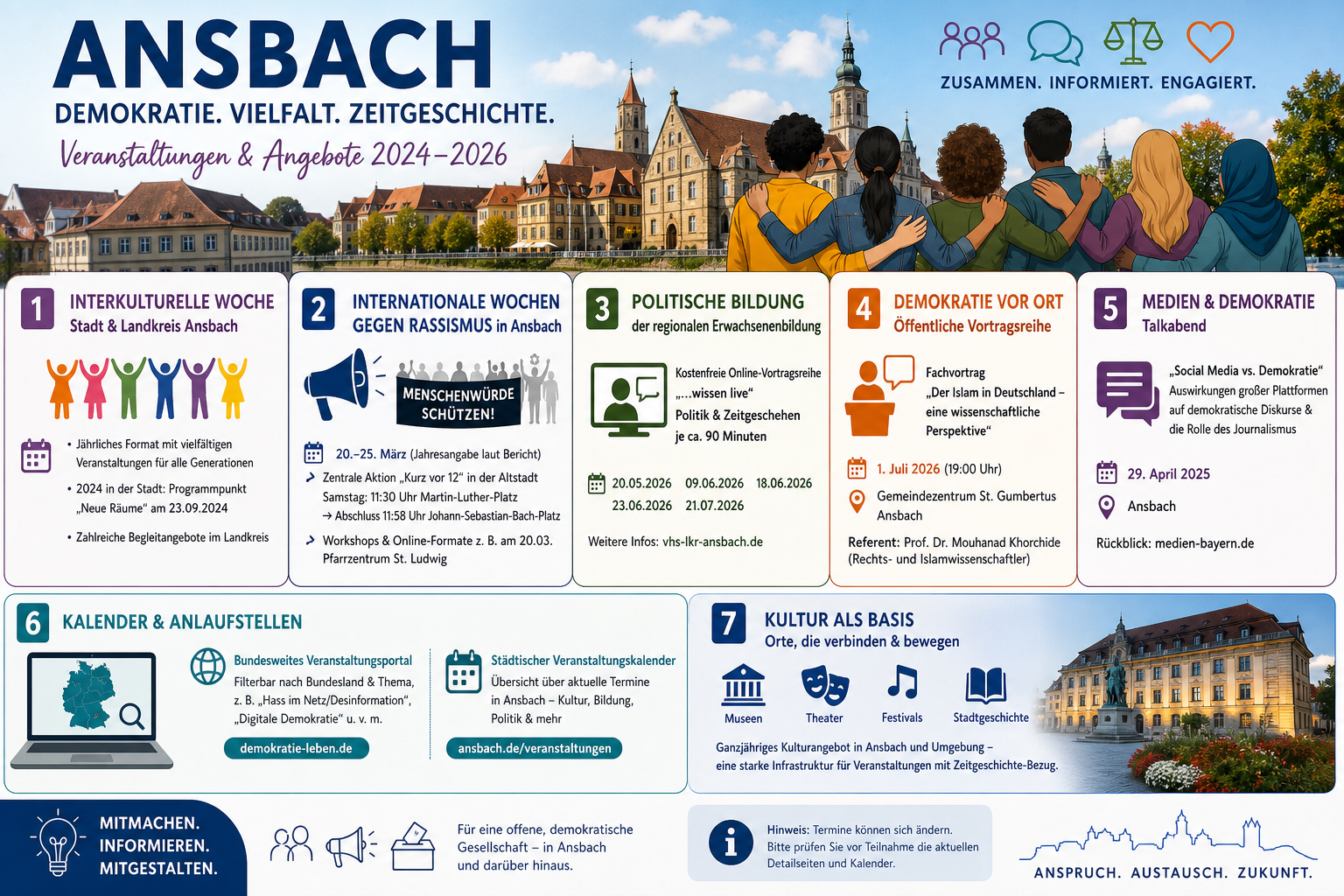
This preview bundles formats that, based on experience, play a special role in the coming months and the next year: the Intercultural Week, the International Weeks Against Racism, as well as accompanying lecture and discussion series (online and on-site) on politics, media, and contemporary history.
Intercultural Week (Autumn 2026): Encounter, Human Rights, Cohesion
The Intercultural Week takes place nationwide every year and is also typically implemented in Ansbach and the region in autumn with a local program of encounter formats, cultural events, and educational offerings. The goal is to enable dialogue, break down prejudices, and make participation visible – in everyday life, in clubs, in schools, and in urban society.
Which formats you should particularly keep an eye on in Ansbach in 2026
- Discussion evenings & moderated dialogue forums on diversity, democratic coexistence, and local cohesion
- Creative workshops (e.g., language, theater, music, or cooking together) as low-threshold spaces for encounters
- City and themed tours focusing on migration history, culture of remembrance, or local democracy sites
- Family-friendly activities and offerings accessible without prior knowledge
Anyone visiting Ansbach in autumn 2026 or living in the region can use this week specifically to get to know Ansbach beyond classic routines: through personal stories, local initiatives, and practical solidarity.
International Weeks Against Racism (expected Spring 2027): Taking a Stand, Building Skills
The International Weeks Against Racism are organized nationwide around the International Day Against Racism (March 21). For Ansbach, actions and educational formats can also be expected for the next event window in spring 2027, which send a clear signal against hostility towards people and at the same time convey practical everyday skills.
What you can typically expect from Ansbach's contributions
- Public sign actions in urban space (e.g., joint rallies, cultural contributions, music and speeches)
- Workshops on civil courage and dealing with discriminatory remarks in everyday situations
- Educational offerings on structural racism, anti-discrimination, and democratic debate culture
- School and youth formats that promote media literacy, empathy, and fact orientation
For visitors, the format offers direct access to the city's present: Democracy is not negotiated here in the abstract, but as a common standard in public space.
Political Education Online (Summer 2026): Lectures on Politics & Current Affairs
Online lectures are a practical way for many people in Ansbach and the surrounding area to get well-founded information – regardless of working hours, mobility, or place of residence. For the summer semester 2026, digital event series on politics and current affairs can still be expected in regional adult education, often in the evening and with a Q&A session.
Why these formats are strong in E-E-A-T (and what you should pay attention to as a participant)
- Context instead of headlines: Good lectures show sources, terms, and connections – and transparently indicate uncertainties.
- Traceability: Reputable providers name speakers, qualifications, topic framework, and organizational information (registration, technology, data protection).
- Discussion: A moderated Q&A session helps clarify misunderstandings and examine different perspectives.
If you want to participate, a quick check is worthwhile: Is the event assigned to a clear topic (e.g., international politics, contemporary history, institutions, media & public)? Is there an organizer page with a contact person and participation conditions? Are accompanying materials or literature recommendations offered?
“Democracy on Site” (2026): Science Meets Everyday Life
Public lectures and discussion series that combine scientific perspectives with local issues are particularly valuable for democratic debates. In Ansbach, formats can also be expected in 2026 that frame socially controversial topics objectively – such as freedom of religion, state neutrality, integration, political culture, and dealing with prejudices.
This is how you benefit most from such evenings
- Preparation: Write down two to three specific questions that you really want to clarify for Ansbach and the region.
- Check terms: Pay attention to how key terms are defined (e.g., “freedom of religion,” “discrimination,” “radicalization,” “neutrality”).
- Transfer to everyday life: Good events do not end with theory, but provide information on which actors and structures are relevant on site (e.g., counseling centers, educational offerings, municipal responsibilities).
Important: Reputable events clearly distinguish between facts, evaluation, and open research questions. This builds trust – even when people in the audience have different starting points.
Media, Social Media & Democracy (2026/2027): Strengthening Discourse Skills in the Digital Space
Disinformation, “hate on the net,” and algorithmically amplified outrage directly influence political opinion formation. In Ansbach, formats dealing with digital public spheres can therefore also be expected in the coming months – such as panel discussions, lectures, or workshops on media literacy.
Typical topics that may be addressed in upcoming Ansbach formats
- How disinformation works: Narratives, manipulation, image/video context, “framing”
- What platform logics reinforce: Reach, attention economy, recommendation mechanisms
- How to respond: Reporting channels, de-escalation, fact checks, protection from digital violence
- What schools and clubs can do: Media education, group rules, moderation practice
If you specifically want to learn how to check content, events with practical exercises (example analyses, source evaluation, checklists) usually help more than pure keynote lectures.
Venues, Calendars & Practical Tips for Planning in Ansbach
For reliable planning, official event pages and established educational portals are the best basis. In Ansbach, city overviews, regional educational providers, and nationwide portals typically play a role. Use these sources especially for:
- Registration & access: Location, admission, accessibility, participation fee, online access data
- Quality signals: clear organizer information, speaker profile, data protection information (for online formats)
- Up-to-dateness: program changes, room changes, or short-term cancellations
If you want to combine your stay in Ansbach with political education or contemporary history, you can specifically plan your travel time around the major recurring formats: Intercultural Week (autumn) and Weeks Against Racism (spring) – supplemented by lectures, workshops, and discussions throughout the year.