
Martin-Luther-Platz 16, Ansbach
Martin-Luther-Platz 16, 91522 Ansbach, Germany
St. Johannis, Ansbach | Worship & Parish Office
St. Johannis in Ansbach is one of the most prominent places in the city center, combining the Protestant city church, historical architecture, and vibrant community work into an ensemble that extends far beyond a single church space. Those searching for St. Johannis Ansbach are often also interested in worship services, the parish office, the community newsletter, confirmation, the community center, the parish house, children's and youth work, or practical questions about access and parking. This multifaceted nature makes the place so attractive: it is not only a monument from the Middle Ages but also an active center of church life right in the heart of Ansbach. The official city website describes St. Johannis as a civic parish church and highlights its uniform design from the 15th century, while the city center churches emphasize the long history, the culture of worship, and the connection to St. Gumbertus. For visitors, this creates a clear impression: St. Johannis is a place where history, music, pastoral care, community, and urban life intersect. This connection of tradition and present continues to shape the church's profile today and explains why it remains an important point of contact for both locals and guests. ([tourismus-ansbach.de](https://www.tourismus-ansbach.de/ansbach-erleben/sehenswuerdigkeiten/sankt-johannis/sankt-johannis))
Worship, Parish Office, and Community Life
Those who find St. Johannis Ansbach with the search term worship will land at a clearly structured and lively city center community. The shared parish office of St. Gumbertus and St. Johannis is located at Johann-Sebastian-Bach-Platz 5 in 91522 Ansbach. There, pastors Oliver Englert, pastor Andrea Möller, pastor Elisabeth Küfeldt, and dean Dr. Matthias Büttner are mentioned; the parish office hours are Monday and Friday from 9 to 12 and Thursday from 9 to 12 and 1 to 5 PM. The website of the city center churches consolidates the daily life of the community under categories such as worship services, community newsletter, current events, church music, and offerings, making it clear that here, church is not just on Sundays, but throughout the year. The worship overview regularly features formats such as Holy Week prayers, communion services, Easter vigil, family services, and other liturgical celebrations. This shows: St. Johannis is a reliable place for classic Sunday services as well as for special church times and festive occasions. The search terms pastor St. Johannis Ansbach, parish office St. Johannis Ansbach, and church community St. Johannis Ansbach therefore describe not just an address, but an organized network of pastoral care, information, music, and community life. Those who visit the church experience not just a space but a community that visibly presents itself in the city center and remains accessible through worship services, appointments, and personal contacts. ([innenstadtkirchen-ansbach.de](https://innenstadtkirchen-ansbach.de/pfarramt/))
History of the City Parish Church St. Johannis in Ansbach
The history of St. Johannis Ansbach dates back far and makes the church one of the oldest ecclesiastical reference points in the city. The Bach Week cites the probable founding period as 911 to 931; the church is first mentioned in a document in 1139. Between 1410 and 1458, it was expanded into a Gothic hall church, and in 1436 St. Johannis became an independent parish, thus independent from St. Gumbertus. This development turned the church into a civic church for the city center and numerous districts. Another historically significant turning point followed in 1525: with a service in St. Johannis, the Reformation began in Ansbach. The church thus stands not only for medieval piety but also for the transition into the Protestant tradition of the city. The Bach Week also points out that the interior underwent Baroque changes in the 18th century, which makes the current mix of Gothic basic structure and later additions understandable. These layers of history are typical for the place and define its character: St. Johannis is not static but a building that has changed over centuries while never losing its religious function. Thus, when one looks at the church today, one is not only looking at walls and vaults but at several epochs of Ansbach's urban history at once. This explains why St. Johannis remains so present in local memory, in church music, and in the worship services of the city center to this day. ([bachwoche.de](https://www.bachwoche.de/en/venues/st-johannis-church.html))
Architecture, Flötner Altar, and Special Furnishings
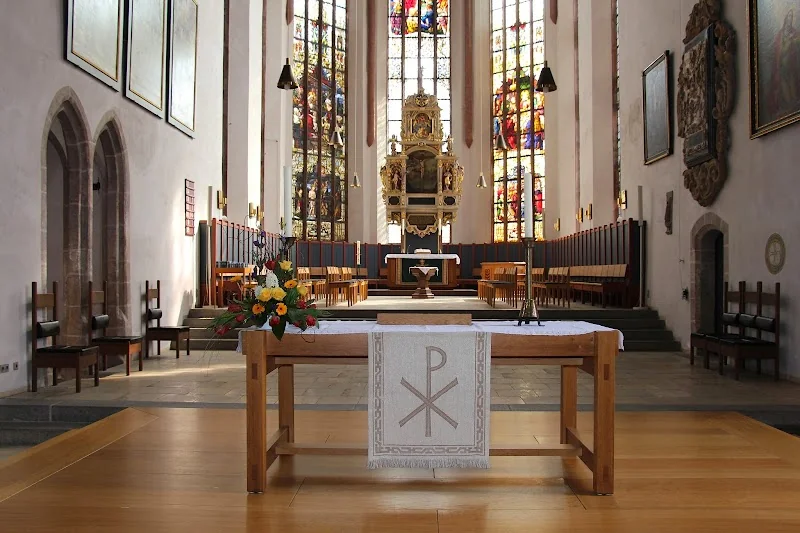
Architecturally, St. Johannis Ansbach presents itself as a Protestant-Lutheran parish church with a clear, historically evolved form language. The city of Ansbach describes it as a relatively uniformly built three-nave pseudo-basilica from the 15th century, while the city center churches particularly highlight the three-nave hall. This construction style gives the interior a calm, spacious, and orderly effect. Particularly important for visitors are the furnishing elements that are frequently mentioned: the Flötner altar, the stained glass windows painted by the court glass painting Zettler in 1903, and the Güllbrünnlein on the outer wall. According to the city center churches, the altar was taken over from St. Gumbertus and attributed to Peter Flötner; it is considered an early example of the reception of Upper Italian Renaissance forms and was slightly altered around 1600. This makes it one of the most significant works of art in the ensemble of the city center. The tourism site also highlights the stained glass windows and the altar as special points of interest. Outside, the Güllbrünnlein, with a motif from the poem Pflaumenregen, reminds of Friedrich Wilhelm Güll, whose birthplace is located across the street. Thus, St. Johannis connects architecture, poetry, and urban history in a small space. The church is therefore not only a liturgical space but also a site of art and memory, where Gothic, Renaissance references, and later renovations interact. Especially for visitors searching for images of St. Johannis Ansbach, this building offers a wealth of motifs and perspectives, from the overall structure to the details of the furnishings. ([tourismus-ansbach.de](https://www.tourismus-ansbach.de/ansbach-erleben/sehenswuerdigkeiten/sankt-johannis/sankt-johannis))
Community Center, Kindergarten, and Family Offers
St. Johannis Ansbach is not only a church but also an active center for families, children, youth, and older community members. The city center churches explicitly describe their offerings as open to members of St. Johannis and St. Gumbertus as well as to interested parties. The spectrum is broad: it ranges from parent-child groups to youth groups and women's circles, visiting services, grief support, and senior afternoons. Particularly important for search queries such as community center St. Johannis Ansbach or parish house St. Johannis Ansbach is the note that the choirs of the Ansbach children's and youth choir rehearse on Tuesdays in the community center St. Johannis at Schaitberger Straße 6 to 8. There, children are supported in voice training, rhythm, and language, and choir work is open and free of charge. In addition, there is the Protestant daycare center St. Johannis at Steingruberstraße 14, which is run by the Ev.-Luth. Church Community St. Johannis. This shows that the search term kindergarten St. Johannis Ansbach has a real, institutional reference and is not just a peripheral topic. The area of seniors is also closely integrated: the senior center Hospital is run as the Landesherrliche Hospital Foundation St. Johannis, Ansbach and offers full-time care, day care, short-term care, and an open dementia living group. The location thus has a remarkable social breadth. From childcare to support in old age, there is a network of offerings that extends the church into the everyday life of the city. Therefore, those searching for church community offerings will find in St. Johannis not only worship services but a whole infrastructure for community, education, music, and support in different life phases. ([innenstadtkirchen-ansbach.de](https://innenstadtkirchen-ansbach.de/gruppen-kreise-in-st-johannis/))
Access, Parking, and Barrier-Free Access in the City Center
The location of St. Johannis is particularly convenient for visitors because the church is located right in the pedestrian zone of the Ansbach city center. The official tourism site lists the address as Martin-Luther-Platz 16 in 91522 Ansbach; at the same time, the city center churches' site refers to the location in the pedestrian zone and recommends parking options at the riding arena of the Ansbach Residence and the Rezat meadows. For all those searching for access St. Johannis Ansbach or parking St. Johannis Ansbach, these are the most important orientation data. Additionally, there is an important plus point: the city church is barrier-free accessible. This makes access significantly easier for people with mobility impairments, families with strollers, or older visitors. The tourism site also mentions the opening outside of worship services and notes ongoing renovation work until March 6, 2026. This is especially important as a current note when planning a visit or incorporating a tour into a city walk. Practically relevant is also the proximity to other city center destinations, as St. Johannis is located in direct proximity to St. Gumbertus, the historic old town, and other sights that the city of Ansbach highlights on its pages. Therefore, anyone planning a tour through the city center can easily combine the church with a walk. Especially because the location is so central, it is advisable to check the current notices from the city and the community before the visit, especially for planned tours, events, or special church times. For visitors, St. Johannis thus remains easily accessible, conveniently located, and embedded in a historical but well-developed city center. ([tourismus-ansbach.de](https://www.tourismus-ansbach.de/ansbach-erleben/sehenswuerdigkeiten/sankt-johannis/sankt-johannis))
Confirmation, Community Newsletter, and Current Dates
Among the most frequently searched topics related to St. Johannis Ansbach are confirmation, community newsletter, and current events. The website of the city center churches consolidates this information in a clear structure: under current events, worship services, community newsletter, church music, and offerings, the ongoing topics of the parish are published. This is important for all those preparing for a confirmation, looking for a special worship service, or wanting to know which dates are upcoming in the city center community. The church council meetings are also announced in the current community newsletter according to the groups and circles page, which shows that the bulletin is not just an information sheet but a central communication tool of the community. In addition to purely church life, St. Johannis also plays a role in the cultural calendar of the city. The Bach Week Ansbach lists St. Johannis as a venue and features concerts, opening worship services, and other musical formats. For search queries such as city parish church St. Johannis Ansbach or images of St. Johannis Ansbach, it is therefore important to know that the place is used both religiously, culturally, and in terms of urban history. The city of Ansbach also refers to events in front of the church, such as memorial services at the memorial or church-related support in public spaces. Thus, St. Johannis does not remain in a historical state but is regularly integrated into current events. Those interested in confirmation St. Johannis Ansbach, community newsletter St. Johannis Ansbach, or pastor St. Johannis Ansbach will find here a location that connects its tradition with a clear, contemporary communication structure. This makes the church a vibrant part of the Ansbach cityscape and a place where one not only sees history but experiences the present. ([innenstadtkirchen-ansbach.de](https://innenstadtkirchen-ansbach.de/aktuelles/))
Sources:
- City of Ansbach Culture & Tourism – St. Johannis in Ansbach
- Protestant City Center Churches Ansbach – Church St. Johannis
- Protestant City Center Churches Ansbach – Parish Office St. Gumbertus – St. Johannis
- Protestant City Center Churches Ansbach – Groups & Circles St. Johannis
- Protestant City Center Churches Ansbach – Worship Services
- Bach Week Ansbach – St. Johannis' Church
- City of Ansbach – Daycare Centers
- City of Ansbach – Nursing Homes
Show moreShow less
St. Johannis, Ansbach | Worship & Parish Office
St. Johannis in Ansbach is one of the most prominent places in the city center, combining the Protestant city church, historical architecture, and vibrant community work into an ensemble that extends far beyond a single church space. Those searching for St. Johannis Ansbach are often also interested in worship services, the parish office, the community newsletter, confirmation, the community center, the parish house, children's and youth work, or practical questions about access and parking. This multifaceted nature makes the place so attractive: it is not only a monument from the Middle Ages but also an active center of church life right in the heart of Ansbach. The official city website describes St. Johannis as a civic parish church and highlights its uniform design from the 15th century, while the city center churches emphasize the long history, the culture of worship, and the connection to St. Gumbertus. For visitors, this creates a clear impression: St. Johannis is a place where history, music, pastoral care, community, and urban life intersect. This connection of tradition and present continues to shape the church's profile today and explains why it remains an important point of contact for both locals and guests. ([tourismus-ansbach.de](https://www.tourismus-ansbach.de/ansbach-erleben/sehenswuerdigkeiten/sankt-johannis/sankt-johannis))
Worship, Parish Office, and Community Life
Those who find St. Johannis Ansbach with the search term worship will land at a clearly structured and lively city center community. The shared parish office of St. Gumbertus and St. Johannis is located at Johann-Sebastian-Bach-Platz 5 in 91522 Ansbach. There, pastors Oliver Englert, pastor Andrea Möller, pastor Elisabeth Küfeldt, and dean Dr. Matthias Büttner are mentioned; the parish office hours are Monday and Friday from 9 to 12 and Thursday from 9 to 12 and 1 to 5 PM. The website of the city center churches consolidates the daily life of the community under categories such as worship services, community newsletter, current events, church music, and offerings, making it clear that here, church is not just on Sundays, but throughout the year. The worship overview regularly features formats such as Holy Week prayers, communion services, Easter vigil, family services, and other liturgical celebrations. This shows: St. Johannis is a reliable place for classic Sunday services as well as for special church times and festive occasions. The search terms pastor St. Johannis Ansbach, parish office St. Johannis Ansbach, and church community St. Johannis Ansbach therefore describe not just an address, but an organized network of pastoral care, information, music, and community life. Those who visit the church experience not just a space but a community that visibly presents itself in the city center and remains accessible through worship services, appointments, and personal contacts. ([innenstadtkirchen-ansbach.de](https://innenstadtkirchen-ansbach.de/pfarramt/))
History of the City Parish Church St. Johannis in Ansbach
The history of St. Johannis Ansbach dates back far and makes the church one of the oldest ecclesiastical reference points in the city. The Bach Week cites the probable founding period as 911 to 931; the church is first mentioned in a document in 1139. Between 1410 and 1458, it was expanded into a Gothic hall church, and in 1436 St. Johannis became an independent parish, thus independent from St. Gumbertus. This development turned the church into a civic church for the city center and numerous districts. Another historically significant turning point followed in 1525: with a service in St. Johannis, the Reformation began in Ansbach. The church thus stands not only for medieval piety but also for the transition into the Protestant tradition of the city. The Bach Week also points out that the interior underwent Baroque changes in the 18th century, which makes the current mix of Gothic basic structure and later additions understandable. These layers of history are typical for the place and define its character: St. Johannis is not static but a building that has changed over centuries while never losing its religious function. Thus, when one looks at the church today, one is not only looking at walls and vaults but at several epochs of Ansbach's urban history at once. This explains why St. Johannis remains so present in local memory, in church music, and in the worship services of the city center to this day. ([bachwoche.de](https://www.bachwoche.de/en/venues/st-johannis-church.html))
Architecture, Flötner Altar, and Special Furnishings
Architecturally, St. Johannis Ansbach presents itself as a Protestant-Lutheran parish church with a clear, historically evolved form language. The city of Ansbach describes it as a relatively uniformly built three-nave pseudo-basilica from the 15th century, while the city center churches particularly highlight the three-nave hall. This construction style gives the interior a calm, spacious, and orderly effect. Particularly important for visitors are the furnishing elements that are frequently mentioned: the Flötner altar, the stained glass windows painted by the court glass painting Zettler in 1903, and the Güllbrünnlein on the outer wall. According to the city center churches, the altar was taken over from St. Gumbertus and attributed to Peter Flötner; it is considered an early example of the reception of Upper Italian Renaissance forms and was slightly altered around 1600. This makes it one of the most significant works of art in the ensemble of the city center. The tourism site also highlights the stained glass windows and the altar as special points of interest. Outside, the Güllbrünnlein, with a motif from the poem Pflaumenregen, reminds of Friedrich Wilhelm Güll, whose birthplace is located across the street. Thus, St. Johannis connects architecture, poetry, and urban history in a small space. The church is therefore not only a liturgical space but also a site of art and memory, where Gothic, Renaissance references, and later renovations interact. Especially for visitors searching for images of St. Johannis Ansbach, this building offers a wealth of motifs and perspectives, from the overall structure to the details of the furnishings. ([tourismus-ansbach.de](https://www.tourismus-ansbach.de/ansbach-erleben/sehenswuerdigkeiten/sankt-johannis/sankt-johannis))
Community Center, Kindergarten, and Family Offers
St. Johannis Ansbach is not only a church but also an active center for families, children, youth, and older community members. The city center churches explicitly describe their offerings as open to members of St. Johannis and St. Gumbertus as well as to interested parties. The spectrum is broad: it ranges from parent-child groups to youth groups and women's circles, visiting services, grief support, and senior afternoons. Particularly important for search queries such as community center St. Johannis Ansbach or parish house St. Johannis Ansbach is the note that the choirs of the Ansbach children's and youth choir rehearse on Tuesdays in the community center St. Johannis at Schaitberger Straße 6 to 8. There, children are supported in voice training, rhythm, and language, and choir work is open and free of charge. In addition, there is the Protestant daycare center St. Johannis at Steingruberstraße 14, which is run by the Ev.-Luth. Church Community St. Johannis. This shows that the search term kindergarten St. Johannis Ansbach has a real, institutional reference and is not just a peripheral topic. The area of seniors is also closely integrated: the senior center Hospital is run as the Landesherrliche Hospital Foundation St. Johannis, Ansbach and offers full-time care, day care, short-term care, and an open dementia living group. The location thus has a remarkable social breadth. From childcare to support in old age, there is a network of offerings that extends the church into the everyday life of the city. Therefore, those searching for church community offerings will find in St. Johannis not only worship services but a whole infrastructure for community, education, music, and support in different life phases. ([innenstadtkirchen-ansbach.de](https://innenstadtkirchen-ansbach.de/gruppen-kreise-in-st-johannis/))
Access, Parking, and Barrier-Free Access in the City Center
The location of St. Johannis is particularly convenient for visitors because the church is located right in the pedestrian zone of the Ansbach city center. The official tourism site lists the address as Martin-Luther-Platz 16 in 91522 Ansbach; at the same time, the city center churches' site refers to the location in the pedestrian zone and recommends parking options at the riding arena of the Ansbach Residence and the Rezat meadows. For all those searching for access St. Johannis Ansbach or parking St. Johannis Ansbach, these are the most important orientation data. Additionally, there is an important plus point: the city church is barrier-free accessible. This makes access significantly easier for people with mobility impairments, families with strollers, or older visitors. The tourism site also mentions the opening outside of worship services and notes ongoing renovation work until March 6, 2026. This is especially important as a current note when planning a visit or incorporating a tour into a city walk. Practically relevant is also the proximity to other city center destinations, as St. Johannis is located in direct proximity to St. Gumbertus, the historic old town, and other sights that the city of Ansbach highlights on its pages. Therefore, anyone planning a tour through the city center can easily combine the church with a walk. Especially because the location is so central, it is advisable to check the current notices from the city and the community before the visit, especially for planned tours, events, or special church times. For visitors, St. Johannis thus remains easily accessible, conveniently located, and embedded in a historical but well-developed city center. ([tourismus-ansbach.de](https://www.tourismus-ansbach.de/ansbach-erleben/sehenswuerdigkeiten/sankt-johannis/sankt-johannis))
Confirmation, Community Newsletter, and Current Dates
Among the most frequently searched topics related to St. Johannis Ansbach are confirmation, community newsletter, and current events. The website of the city center churches consolidates this information in a clear structure: under current events, worship services, community newsletter, church music, and offerings, the ongoing topics of the parish are published. This is important for all those preparing for a confirmation, looking for a special worship service, or wanting to know which dates are upcoming in the city center community. The church council meetings are also announced in the current community newsletter according to the groups and circles page, which shows that the bulletin is not just an information sheet but a central communication tool of the community. In addition to purely church life, St. Johannis also plays a role in the cultural calendar of the city. The Bach Week Ansbach lists St. Johannis as a venue and features concerts, opening worship services, and other musical formats. For search queries such as city parish church St. Johannis Ansbach or images of St. Johannis Ansbach, it is therefore important to know that the place is used both religiously, culturally, and in terms of urban history. The city of Ansbach also refers to events in front of the church, such as memorial services at the memorial or church-related support in public spaces. Thus, St. Johannis does not remain in a historical state but is regularly integrated into current events. Those interested in confirmation St. Johannis Ansbach, community newsletter St. Johannis Ansbach, or pastor St. Johannis Ansbach will find here a location that connects its tradition with a clear, contemporary communication structure. This makes the church a vibrant part of the Ansbach cityscape and a place where one not only sees history but experiences the present. ([innenstadtkirchen-ansbach.de](https://innenstadtkirchen-ansbach.de/aktuelles/))
Sources:
- City of Ansbach Culture & Tourism – St. Johannis in Ansbach
- Protestant City Center Churches Ansbach – Church St. Johannis
- Protestant City Center Churches Ansbach – Parish Office St. Gumbertus – St. Johannis
- Protestant City Center Churches Ansbach – Groups & Circles St. Johannis
- Protestant City Center Churches Ansbach – Worship Services
- Bach Week Ansbach – St. Johannis' Church
- City of Ansbach – Daycare Centers
- City of Ansbach – Nursing Homes
St. Johannis, Ansbach | Worship & Parish Office
St. Johannis in Ansbach is one of the most prominent places in the city center, combining the Protestant city church, historical architecture, and vibrant community work into an ensemble that extends far beyond a single church space. Those searching for St. Johannis Ansbach are often also interested in worship services, the parish office, the community newsletter, confirmation, the community center, the parish house, children's and youth work, or practical questions about access and parking. This multifaceted nature makes the place so attractive: it is not only a monument from the Middle Ages but also an active center of church life right in the heart of Ansbach. The official city website describes St. Johannis as a civic parish church and highlights its uniform design from the 15th century, while the city center churches emphasize the long history, the culture of worship, and the connection to St. Gumbertus. For visitors, this creates a clear impression: St. Johannis is a place where history, music, pastoral care, community, and urban life intersect. This connection of tradition and present continues to shape the church's profile today and explains why it remains an important point of contact for both locals and guests. ([tourismus-ansbach.de](https://www.tourismus-ansbach.de/ansbach-erleben/sehenswuerdigkeiten/sankt-johannis/sankt-johannis))
Worship, Parish Office, and Community Life
Those who find St. Johannis Ansbach with the search term worship will land at a clearly structured and lively city center community. The shared parish office of St. Gumbertus and St. Johannis is located at Johann-Sebastian-Bach-Platz 5 in 91522 Ansbach. There, pastors Oliver Englert, pastor Andrea Möller, pastor Elisabeth Küfeldt, and dean Dr. Matthias Büttner are mentioned; the parish office hours are Monday and Friday from 9 to 12 and Thursday from 9 to 12 and 1 to 5 PM. The website of the city center churches consolidates the daily life of the community under categories such as worship services, community newsletter, current events, church music, and offerings, making it clear that here, church is not just on Sundays, but throughout the year. The worship overview regularly features formats such as Holy Week prayers, communion services, Easter vigil, family services, and other liturgical celebrations. This shows: St. Johannis is a reliable place for classic Sunday services as well as for special church times and festive occasions. The search terms pastor St. Johannis Ansbach, parish office St. Johannis Ansbach, and church community St. Johannis Ansbach therefore describe not just an address, but an organized network of pastoral care, information, music, and community life. Those who visit the church experience not just a space but a community that visibly presents itself in the city center and remains accessible through worship services, appointments, and personal contacts. ([innenstadtkirchen-ansbach.de](https://innenstadtkirchen-ansbach.de/pfarramt/))
History of the City Parish Church St. Johannis in Ansbach
The history of St. Johannis Ansbach dates back far and makes the church one of the oldest ecclesiastical reference points in the city. The Bach Week cites the probable founding period as 911 to 931; the church is first mentioned in a document in 1139. Between 1410 and 1458, it was expanded into a Gothic hall church, and in 1436 St. Johannis became an independent parish, thus independent from St. Gumbertus. This development turned the church into a civic church for the city center and numerous districts. Another historically significant turning point followed in 1525: with a service in St. Johannis, the Reformation began in Ansbach. The church thus stands not only for medieval piety but also for the transition into the Protestant tradition of the city. The Bach Week also points out that the interior underwent Baroque changes in the 18th century, which makes the current mix of Gothic basic structure and later additions understandable. These layers of history are typical for the place and define its character: St. Johannis is not static but a building that has changed over centuries while never losing its religious function. Thus, when one looks at the church today, one is not only looking at walls and vaults but at several epochs of Ansbach's urban history at once. This explains why St. Johannis remains so present in local memory, in church music, and in the worship services of the city center to this day. ([bachwoche.de](https://www.bachwoche.de/en/venues/st-johannis-church.html))
Architecture, Flötner Altar, and Special Furnishings
Architecturally, St. Johannis Ansbach presents itself as a Protestant-Lutheran parish church with a clear, historically evolved form language. The city of Ansbach describes it as a relatively uniformly built three-nave pseudo-basilica from the 15th century, while the city center churches particularly highlight the three-nave hall. This construction style gives the interior a calm, spacious, and orderly effect. Particularly important for visitors are the furnishing elements that are frequently mentioned: the Flötner altar, the stained glass windows painted by the court glass painting Zettler in 1903, and the Güllbrünnlein on the outer wall. According to the city center churches, the altar was taken over from St. Gumbertus and attributed to Peter Flötner; it is considered an early example of the reception of Upper Italian Renaissance forms and was slightly altered around 1600. This makes it one of the most significant works of art in the ensemble of the city center. The tourism site also highlights the stained glass windows and the altar as special points of interest. Outside, the Güllbrünnlein, with a motif from the poem Pflaumenregen, reminds of Friedrich Wilhelm Güll, whose birthplace is located across the street. Thus, St. Johannis connects architecture, poetry, and urban history in a small space. The church is therefore not only a liturgical space but also a site of art and memory, where Gothic, Renaissance references, and later renovations interact. Especially for visitors searching for images of St. Johannis Ansbach, this building offers a wealth of motifs and perspectives, from the overall structure to the details of the furnishings. ([tourismus-ansbach.de](https://www.tourismus-ansbach.de/ansbach-erleben/sehenswuerdigkeiten/sankt-johannis/sankt-johannis))
Community Center, Kindergarten, and Family Offers
St. Johannis Ansbach is not only a church but also an active center for families, children, youth, and older community members. The city center churches explicitly describe their offerings as open to members of St. Johannis and St. Gumbertus as well as to interested parties. The spectrum is broad: it ranges from parent-child groups to youth groups and women's circles, visiting services, grief support, and senior afternoons. Particularly important for search queries such as community center St. Johannis Ansbach or parish house St. Johannis Ansbach is the note that the choirs of the Ansbach children's and youth choir rehearse on Tuesdays in the community center St. Johannis at Schaitberger Straße 6 to 8. There, children are supported in voice training, rhythm, and language, and choir work is open and free of charge. In addition, there is the Protestant daycare center St. Johannis at Steingruberstraße 14, which is run by the Ev.-Luth. Church Community St. Johannis. This shows that the search term kindergarten St. Johannis Ansbach has a real, institutional reference and is not just a peripheral topic. The area of seniors is also closely integrated: the senior center Hospital is run as the Landesherrliche Hospital Foundation St. Johannis, Ansbach and offers full-time care, day care, short-term care, and an open dementia living group. The location thus has a remarkable social breadth. From childcare to support in old age, there is a network of offerings that extends the church into the everyday life of the city. Therefore, those searching for church community offerings will find in St. Johannis not only worship services but a whole infrastructure for community, education, music, and support in different life phases. ([innenstadtkirchen-ansbach.de](https://innenstadtkirchen-ansbach.de/gruppen-kreise-in-st-johannis/))
Access, Parking, and Barrier-Free Access in the City Center
The location of St. Johannis is particularly convenient for visitors because the church is located right in the pedestrian zone of the Ansbach city center. The official tourism site lists the address as Martin-Luther-Platz 16 in 91522 Ansbach; at the same time, the city center churches' site refers to the location in the pedestrian zone and recommends parking options at the riding arena of the Ansbach Residence and the Rezat meadows. For all those searching for access St. Johannis Ansbach or parking St. Johannis Ansbach, these are the most important orientation data. Additionally, there is an important plus point: the city church is barrier-free accessible. This makes access significantly easier for people with mobility impairments, families with strollers, or older visitors. The tourism site also mentions the opening outside of worship services and notes ongoing renovation work until March 6, 2026. This is especially important as a current note when planning a visit or incorporating a tour into a city walk. Practically relevant is also the proximity to other city center destinations, as St. Johannis is located in direct proximity to St. Gumbertus, the historic old town, and other sights that the city of Ansbach highlights on its pages. Therefore, anyone planning a tour through the city center can easily combine the church with a walk. Especially because the location is so central, it is advisable to check the current notices from the city and the community before the visit, especially for planned tours, events, or special church times. For visitors, St. Johannis thus remains easily accessible, conveniently located, and embedded in a historical but well-developed city center. ([tourismus-ansbach.de](https://www.tourismus-ansbach.de/ansbach-erleben/sehenswuerdigkeiten/sankt-johannis/sankt-johannis))
Confirmation, Community Newsletter, and Current Dates
Among the most frequently searched topics related to St. Johannis Ansbach are confirmation, community newsletter, and current events. The website of the city center churches consolidates this information in a clear structure: under current events, worship services, community newsletter, church music, and offerings, the ongoing topics of the parish are published. This is important for all those preparing for a confirmation, looking for a special worship service, or wanting to know which dates are upcoming in the city center community. The church council meetings are also announced in the current community newsletter according to the groups and circles page, which shows that the bulletin is not just an information sheet but a central communication tool of the community. In addition to purely church life, St. Johannis also plays a role in the cultural calendar of the city. The Bach Week Ansbach lists St. Johannis as a venue and features concerts, opening worship services, and other musical formats. For search queries such as city parish church St. Johannis Ansbach or images of St. Johannis Ansbach, it is therefore important to know that the place is used both religiously, culturally, and in terms of urban history. The city of Ansbach also refers to events in front of the church, such as memorial services at the memorial or church-related support in public spaces. Thus, St. Johannis does not remain in a historical state but is regularly integrated into current events. Those interested in confirmation St. Johannis Ansbach, community newsletter St. Johannis Ansbach, or pastor St. Johannis Ansbach will find here a location that connects its tradition with a clear, contemporary communication structure. This makes the church a vibrant part of the Ansbach cityscape and a place where one not only sees history but experiences the present. ([innenstadtkirchen-ansbach.de](https://innenstadtkirchen-ansbach.de/aktuelles/))
Sources:
- City of Ansbach Culture & Tourism – St. Johannis in Ansbach
- Protestant City Center Churches Ansbach – Church St. Johannis
- Protestant City Center Churches Ansbach – Parish Office St. Gumbertus – St. Johannis
- Protestant City Center Churches Ansbach – Groups & Circles St. Johannis
- Protestant City Center Churches Ansbach – Worship Services
- Bach Week Ansbach – St. Johannis' Church
- City of Ansbach – Daycare Centers
- City of Ansbach – Nursing Homes
Frequently Asked Questions
Reviews
david antoun
18. September 2024
gothic medieval church with two towers. the interior has parts that dated till the 18th century. the organ is the newly added piece. monuments of war victims and a fountain featuring poem are attached to the church's wall.
Marek Słomianowski
16. July 2022
Near St. Gumbertus Church, on Martin Luther Square, the Church of St. John the Baptist boasts its uneven towers. According to tradition, the first church was built here around 1139 by the then Bishop of Wurtzburg. The current church dates from the second decade of the 15th century. It was built by master builders E. Embhart and N. Esler the Younger from soft sandstone, giving it the shape of a three-aisled pseudo-basilica. The main nave was vaulted in 1435, probably also when the lower church tower was completed and the first bell was hung. Construction of the chancel continued for another dozen years, and the church was finally consecrated in 1458. The taller, northern tower was built until 1508. Then came the Reformation, and the margraves embraced the teachings of Martin Luther. John's became a church and remains so to this day. Few artefacts remain beneath the rich net vault. A small side altar from 1522, attributed to P. Flotner, a few epitaphs, remnants of old frescoes—that's all. On the wall of the north tower, a bas-relief commemorating those who died in the Great War of 1914-1918 is placed. Beneath it, a plaque with the dates 1939-1945—well, German soldiers, but somehow I can't look at such memorabilia without a feeling of distaste. As is often the case in Bavaria, the church's exterior is more interesting than its interior.
Michael von Ferrari
3. September 2018
In my opinion, the interior is one of the more boring Gothic churches I've seen so far. The exception is the ceiling construction, which is extremely interesting. See photos.
Werner Röder
13. February 2020
A beautiful Gothic hall church...we were lucky enough to hear the organist rehearsing...great acoustics!
franz wolfinger
18. March 2025
Beautiful, pure Gothic architecture. Good for reflecting on what's essential.