
Ansbach
Scheerweiher, 91522 Ansbach, Deutschland
Scheerweiher | Circular Path & Observation Platform
The Scheerweiher in Ansbach is a quiet natural destination with surprisingly much substance: The area is the only nature reserve within the city limits of Ansbach and is also registered as FFH area 6629-301; it is officially listed with 52.8 hectares. It is described as a landscape of nutrient-rich ponds and lakes, extensive reed zones, reed belts, old trees, extensive meadows, wet meadows, semi-dry grasslands, and deciduous mixed forests. Those who come here are usually not looking for a grand stage, but for peace, short paths, and intense moments in nature. This is exactly what the Scheerweiher is known for: a compact circular path, a small observation platform at the parking lot, bird watching, amphibian life in spring, and a landscape that feels surprisingly original despite its proximity to Ansbach. ([ansbach.de](https://www.ansbach.de/B%C3%BCrger/Umwelt-Natur/Naturschutz/Schutzgebiete-und-objekte/Naturschutzgebiete-NSG-/?utm_source=openai))
Scheerweiher Circular Path, Observation Platform, and Walk Around the Water
The official Scheerweiher circular path is the centerpiece for all those who want to experience the Scheerweiher in Ansbach on foot. The tour is indicated with a length of 3.8 kilometers, a walking time of about 1:05 hours, as well as 36 meters of ascent and 37 meters of descent; it is classified as easy and designed as a circular path. This compact form makes the path so attractive for a short trip, a quiet afternoon walk, or a little nature break in between. The path does not lead through a staged excursion facility but through a sensitive protected area, where the view repeatedly falls on water, reeds, shrubs, and open meadow areas. This creates a very direct impression of the landscape, without long travel times and without complicated route guidance. ([tourismus-ansbach.de](https://www.tourismus-ansbach.de/detail/id%3D61a63b000ecf8268e0d0fb81))
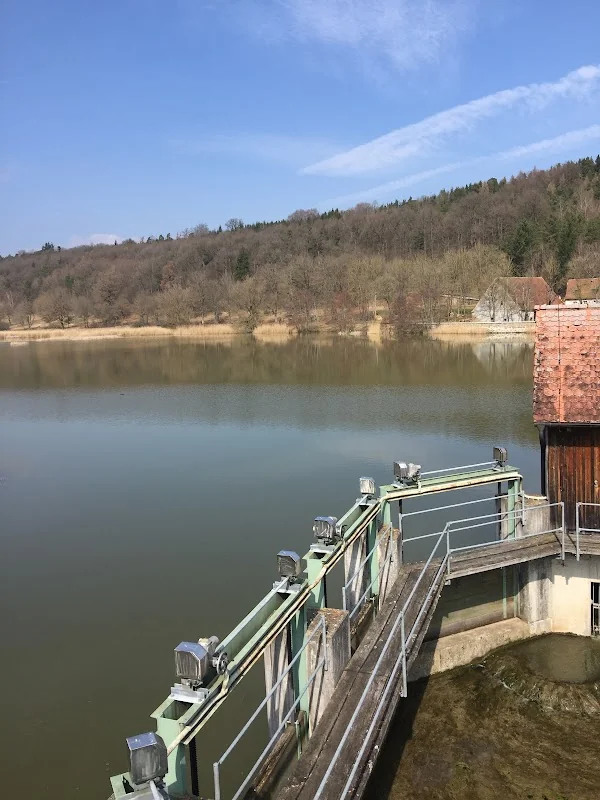
Particularly defining is the observation platform at the parking lot. According to the tourism site, the water surface can be observed very well from there, and just a few steps up the stairs opens up a wide view over the Scheerweiher. The circular path does not start with a long walk but with an immediate panorama that makes the dimensions of the pond experienceable in a small space. Afterwards, the path leads over the Scheerweiher dam to the Scheermühle and then through the forest towards Neudorfer Mühle, before it returns to the starting point in a curve. The last section runs along a former roadway parallel to the railway tracks. This is an interesting mix of nature path, historical access, and quiet infrastructure that captures the character of the area well: nothing overloaded, but a quiet, functional route with clear viewpoints and plenty of landscape in between. ([tourismus-ansbach.de](https://www.tourismus-ansbach.de/detail/id%3D61a63b000ecf8268e0d0fb81))
Seasonally, the circular path also has clear strengths. The official tourism description mentions particularly beautiful impressions during the amphibian spawning season in spring, during the bird migration times in spring and autumn, during the orchid bloom in spring, and in the autumn coloring of the deciduous forest. Thus, the Scheerweiher is not a place for just one season, but an area with recurring natural highlights. Especially those who want to hike the Scheerweiher in Ansbach or explore it as a short round trip get a different picture in each season: sometimes the water and reeds reflect more calmly, sometimes movement and sounds from the bird world are more present, sometimes the foliage dominates, sometimes the moisture in the lowlands. This makes the circular path a small but very versatile nature experience. ([tourismus-ansbach.de](https://www.tourismus-ansbach.de/detail/id%3D61a63b000ecf8268e0d0fb81))
Nature Reserve Scheerweiher Area near Schalkhausen and the Protection Rules
Those who search for the Scheerweiher do not only find a beautiful walking destination but also a strictly protected area. The city of Ansbach designates the Scheerweiher area near Schalkhausen as its only nature reserve. The Federal Agency for Nature Conservation classifies it as an FFH area and describes it as a habitat complex of nutrient-rich ponds and lakes with extensive reed zones, adjacent extensive meadows, wet meadows, semi-dry grasslands, and deciduous mixed forests. This protection category is important because it explains why the place appears so original: recreational use is not the focus, but the preservation of habitats and species. This point is central for users searching for terms like nature reserve scheerweiher, scheerweiher schalkhausen, or scheerweiher ansbach hiking. ([ansbach.de](https://www.ansbach.de/B%C3%BCrger/Umwelt-Natur/Naturschutz/Schutzgebiete-und-objekte/Naturschutzgebiete-NSG-/?utm_source=openai))
The official tourism information makes the protection rules very clear. In the core area, the protected area may not be entered year-round. Additionally, from March 1 to July 31, there is a prohibition on entering outside the paths to protect animals and plants, and dogs must be kept on a leash. This is not a formal footnote but an essential part of the visitor experience: The Scheerweiher is not a place for arbitrary deviation from the path but a natural space with clear boundaries. Those who are attentive while walking experience not less, but more quality, because disturbances are reduced and the observation of water, reeds, meadows, and forest is more concentrated. The official description of the area on the BfN site also shows with the mentioned habitat types 3150, 6210, 6430, and 6510 how diverse and at the same time sensitive this area is. ([tourismus-ansbach.de](https://www.tourismus-ansbach.de/detail/id%3D61a63b000ecf8268e0d0fb81))
For the search query scheerweiher ansbach swimming, a factual classification is therefore important: On the official information pages, the Scheerweiher is described as a protected and natural area, not as a swimming lake. The circular path, observation platform, bird watching, amphibian spawning season, and nature experience are mentioned; a swimming area or recreational swimming infrastructure is not indicated there. This means in practice that the place is primarily intended for slow walking, looking, and observing. This tranquility is part of its attractiveness. The Scheerweiher is not a loud amusement park by the water, but a sensitive habitat where the proper handling of paths and protection times is crucial. Those who respect this receive one of the most authentic natural places in Ansbach. ([tourismus-ansbach.de](https://www.tourismus-ansbach.de/detail/id%3D61a63b000ecf8268e0d0fb81))
Access, Parking, and Orientation at Scheerweiher in Schalkhausen
The access to the Scheerweiher is relatively uncomplicated if one pays attention to the official orientation. The tourism site lists the address Steinersdorfer Steige, 91522 Ansbach, and describes the access coming from Schalkhausen: right after the railway underpass, there is a parking lot. This is also where the circular path starts. For search queries like access scheerweiher or parking scheerweiher, this is the most important practical information, as it shows that the entry into the area is not extensive or complicated. One reaches the natural space relatively directly, without large visitor centers, long footpaths, or elaborate development. This fits the character of the place: The Scheerweiher does not want to be spectacularly staged, but quietly entered and attentively experienced. ([tourismus-ansbach.de](https://www.tourismus-ansbach.de/detail/id%3D6603f8b95f4d323a158bca17))
The tour description also helps with internal orientation on site. The circular path first leads to the small observation tower, then over the Scheerweiher dam to the Scheermühle, and subsequently through the forest towards Neudorfer Mühle. Afterwards, the circle closes over a former roadway parallel to the railway tracks back to the starting point. This sequence makes the path very understandable, even if it is not continuously signposted. Especially because the path is described as unmarked, it is sensible to remember the main direction before starting: parking lot, observation tower, dam, Scheermühle, forest, return path. This turns a short tour into a relaxed, safe walk. For visitors searching for ansbach scheerweiher or scheerweiher circular path, this is the practical core information that makes the trip planable. ([tourismus-ansbach.de](https://www.tourismus-ansbach.de/detail/id%3D61a63b000ecf8268e0d0fb81))
The location in the surroundings is also interesting. The Scheerweiher is located near Schalkhausen and is thus very close to a district of Ansbach, while at the same time being clearly separated from the urban center in terms of landscape. The path runs in parts along historical and technical traces, such as at the railway underpass and parallel to the tracks, but remains visually shaped by the water and meadow space. This creates a contrast that is particularly appealing to many visitors: One drives or comes relatively quickly out of the city, then stands at the parking lot, climbs a few steps to the observation platform, and looks directly at a protected water landscape. For a short nature appointment, this is ideal because the effort and experience are in a very good ratio. ([tourismus-ansbach.de](https://www.tourismus-ansbach.de/detail/id%3D61a63b000ecf8268e0d0fb81))
History of the Scheerweiher and the Scheermühle
The historical depth of the Scheerweiher is one of its strongest attractions. According to the official tourism description, the namesake pond was already created in the Middle Ages by damming two streams as a fish pond. The management plan of the area also makes the close connection to water and landscape visible: The pond area lies in an anmoor to moor valley fill, and the area forms an important stepping stone in a larger ecological network. Thus, the Scheerweiher is not only an old pond but a historically shaped natural space, whose use and protection have intertwined over centuries. This also explains why the present landscape appears so multifaceted: water, valley floor, meadows, forests, and old usage structures do not stand side by side here but have historically grown together. ([tourismus-ansbach.de](https://www.tourismus-ansbach.de/detail/id%3D61a63b000ecf8268e0d0fb81))
This is particularly vividly illustrated at the Scheermühle. According to the tourism site, the water of the pond was used until 1930 to operate the Scheermühle, which was built in the 17th century. A wooden coat of arms in the gable of the half-timbered house refers to this history. The dam over which the circular path leads is therefore not just a landscape transition but a historical element of water use. Those who stand there see not only a beautiful backdrop but a piece of functional landscape history. The Scheerweiher was a fish pond, mill pond, water reserve, and today primarily a protected area. This transformation from use to preservation makes the area so exciting. It shows how an old economic space can transition into a highly sensitive natural space without losing its historical narrative. ([tourismus-ansbach.de](https://www.tourismus-ansbach.de/detail/id%3D61a63b000ecf8268e0d0fb81))
The management plan complements this perspective with important ownership and networking aspects. The open land areas of the region are almost entirely owned by the city of Ansbach, the forest share is state forest, and the fishing rights for the Scheerweiher are in private hands. At the same time, the area is described as a regionally significant stepping stone for still water inhabitants between the Franconian Lake District and the pond areas in the Höchstadt and Dinkelsbühl-Bechhofen area. It is also a presumably essential remnant of a previously large-scale wetland and wet meadow area on and around the Frankenhöhe. For users who are looking for not just an excursion destination behind scheermühle scheerweiher or scheerweiher area near schalkhausen but also context, this is particularly valuable: The Scheerweiher is not interesting by chance but part of a larger landscape history and a much larger ecological context. ([lfu.bayern.de](https://www.lfu.bayern.de/natur/natura2000_managementplaene/6020_6946/doc/6629_301/texte/de6629301_t_ge_nfin_ffin.pdf))
Birdlife, Amphibians, and Nature Observation at Scheerweiher
Nature observation at the Scheerweiher is not a secondary aspect but one of the main reasons for a visit. The tourism description mentions more than 60 breeding bird species in the area. Additionally, toads and newts use the nearby pond for spawning, and over five thousand common toads form one of the largest populations in the natural area of Frankenhöhe. These are remarkable figures because they show that the Scheerweiher, despite its manageable size, has an extraordinarily high ecological density. Those interested in bird watching scheerweiher, amphibian spawning in spring, or simply a vibrant wetland will find a landscape here that not only looks beautiful but also demonstrably supports a lot of life. ([tourismus-ansbach.de](https://www.tourismus-ansbach.de/detail/id%3D61a63b000ecf8268e0d0fb81))
The BfN and LFU data make this diversity even more tangible. Mentioned species include the crested newt, the hermit beetle, and the narrow-mouthed snail. As habitat types, natural eutrophic lakes, orchid-rich calcareous dry grasslands, moist tall herb communities, and extensive meadows are recorded. The management plan also highlights the networking with neighboring Natura 2000 areas and points to the special value for the hermit beetle. Such information is not just technical information for visitors but explains why the area is so worthy of protection: It is a mosaic of water, edge biotopes, open land, and forest that provides habitats for various species groups. For people who want to not only look at nature but understand it, the Scheerweiher area is therefore particularly exciting. ([bfn.de](https://www.bfn.de/natura-2000-gebiet/naturschutzgebiet-scheerweihergebiet-bei-schalkhausen))
The seasonal observation opportunities are also remarkable. In spring, the amphibian spawning season and orchid bloom shape the picture, while in autumn, bird migration and leaf coloring are added. The official information thus indirectly recommends a quiet, observing use of the area: not to rush through quickly, but to stop, look, and perceive the changes throughout the year. The combination of water surface, reeds, old trees, and open meadows makes the scenery so readable. In spring, it appears lively and moist, in summer green and dense, in autumn open and colorful. This is a natural space that does not change artificially but reveals itself anew from within. ([tourismus-ansbach.de](https://www.tourismus-ansbach.de/detail/id%3D61a63b000ecf8268e0d0fb81))
In summary, the Scheerweiher in Ansbach is much more than a local lake or a short walking path. It is a historically grown, strictly protected, and ecologically valuable space where the circular path, observation platform, history, species diversity, and protection rules complement each other meaningfully. Those searching for scheerweiher ansbach, scheerweiher schalkhausen, or scheerweiher circular path should expect exactly this mix: no loud attraction, but a quiet nature experience with real depth. This makes the place particularly valuable for people who have little time in everyday life but seek a lot of landscape and tranquility in a small space. ([tourismus-ansbach.de](https://www.tourismus-ansbach.de/detail/id%3D61a63b000ecf8268e0d0fb81))
Sources:
- Scheerweiher Circular Path - Tourism Ansbach
- Scheerweiher near Schalkhausen, Ansbach - Tourism Ansbach
- Nature Reserves (NSG) - City of Ansbach
- Nature Reserve Scheerweiher Area near Schalkhausen - Federal Agency for Nature Conservation
- Management Plan Scheerweiher Area near Schalkhausen - Bavarian State Office for the Environment
Mehr anzeigenWeniger anzeigen
Scheerweiher | Circular Path & Observation Platform
The Scheerweiher in Ansbach is a quiet natural destination with surprisingly much substance: The area is the only nature reserve within the city limits of Ansbach and is also registered as FFH area 6629-301; it is officially listed with 52.8 hectares. It is described as a landscape of nutrient-rich ponds and lakes, extensive reed zones, reed belts, old trees, extensive meadows, wet meadows, semi-dry grasslands, and deciduous mixed forests. Those who come here are usually not looking for a grand stage, but for peace, short paths, and intense moments in nature. This is exactly what the Scheerweiher is known for: a compact circular path, a small observation platform at the parking lot, bird watching, amphibian life in spring, and a landscape that feels surprisingly original despite its proximity to Ansbach. ([ansbach.de](https://www.ansbach.de/B%C3%BCrger/Umwelt-Natur/Naturschutz/Schutzgebiete-und-objekte/Naturschutzgebiete-NSG-/?utm_source=openai))
Scheerweiher Circular Path, Observation Platform, and Walk Around the Water
The official Scheerweiher circular path is the centerpiece for all those who want to experience the Scheerweiher in Ansbach on foot. The tour is indicated with a length of 3.8 kilometers, a walking time of about 1:05 hours, as well as 36 meters of ascent and 37 meters of descent; it is classified as easy and designed as a circular path. This compact form makes the path so attractive for a short trip, a quiet afternoon walk, or a little nature break in between. The path does not lead through a staged excursion facility but through a sensitive protected area, where the view repeatedly falls on water, reeds, shrubs, and open meadow areas. This creates a very direct impression of the landscape, without long travel times and without complicated route guidance. ([tourismus-ansbach.de](https://www.tourismus-ansbach.de/detail/id%3D61a63b000ecf8268e0d0fb81))
Particularly defining is the observation platform at the parking lot. According to the tourism site, the water surface can be observed very well from there, and just a few steps up the stairs opens up a wide view over the Scheerweiher. The circular path does not start with a long walk but with an immediate panorama that makes the dimensions of the pond experienceable in a small space. Afterwards, the path leads over the Scheerweiher dam to the Scheermühle and then through the forest towards Neudorfer Mühle, before it returns to the starting point in a curve. The last section runs along a former roadway parallel to the railway tracks. This is an interesting mix of nature path, historical access, and quiet infrastructure that captures the character of the area well: nothing overloaded, but a quiet, functional route with clear viewpoints and plenty of landscape in between. ([tourismus-ansbach.de](https://www.tourismus-ansbach.de/detail/id%3D61a63b000ecf8268e0d0fb81))
Seasonally, the circular path also has clear strengths. The official tourism description mentions particularly beautiful impressions during the amphibian spawning season in spring, during the bird migration times in spring and autumn, during the orchid bloom in spring, and in the autumn coloring of the deciduous forest. Thus, the Scheerweiher is not a place for just one season, but an area with recurring natural highlights. Especially those who want to hike the Scheerweiher in Ansbach or explore it as a short round trip get a different picture in each season: sometimes the water and reeds reflect more calmly, sometimes movement and sounds from the bird world are more present, sometimes the foliage dominates, sometimes the moisture in the lowlands. This makes the circular path a small but very versatile nature experience. ([tourismus-ansbach.de](https://www.tourismus-ansbach.de/detail/id%3D61a63b000ecf8268e0d0fb81))
Nature Reserve Scheerweiher Area near Schalkhausen and the Protection Rules
Those who search for the Scheerweiher do not only find a beautiful walking destination but also a strictly protected area. The city of Ansbach designates the Scheerweiher area near Schalkhausen as its only nature reserve. The Federal Agency for Nature Conservation classifies it as an FFH area and describes it as a habitat complex of nutrient-rich ponds and lakes with extensive reed zones, adjacent extensive meadows, wet meadows, semi-dry grasslands, and deciduous mixed forests. This protection category is important because it explains why the place appears so original: recreational use is not the focus, but the preservation of habitats and species. This point is central for users searching for terms like nature reserve scheerweiher, scheerweiher schalkhausen, or scheerweiher ansbach hiking. ([ansbach.de](https://www.ansbach.de/B%C3%BCrger/Umwelt-Natur/Naturschutz/Schutzgebiete-und-objekte/Naturschutzgebiete-NSG-/?utm_source=openai))
The official tourism information makes the protection rules very clear. In the core area, the protected area may not be entered year-round. Additionally, from March 1 to July 31, there is a prohibition on entering outside the paths to protect animals and plants, and dogs must be kept on a leash. This is not a formal footnote but an essential part of the visitor experience: The Scheerweiher is not a place for arbitrary deviation from the path but a natural space with clear boundaries. Those who are attentive while walking experience not less, but more quality, because disturbances are reduced and the observation of water, reeds, meadows, and forest is more concentrated. The official description of the area on the BfN site also shows with the mentioned habitat types 3150, 6210, 6430, and 6510 how diverse and at the same time sensitive this area is. ([tourismus-ansbach.de](https://www.tourismus-ansbach.de/detail/id%3D61a63b000ecf8268e0d0fb81))
For the search query scheerweiher ansbach swimming, a factual classification is therefore important: On the official information pages, the Scheerweiher is described as a protected and natural area, not as a swimming lake. The circular path, observation platform, bird watching, amphibian spawning season, and nature experience are mentioned; a swimming area or recreational swimming infrastructure is not indicated there. This means in practice that the place is primarily intended for slow walking, looking, and observing. This tranquility is part of its attractiveness. The Scheerweiher is not a loud amusement park by the water, but a sensitive habitat where the proper handling of paths and protection times is crucial. Those who respect this receive one of the most authentic natural places in Ansbach. ([tourismus-ansbach.de](https://www.tourismus-ansbach.de/detail/id%3D61a63b000ecf8268e0d0fb81))
Access, Parking, and Orientation at Scheerweiher in Schalkhausen
The access to the Scheerweiher is relatively uncomplicated if one pays attention to the official orientation. The tourism site lists the address Steinersdorfer Steige, 91522 Ansbach, and describes the access coming from Schalkhausen: right after the railway underpass, there is a parking lot. This is also where the circular path starts. For search queries like access scheerweiher or parking scheerweiher, this is the most important practical information, as it shows that the entry into the area is not extensive or complicated. One reaches the natural space relatively directly, without large visitor centers, long footpaths, or elaborate development. This fits the character of the place: The Scheerweiher does not want to be spectacularly staged, but quietly entered and attentively experienced. ([tourismus-ansbach.de](https://www.tourismus-ansbach.de/detail/id%3D6603f8b95f4d323a158bca17))
The tour description also helps with internal orientation on site. The circular path first leads to the small observation tower, then over the Scheerweiher dam to the Scheermühle, and subsequently through the forest towards Neudorfer Mühle. Afterwards, the circle closes over a former roadway parallel to the railway tracks back to the starting point. This sequence makes the path very understandable, even if it is not continuously signposted. Especially because the path is described as unmarked, it is sensible to remember the main direction before starting: parking lot, observation tower, dam, Scheermühle, forest, return path. This turns a short tour into a relaxed, safe walk. For visitors searching for ansbach scheerweiher or scheerweiher circular path, this is the practical core information that makes the trip planable. ([tourismus-ansbach.de](https://www.tourismus-ansbach.de/detail/id%3D61a63b000ecf8268e0d0fb81))
The location in the surroundings is also interesting. The Scheerweiher is located near Schalkhausen and is thus very close to a district of Ansbach, while at the same time being clearly separated from the urban center in terms of landscape. The path runs in parts along historical and technical traces, such as at the railway underpass and parallel to the tracks, but remains visually shaped by the water and meadow space. This creates a contrast that is particularly appealing to many visitors: One drives or comes relatively quickly out of the city, then stands at the parking lot, climbs a few steps to the observation platform, and looks directly at a protected water landscape. For a short nature appointment, this is ideal because the effort and experience are in a very good ratio. ([tourismus-ansbach.de](https://www.tourismus-ansbach.de/detail/id%3D61a63b000ecf8268e0d0fb81))
History of the Scheerweiher and the Scheermühle
The historical depth of the Scheerweiher is one of its strongest attractions. According to the official tourism description, the namesake pond was already created in the Middle Ages by damming two streams as a fish pond. The management plan of the area also makes the close connection to water and landscape visible: The pond area lies in an anmoor to moor valley fill, and the area forms an important stepping stone in a larger ecological network. Thus, the Scheerweiher is not only an old pond but a historically shaped natural space, whose use and protection have intertwined over centuries. This also explains why the present landscape appears so multifaceted: water, valley floor, meadows, forests, and old usage structures do not stand side by side here but have historically grown together. ([tourismus-ansbach.de](https://www.tourismus-ansbach.de/detail/id%3D61a63b000ecf8268e0d0fb81))
This is particularly vividly illustrated at the Scheermühle. According to the tourism site, the water of the pond was used until 1930 to operate the Scheermühle, which was built in the 17th century. A wooden coat of arms in the gable of the half-timbered house refers to this history. The dam over which the circular path leads is therefore not just a landscape transition but a historical element of water use. Those who stand there see not only a beautiful backdrop but a piece of functional landscape history. The Scheerweiher was a fish pond, mill pond, water reserve, and today primarily a protected area. This transformation from use to preservation makes the area so exciting. It shows how an old economic space can transition into a highly sensitive natural space without losing its historical narrative. ([tourismus-ansbach.de](https://www.tourismus-ansbach.de/detail/id%3D61a63b000ecf8268e0d0fb81))
The management plan complements this perspective with important ownership and networking aspects. The open land areas of the region are almost entirely owned by the city of Ansbach, the forest share is state forest, and the fishing rights for the Scheerweiher are in private hands. At the same time, the area is described as a regionally significant stepping stone for still water inhabitants between the Franconian Lake District and the pond areas in the Höchstadt and Dinkelsbühl-Bechhofen area. It is also a presumably essential remnant of a previously large-scale wetland and wet meadow area on and around the Frankenhöhe. For users who are looking for not just an excursion destination behind scheermühle scheerweiher or scheerweiher area near schalkhausen but also context, this is particularly valuable: The Scheerweiher is not interesting by chance but part of a larger landscape history and a much larger ecological context. ([lfu.bayern.de](https://www.lfu.bayern.de/natur/natura2000_managementplaene/6020_6946/doc/6629_301/texte/de6629301_t_ge_nfin_ffin.pdf))
Birdlife, Amphibians, and Nature Observation at Scheerweiher
Nature observation at the Scheerweiher is not a secondary aspect but one of the main reasons for a visit. The tourism description mentions more than 60 breeding bird species in the area. Additionally, toads and newts use the nearby pond for spawning, and over five thousand common toads form one of the largest populations in the natural area of Frankenhöhe. These are remarkable figures because they show that the Scheerweiher, despite its manageable size, has an extraordinarily high ecological density. Those interested in bird watching scheerweiher, amphibian spawning in spring, or simply a vibrant wetland will find a landscape here that not only looks beautiful but also demonstrably supports a lot of life. ([tourismus-ansbach.de](https://www.tourismus-ansbach.de/detail/id%3D61a63b000ecf8268e0d0fb81))
The BfN and LFU data make this diversity even more tangible. Mentioned species include the crested newt, the hermit beetle, and the narrow-mouthed snail. As habitat types, natural eutrophic lakes, orchid-rich calcareous dry grasslands, moist tall herb communities, and extensive meadows are recorded. The management plan also highlights the networking with neighboring Natura 2000 areas and points to the special value for the hermit beetle. Such information is not just technical information for visitors but explains why the area is so worthy of protection: It is a mosaic of water, edge biotopes, open land, and forest that provides habitats for various species groups. For people who want to not only look at nature but understand it, the Scheerweiher area is therefore particularly exciting. ([bfn.de](https://www.bfn.de/natura-2000-gebiet/naturschutzgebiet-scheerweihergebiet-bei-schalkhausen))
The seasonal observation opportunities are also remarkable. In spring, the amphibian spawning season and orchid bloom shape the picture, while in autumn, bird migration and leaf coloring are added. The official information thus indirectly recommends a quiet, observing use of the area: not to rush through quickly, but to stop, look, and perceive the changes throughout the year. The combination of water surface, reeds, old trees, and open meadows makes the scenery so readable. In spring, it appears lively and moist, in summer green and dense, in autumn open and colorful. This is a natural space that does not change artificially but reveals itself anew from within. ([tourismus-ansbach.de](https://www.tourismus-ansbach.de/detail/id%3D61a63b000ecf8268e0d0fb81))
In summary, the Scheerweiher in Ansbach is much more than a local lake or a short walking path. It is a historically grown, strictly protected, and ecologically valuable space where the circular path, observation platform, history, species diversity, and protection rules complement each other meaningfully. Those searching for scheerweiher ansbach, scheerweiher schalkhausen, or scheerweiher circular path should expect exactly this mix: no loud attraction, but a quiet nature experience with real depth. This makes the place particularly valuable for people who have little time in everyday life but seek a lot of landscape and tranquility in a small space. ([tourismus-ansbach.de](https://www.tourismus-ansbach.de/detail/id%3D61a63b000ecf8268e0d0fb81))
Sources:
- Scheerweiher Circular Path - Tourism Ansbach
- Scheerweiher near Schalkhausen, Ansbach - Tourism Ansbach
- Nature Reserves (NSG) - City of Ansbach
- Nature Reserve Scheerweiher Area near Schalkhausen - Federal Agency for Nature Conservation
- Management Plan Scheerweiher Area near Schalkhausen - Bavarian State Office for the Environment
Scheerweiher | Circular Path & Observation Platform
The Scheerweiher in Ansbach is a quiet natural destination with surprisingly much substance: The area is the only nature reserve within the city limits of Ansbach and is also registered as FFH area 6629-301; it is officially listed with 52.8 hectares. It is described as a landscape of nutrient-rich ponds and lakes, extensive reed zones, reed belts, old trees, extensive meadows, wet meadows, semi-dry grasslands, and deciduous mixed forests. Those who come here are usually not looking for a grand stage, but for peace, short paths, and intense moments in nature. This is exactly what the Scheerweiher is known for: a compact circular path, a small observation platform at the parking lot, bird watching, amphibian life in spring, and a landscape that feels surprisingly original despite its proximity to Ansbach. ([ansbach.de](https://www.ansbach.de/B%C3%BCrger/Umwelt-Natur/Naturschutz/Schutzgebiete-und-objekte/Naturschutzgebiete-NSG-/?utm_source=openai))
Scheerweiher Circular Path, Observation Platform, and Walk Around the Water
The official Scheerweiher circular path is the centerpiece for all those who want to experience the Scheerweiher in Ansbach on foot. The tour is indicated with a length of 3.8 kilometers, a walking time of about 1:05 hours, as well as 36 meters of ascent and 37 meters of descent; it is classified as easy and designed as a circular path. This compact form makes the path so attractive for a short trip, a quiet afternoon walk, or a little nature break in between. The path does not lead through a staged excursion facility but through a sensitive protected area, where the view repeatedly falls on water, reeds, shrubs, and open meadow areas. This creates a very direct impression of the landscape, without long travel times and without complicated route guidance. ([tourismus-ansbach.de](https://www.tourismus-ansbach.de/detail/id%3D61a63b000ecf8268e0d0fb81))
Particularly defining is the observation platform at the parking lot. According to the tourism site, the water surface can be observed very well from there, and just a few steps up the stairs opens up a wide view over the Scheerweiher. The circular path does not start with a long walk but with an immediate panorama that makes the dimensions of the pond experienceable in a small space. Afterwards, the path leads over the Scheerweiher dam to the Scheermühle and then through the forest towards Neudorfer Mühle, before it returns to the starting point in a curve. The last section runs along a former roadway parallel to the railway tracks. This is an interesting mix of nature path, historical access, and quiet infrastructure that captures the character of the area well: nothing overloaded, but a quiet, functional route with clear viewpoints and plenty of landscape in between. ([tourismus-ansbach.de](https://www.tourismus-ansbach.de/detail/id%3D61a63b000ecf8268e0d0fb81))
Seasonally, the circular path also has clear strengths. The official tourism description mentions particularly beautiful impressions during the amphibian spawning season in spring, during the bird migration times in spring and autumn, during the orchid bloom in spring, and in the autumn coloring of the deciduous forest. Thus, the Scheerweiher is not a place for just one season, but an area with recurring natural highlights. Especially those who want to hike the Scheerweiher in Ansbach or explore it as a short round trip get a different picture in each season: sometimes the water and reeds reflect more calmly, sometimes movement and sounds from the bird world are more present, sometimes the foliage dominates, sometimes the moisture in the lowlands. This makes the circular path a small but very versatile nature experience. ([tourismus-ansbach.de](https://www.tourismus-ansbach.de/detail/id%3D61a63b000ecf8268e0d0fb81))
Nature Reserve Scheerweiher Area near Schalkhausen and the Protection Rules
Those who search for the Scheerweiher do not only find a beautiful walking destination but also a strictly protected area. The city of Ansbach designates the Scheerweiher area near Schalkhausen as its only nature reserve. The Federal Agency for Nature Conservation classifies it as an FFH area and describes it as a habitat complex of nutrient-rich ponds and lakes with extensive reed zones, adjacent extensive meadows, wet meadows, semi-dry grasslands, and deciduous mixed forests. This protection category is important because it explains why the place appears so original: recreational use is not the focus, but the preservation of habitats and species. This point is central for users searching for terms like nature reserve scheerweiher, scheerweiher schalkhausen, or scheerweiher ansbach hiking. ([ansbach.de](https://www.ansbach.de/B%C3%BCrger/Umwelt-Natur/Naturschutz/Schutzgebiete-und-objekte/Naturschutzgebiete-NSG-/?utm_source=openai))
The official tourism information makes the protection rules very clear. In the core area, the protected area may not be entered year-round. Additionally, from March 1 to July 31, there is a prohibition on entering outside the paths to protect animals and plants, and dogs must be kept on a leash. This is not a formal footnote but an essential part of the visitor experience: The Scheerweiher is not a place for arbitrary deviation from the path but a natural space with clear boundaries. Those who are attentive while walking experience not less, but more quality, because disturbances are reduced and the observation of water, reeds, meadows, and forest is more concentrated. The official description of the area on the BfN site also shows with the mentioned habitat types 3150, 6210, 6430, and 6510 how diverse and at the same time sensitive this area is. ([tourismus-ansbach.de](https://www.tourismus-ansbach.de/detail/id%3D61a63b000ecf8268e0d0fb81))
For the search query scheerweiher ansbach swimming, a factual classification is therefore important: On the official information pages, the Scheerweiher is described as a protected and natural area, not as a swimming lake. The circular path, observation platform, bird watching, amphibian spawning season, and nature experience are mentioned; a swimming area or recreational swimming infrastructure is not indicated there. This means in practice that the place is primarily intended for slow walking, looking, and observing. This tranquility is part of its attractiveness. The Scheerweiher is not a loud amusement park by the water, but a sensitive habitat where the proper handling of paths and protection times is crucial. Those who respect this receive one of the most authentic natural places in Ansbach. ([tourismus-ansbach.de](https://www.tourismus-ansbach.de/detail/id%3D61a63b000ecf8268e0d0fb81))
Access, Parking, and Orientation at Scheerweiher in Schalkhausen
The access to the Scheerweiher is relatively uncomplicated if one pays attention to the official orientation. The tourism site lists the address Steinersdorfer Steige, 91522 Ansbach, and describes the access coming from Schalkhausen: right after the railway underpass, there is a parking lot. This is also where the circular path starts. For search queries like access scheerweiher or parking scheerweiher, this is the most important practical information, as it shows that the entry into the area is not extensive or complicated. One reaches the natural space relatively directly, without large visitor centers, long footpaths, or elaborate development. This fits the character of the place: The Scheerweiher does not want to be spectacularly staged, but quietly entered and attentively experienced. ([tourismus-ansbach.de](https://www.tourismus-ansbach.de/detail/id%3D6603f8b95f4d323a158bca17))
The tour description also helps with internal orientation on site. The circular path first leads to the small observation tower, then over the Scheerweiher dam to the Scheermühle, and subsequently through the forest towards Neudorfer Mühle. Afterwards, the circle closes over a former roadway parallel to the railway tracks back to the starting point. This sequence makes the path very understandable, even if it is not continuously signposted. Especially because the path is described as unmarked, it is sensible to remember the main direction before starting: parking lot, observation tower, dam, Scheermühle, forest, return path. This turns a short tour into a relaxed, safe walk. For visitors searching for ansbach scheerweiher or scheerweiher circular path, this is the practical core information that makes the trip planable. ([tourismus-ansbach.de](https://www.tourismus-ansbach.de/detail/id%3D61a63b000ecf8268e0d0fb81))
The location in the surroundings is also interesting. The Scheerweiher is located near Schalkhausen and is thus very close to a district of Ansbach, while at the same time being clearly separated from the urban center in terms of landscape. The path runs in parts along historical and technical traces, such as at the railway underpass and parallel to the tracks, but remains visually shaped by the water and meadow space. This creates a contrast that is particularly appealing to many visitors: One drives or comes relatively quickly out of the city, then stands at the parking lot, climbs a few steps to the observation platform, and looks directly at a protected water landscape. For a short nature appointment, this is ideal because the effort and experience are in a very good ratio. ([tourismus-ansbach.de](https://www.tourismus-ansbach.de/detail/id%3D61a63b000ecf8268e0d0fb81))
History of the Scheerweiher and the Scheermühle
The historical depth of the Scheerweiher is one of its strongest attractions. According to the official tourism description, the namesake pond was already created in the Middle Ages by damming two streams as a fish pond. The management plan of the area also makes the close connection to water and landscape visible: The pond area lies in an anmoor to moor valley fill, and the area forms an important stepping stone in a larger ecological network. Thus, the Scheerweiher is not only an old pond but a historically shaped natural space, whose use and protection have intertwined over centuries. This also explains why the present landscape appears so multifaceted: water, valley floor, meadows, forests, and old usage structures do not stand side by side here but have historically grown together. ([tourismus-ansbach.de](https://www.tourismus-ansbach.de/detail/id%3D61a63b000ecf8268e0d0fb81))
This is particularly vividly illustrated at the Scheermühle. According to the tourism site, the water of the pond was used until 1930 to operate the Scheermühle, which was built in the 17th century. A wooden coat of arms in the gable of the half-timbered house refers to this history. The dam over which the circular path leads is therefore not just a landscape transition but a historical element of water use. Those who stand there see not only a beautiful backdrop but a piece of functional landscape history. The Scheerweiher was a fish pond, mill pond, water reserve, and today primarily a protected area. This transformation from use to preservation makes the area so exciting. It shows how an old economic space can transition into a highly sensitive natural space without losing its historical narrative. ([tourismus-ansbach.de](https://www.tourismus-ansbach.de/detail/id%3D61a63b000ecf8268e0d0fb81))
The management plan complements this perspective with important ownership and networking aspects. The open land areas of the region are almost entirely owned by the city of Ansbach, the forest share is state forest, and the fishing rights for the Scheerweiher are in private hands. At the same time, the area is described as a regionally significant stepping stone for still water inhabitants between the Franconian Lake District and the pond areas in the Höchstadt and Dinkelsbühl-Bechhofen area. It is also a presumably essential remnant of a previously large-scale wetland and wet meadow area on and around the Frankenhöhe. For users who are looking for not just an excursion destination behind scheermühle scheerweiher or scheerweiher area near schalkhausen but also context, this is particularly valuable: The Scheerweiher is not interesting by chance but part of a larger landscape history and a much larger ecological context. ([lfu.bayern.de](https://www.lfu.bayern.de/natur/natura2000_managementplaene/6020_6946/doc/6629_301/texte/de6629301_t_ge_nfin_ffin.pdf))
Birdlife, Amphibians, and Nature Observation at Scheerweiher
Nature observation at the Scheerweiher is not a secondary aspect but one of the main reasons for a visit. The tourism description mentions more than 60 breeding bird species in the area. Additionally, toads and newts use the nearby pond for spawning, and over five thousand common toads form one of the largest populations in the natural area of Frankenhöhe. These are remarkable figures because they show that the Scheerweiher, despite its manageable size, has an extraordinarily high ecological density. Those interested in bird watching scheerweiher, amphibian spawning in spring, or simply a vibrant wetland will find a landscape here that not only looks beautiful but also demonstrably supports a lot of life. ([tourismus-ansbach.de](https://www.tourismus-ansbach.de/detail/id%3D61a63b000ecf8268e0d0fb81))
The BfN and LFU data make this diversity even more tangible. Mentioned species include the crested newt, the hermit beetle, and the narrow-mouthed snail. As habitat types, natural eutrophic lakes, orchid-rich calcareous dry grasslands, moist tall herb communities, and extensive meadows are recorded. The management plan also highlights the networking with neighboring Natura 2000 areas and points to the special value for the hermit beetle. Such information is not just technical information for visitors but explains why the area is so worthy of protection: It is a mosaic of water, edge biotopes, open land, and forest that provides habitats for various species groups. For people who want to not only look at nature but understand it, the Scheerweiher area is therefore particularly exciting. ([bfn.de](https://www.bfn.de/natura-2000-gebiet/naturschutzgebiet-scheerweihergebiet-bei-schalkhausen))
The seasonal observation opportunities are also remarkable. In spring, the amphibian spawning season and orchid bloom shape the picture, while in autumn, bird migration and leaf coloring are added. The official information thus indirectly recommends a quiet, observing use of the area: not to rush through quickly, but to stop, look, and perceive the changes throughout the year. The combination of water surface, reeds, old trees, and open meadows makes the scenery so readable. In spring, it appears lively and moist, in summer green and dense, in autumn open and colorful. This is a natural space that does not change artificially but reveals itself anew from within. ([tourismus-ansbach.de](https://www.tourismus-ansbach.de/detail/id%3D61a63b000ecf8268e0d0fb81))
In summary, the Scheerweiher in Ansbach is much more than a local lake or a short walking path. It is a historically grown, strictly protected, and ecologically valuable space where the circular path, observation platform, history, species diversity, and protection rules complement each other meaningfully. Those searching for scheerweiher ansbach, scheerweiher schalkhausen, or scheerweiher circular path should expect exactly this mix: no loud attraction, but a quiet nature experience with real depth. This makes the place particularly valuable for people who have little time in everyday life but seek a lot of landscape and tranquility in a small space. ([tourismus-ansbach.de](https://www.tourismus-ansbach.de/detail/id%3D61a63b000ecf8268e0d0fb81))
Sources:
- Scheerweiher Circular Path - Tourism Ansbach
- Scheerweiher near Schalkhausen, Ansbach - Tourism Ansbach
- Nature Reserves (NSG) - City of Ansbach
- Nature Reserve Scheerweiher Area near Schalkhausen - Federal Agency for Nature Conservation
- Management Plan Scheerweiher Area near Schalkhausen - Bavarian State Office for the Environment
Upcoming Events
No events found
Frequently Asked Questions
Reviews
No reviews found