
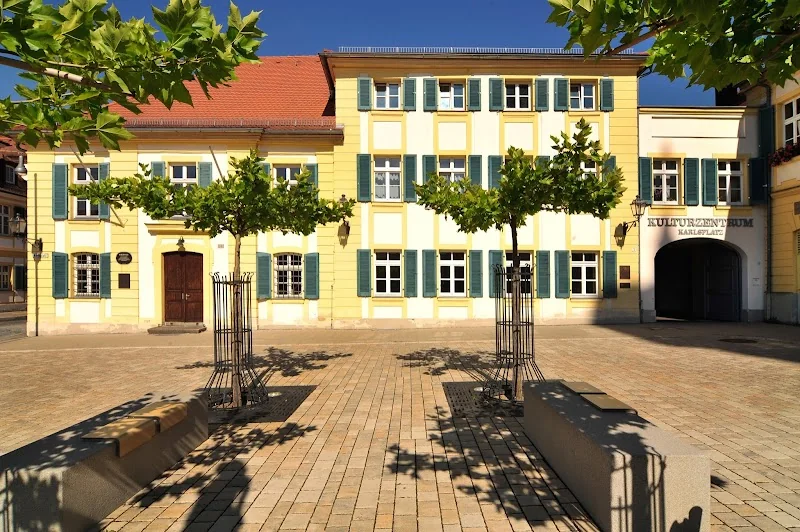
Ansbach
Karlspl. 7/9, 91522 Ansbach, Deutschland
Cultural Center at Karlsplatz | Karlshalle & Angletsaal
The Cultural Center at Karlsplatz in Ansbach is a municipal address with a clear function and remarkable versatility. Located at Karlsplatz 7/9, the Karlshalle and Angletsaal are managed, and the city uses the spaces not only for culture and meetings but also for official appointments, weddings, and sometimes even for administrative tasks. Those looking for a central location in the heart of the city where representation, everyday life, and event practice directly meet will find a venue firmly anchored in urban life. At the same time, the location is a plus for visitors who want to reach the city center without long journeys and are looking for a place with a clear address, good visibility, and diverse use. ([ansbach.de](https://www.ansbach.de/B%C3%BCrger/Rathaus-Service/B%C3%BCrgerservice-Online-Dienste/Wo-finden-Sie-uns-/Kulturzentrum-Karlsplatz.php?FID=2595.685.1&La=1&ModID=9&mNavID=2595.68&object=tx%7C2595.2.1&redir=1&sNavID=2595.68&utm_source=openai))
Karlshalle and Angletsaal in the Cultural Center at Karlsplatz
The Karlshalle is the defining element of the Cultural Center at Karlsplatz, while the Angletsaal appears as another functional and event space. In the municipal communications, the Angletsaal is used not only for events but also as a temporary location for the driver's license office and vehicle registration. This clearly shows how flexible the venue operates in everyday life: it can be used for meetings, speeches, receptions, or cultural formats while also accommodating practical citizen tasks. For organizers, this mix is particularly interesting because it combines official infrastructure with urban visibility. As a result, the place does not feel like an anonymous hall but rather like a vibrant part of the city administration and cultural life. This is a real advantage, especially for formats that require proximity, reliability, and a serious framework. ([ansbach.de](https://www.ansbach.de/B%C3%BCrger/Rathaus-Service/Stadtnachrichten/F%C3%BChrerscheinstelle-ab-sofort-am-Karlsplatz.php?FID=2595.19594.1&La=1&ModID=7&NavID=2595.280&object=tx%2C2595.6.1&utm_source=openai))
The equipment also speaks for versatile use. The city's price list for non-entrepreneurs lists the Karlshalle, the adjoining room, and various additional services separately. This includes seating variants, table arrangements, energy costs, kitchenette, sound system, microphones, projector, standing tables, partition walls, covers, screen, Bechstein grand piano, Kawai grand piano, special cleaning, and caretaker hours; free Wi-Fi is also provided. From an organizer's perspective, this means: the space can be significantly adapted depending on the occasion, from a factual meeting to a festive event with technical and stage requirements. The venue is therefore not a rigid one-size-fits-all model but a house that can adapt to different target groups. This makes the Karlshalle particularly interesting in the competition for conferences, celebrations, and official appointments. ([ansbach.de](https://www.ansbach.de/media/custom/2595_5692_1.PDF?1683809244=&utm_source=openai))
Directions and Parking at Karlsplatz 7/9
The address Karlsplatz 7/9 is located in the heart of Ansbach's city center. The city's parking overview makes it clear that the city center is generally well served: more than 4,000 parking spaces are available in four different price categories. Karlsplatz is assigned to parking zone 3. Parking is subject to fees from Monday to Friday from 8 AM to 6 PM and on Saturdays from 8 AM to 2 PM, while Sundays and public holidays remain free. For guests attending an event at the Karlshalle or Angletsaal, this is important practical information, as the arrival time directly affects parking costs. Those arriving on a free day or in the evening benefit from a much more relaxed situation than during typical daytime hours. ([ansbach.de](https://www.ansbach.de/B%C3%BCrger/Rathaus-Service/B%C3%BCrgerservice-Online-Dienste/Wo-finden-Sie-uns-/Kulturzentrum-Karlsplatz.php?FID=2595.685.1&La=1&ModID=9&mNavID=2595.68&object=tx%7C2595.2.1&redir=1&sNavID=2595.68&utm_source=openai))
Additionally, the city indicates free parking spaces at Aquella and the exhibition center and describes other central areas and parking garages within reachable distance. In the city center, parking spaces can be selected based on need and duration of stay. It is also particularly helpful that Ansbach officially offers mobile parking, which simplifies the payment process and replaces the search for the appropriate machine or ticket. For visitors to the Karlshalle, this is a real plus, as it allows for better planning of the appointment and optimization of the journey depending on the time of day. Those visiting the venue for the first time should check the respective parking zone in advance and see if their event falls within the fee-paying times. This way, the central location does not become a stress factor but rather a very well-calculable advantage. ([ansbach.de](https://www.ansbach.de/B%C3%BCrger/%C3%96PNV-Verkehr/Parken?utm_source=openai))
Events, Weddings, and Municipal Appointments
The Karlshalle is not just an event hall in Ansbach but a place for very different municipal formats. In 2026, the city will invite to the senior assembly there, and the year of Christian-Jewish cooperation will also start in Ansbach with an opening event in the Karlshalle. Additionally, there are other official appointments such as citizen information sessions, ceremonies, political events, and public meetings. This diversity shows that the space is used for speeches, music, exchange, and encounters, and not just for classic show or concert evenings. This is an important part of the venue's identity: it is representative enough for official occasions while also being open enough for very different target groups. This makes it a place where the city community visibly comes together. ([ansbach.de](https://www.ansbach.de/B%C3%BCrger/Rathaus-Service/Stadtnachrichten/Seniorenversammlung-am-11-Juni-2026-in-der-Karlshalle.php?FID=2595.20778.1&La=1&ModID=7&NavID=2595.280&object=tx%2C2595.6.1&utm_source=openai))
Weddings are also part of the official offerings of the city of Ansbach. The civil registry page lists the Karlshalle as a location for Saturday weddings in 2026, and the city's description connects it with a baroque aura from the 18th century. For couples looking for a festive setting with historical atmosphere, this is a strong signal. At the same time, the Karlshalle remains part of everyday city life: it serves not only romantic moments but also factual appointments, conversations, and public events. This combination of festivity and administrative suitability is rare. Those who view the Karlshalle only as a hall overlook an important part of its value, as here symbolic significance and practical use come together. This is particularly interesting for people looking for a venue with character and official relevance. ([ansbach.de](https://www.ansbach.de/B%25C3%25BCrger/Rathaus-Service/B%25C3%25BCrgerservice-Online-Dienste/Standesamt/Eheschlie%25C3%259Fung/?utm_source=openai))
History and Special Location in the Heart of Ansbach
The history of the site is closely linked to Kaspar Hauser and Anselm Ritter von Feuerbach. A municipal commemorative publication describes that the Cultural Center at Karlsplatz is located where Anselm Ritter von Feuerbach resided and where Kaspar Hauser spent the early days of his life in Ansbach. It is also reported that the Kaspar Hauser Festival has outgrown its previous surroundings due to the growing interest. This shows how strongly the place is connected to the cultural memory of the city. It is therefore not just a neutral event space but a place where Ansbach's history, myth, and present meet. This creates a special emotional charge for visitors and organizers that goes beyond mere function. ([ansbach.de](https://www.ansbach.de/media/custom/2595_2589_1.PDF?1578923258=&utm_source=openai))
This historical depth strengthens the impression that the Cultural Center at Karlsplatz is more than just an ordinary building with several rooms. The place stands in a dense urban context, is closely linked to the old town, and repeatedly appears in public formats that are significant in Ansbach. That is why it is suitable for culture, memorial events, lectures, readings, or official receptions, as well as for administrative appointments or festive occasions. Those planning here benefit not only from a bookable hall but also from a place that already generates attention on its own. This is often crucial in practice, as a location with history and public visibility automatically enhances events and gives them more weight. ([ansbach.de](https://www.ansbach.de/media/custom/2595_2589_1.PDF?1578923258=&utm_source=openai))
Photos, Orientation, and Visitor Tips
Those looking for photos can find visible images of the Karlshalle and Karlsplatz on the municipal pages. The homepage of the city of Ansbach explicitly lists both motifs as image components, and various city news also feature images of the venue. For orientation, the exact address Karlsplatz 7/9 is crucial; the official detail page clearly names the location and makes the assignment uncomplicated. In map and navigation services, the venue can be reliably accessed this way. Especially for events where many guests arrive simultaneously, this clear assignment is valuable because it reduces inquiries and makes the journey more predictable. The Karlshalle is therefore not only known but also very easy to find. ([ansbach.de](https://www.ansbach.de/?utm_source=openai))
A publicly visible, permanently published seating plan is not separately indicated in the current municipal sources. Instead, the rental price list explicitly mentions seating and table arrangement variants as bookable components, which is more important for practical use than a rigid scheme. This means: depending on the occasion, the room layout can be adjusted, for example, for lectures, celebrations, meetings, or musical formats. Those seeking impressions of the room's effect in advance should look at the official city pages, event announcements, and rental documents, as these show the venue in different contexts. This way, one gets a realistic picture of how the space appears at official appointments, cultural events, and public receptions. ([ansbach.de](https://www.ansbach.de/media/custom/2595_5692_1.PDF?1683809244=&utm_source=openai))
Rental Prices and Technical Possibilities for Own Events
The city's rental price list for the Cultural Center at Karlsplatz is clearly structured and provides organizers with good orientation. For non-entrepreneurs, the Karlshalle is listed at 190 euros and the adjoining room at 80 euros; there are also separate positions for seating and table arrangement variants as well as energy costs. This is typical for a multifunctional venue: the base space is transparently billed, and additional services are only charged when truly needed. This is helpful for the planning phase, as the cost framework can be structured early on. Those organizing an event, meeting, or celebration can better estimate which costs arise from space, technology, and additional needs. Transparency is often one of the biggest advantages in such venues, and this is exactly where the price list provides a clear basis. ([ansbach.de](https://www.ansbach.de/media/custom/2595_5692_1.PDF?1683809244=&utm_source=openai))
Technically, the venue is also prepared for various formats. The documents list sound system, microphones, projector, screen, standing tables, partition walls, covers, two grand piano models, special cleaning, and caretaker hours; free Wi-Fi is also provided. This indicates that the Karlshalle is suitable for both lectures and discussions as well as for festive events and musical formats. The venue does not rely on a narrow specialization but on adaptability. This makes it interesting for municipal events, cultural evenings, and private occasions. Those looking for a central city center location with an official appearance, practical equipment, and urban usability will find a venue here that can meet a wide range of requirements. ([ansbach.de](https://www.ansbach.de/media/custom/2595_5692_1.PDF?1683809244=&utm_source=openai))
Sources:
Show moreShow less
Cultural Center at Karlsplatz | Karlshalle & Angletsaal
The Cultural Center at Karlsplatz in Ansbach is a municipal address with a clear function and remarkable versatility. Located at Karlsplatz 7/9, the Karlshalle and Angletsaal are managed, and the city uses the spaces not only for culture and meetings but also for official appointments, weddings, and sometimes even for administrative tasks. Those looking for a central location in the heart of the city where representation, everyday life, and event practice directly meet will find a venue firmly anchored in urban life. At the same time, the location is a plus for visitors who want to reach the city center without long journeys and are looking for a place with a clear address, good visibility, and diverse use. ([ansbach.de](https://www.ansbach.de/B%C3%BCrger/Rathaus-Service/B%C3%BCrgerservice-Online-Dienste/Wo-finden-Sie-uns-/Kulturzentrum-Karlsplatz.php?FID=2595.685.1&La=1&ModID=9&mNavID=2595.68&object=tx%7C2595.2.1&redir=1&sNavID=2595.68&utm_source=openai))
Karlshalle and Angletsaal in the Cultural Center at Karlsplatz
The Karlshalle is the defining element of the Cultural Center at Karlsplatz, while the Angletsaal appears as another functional and event space. In the municipal communications, the Angletsaal is used not only for events but also as a temporary location for the driver's license office and vehicle registration. This clearly shows how flexible the venue operates in everyday life: it can be used for meetings, speeches, receptions, or cultural formats while also accommodating practical citizen tasks. For organizers, this mix is particularly interesting because it combines official infrastructure with urban visibility. As a result, the place does not feel like an anonymous hall but rather like a vibrant part of the city administration and cultural life. This is a real advantage, especially for formats that require proximity, reliability, and a serious framework. ([ansbach.de](https://www.ansbach.de/B%C3%BCrger/Rathaus-Service/Stadtnachrichten/F%C3%BChrerscheinstelle-ab-sofort-am-Karlsplatz.php?FID=2595.19594.1&La=1&ModID=7&NavID=2595.280&object=tx%2C2595.6.1&utm_source=openai))
The equipment also speaks for versatile use. The city's price list for non-entrepreneurs lists the Karlshalle, the adjoining room, and various additional services separately. This includes seating variants, table arrangements, energy costs, kitchenette, sound system, microphones, projector, standing tables, partition walls, covers, screen, Bechstein grand piano, Kawai grand piano, special cleaning, and caretaker hours; free Wi-Fi is also provided. From an organizer's perspective, this means: the space can be significantly adapted depending on the occasion, from a factual meeting to a festive event with technical and stage requirements. The venue is therefore not a rigid one-size-fits-all model but a house that can adapt to different target groups. This makes the Karlshalle particularly interesting in the competition for conferences, celebrations, and official appointments. ([ansbach.de](https://www.ansbach.de/media/custom/2595_5692_1.PDF?1683809244=&utm_source=openai))
Directions and Parking at Karlsplatz 7/9
The address Karlsplatz 7/9 is located in the heart of Ansbach's city center. The city's parking overview makes it clear that the city center is generally well served: more than 4,000 parking spaces are available in four different price categories. Karlsplatz is assigned to parking zone 3. Parking is subject to fees from Monday to Friday from 8 AM to 6 PM and on Saturdays from 8 AM to 2 PM, while Sundays and public holidays remain free. For guests attending an event at the Karlshalle or Angletsaal, this is important practical information, as the arrival time directly affects parking costs. Those arriving on a free day or in the evening benefit from a much more relaxed situation than during typical daytime hours. ([ansbach.de](https://www.ansbach.de/B%C3%BCrger/Rathaus-Service/B%C3%BCrgerservice-Online-Dienste/Wo-finden-Sie-uns-/Kulturzentrum-Karlsplatz.php?FID=2595.685.1&La=1&ModID=9&mNavID=2595.68&object=tx%7C2595.2.1&redir=1&sNavID=2595.68&utm_source=openai))
Additionally, the city indicates free parking spaces at Aquella and the exhibition center and describes other central areas and parking garages within reachable distance. In the city center, parking spaces can be selected based on need and duration of stay. It is also particularly helpful that Ansbach officially offers mobile parking, which simplifies the payment process and replaces the search for the appropriate machine or ticket. For visitors to the Karlshalle, this is a real plus, as it allows for better planning of the appointment and optimization of the journey depending on the time of day. Those visiting the venue for the first time should check the respective parking zone in advance and see if their event falls within the fee-paying times. This way, the central location does not become a stress factor but rather a very well-calculable advantage. ([ansbach.de](https://www.ansbach.de/B%C3%BCrger/%C3%96PNV-Verkehr/Parken?utm_source=openai))
Events, Weddings, and Municipal Appointments
The Karlshalle is not just an event hall in Ansbach but a place for very different municipal formats. In 2026, the city will invite to the senior assembly there, and the year of Christian-Jewish cooperation will also start in Ansbach with an opening event in the Karlshalle. Additionally, there are other official appointments such as citizen information sessions, ceremonies, political events, and public meetings. This diversity shows that the space is used for speeches, music, exchange, and encounters, and not just for classic show or concert evenings. This is an important part of the venue's identity: it is representative enough for official occasions while also being open enough for very different target groups. This makes it a place where the city community visibly comes together. ([ansbach.de](https://www.ansbach.de/B%C3%BCrger/Rathaus-Service/Stadtnachrichten/Seniorenversammlung-am-11-Juni-2026-in-der-Karlshalle.php?FID=2595.20778.1&La=1&ModID=7&NavID=2595.280&object=tx%2C2595.6.1&utm_source=openai))
Weddings are also part of the official offerings of the city of Ansbach. The civil registry page lists the Karlshalle as a location for Saturday weddings in 2026, and the city's description connects it with a baroque aura from the 18th century. For couples looking for a festive setting with historical atmosphere, this is a strong signal. At the same time, the Karlshalle remains part of everyday city life: it serves not only romantic moments but also factual appointments, conversations, and public events. This combination of festivity and administrative suitability is rare. Those who view the Karlshalle only as a hall overlook an important part of its value, as here symbolic significance and practical use come together. This is particularly interesting for people looking for a venue with character and official relevance. ([ansbach.de](https://www.ansbach.de/B%25C3%25BCrger/Rathaus-Service/B%25C3%25BCrgerservice-Online-Dienste/Standesamt/Eheschlie%25C3%259Fung/?utm_source=openai))
History and Special Location in the Heart of Ansbach
The history of the site is closely linked to Kaspar Hauser and Anselm Ritter von Feuerbach. A municipal commemorative publication describes that the Cultural Center at Karlsplatz is located where Anselm Ritter von Feuerbach resided and where Kaspar Hauser spent the early days of his life in Ansbach. It is also reported that the Kaspar Hauser Festival has outgrown its previous surroundings due to the growing interest. This shows how strongly the place is connected to the cultural memory of the city. It is therefore not just a neutral event space but a place where Ansbach's history, myth, and present meet. This creates a special emotional charge for visitors and organizers that goes beyond mere function. ([ansbach.de](https://www.ansbach.de/media/custom/2595_2589_1.PDF?1578923258=&utm_source=openai))
This historical depth strengthens the impression that the Cultural Center at Karlsplatz is more than just an ordinary building with several rooms. The place stands in a dense urban context, is closely linked to the old town, and repeatedly appears in public formats that are significant in Ansbach. That is why it is suitable for culture, memorial events, lectures, readings, or official receptions, as well as for administrative appointments or festive occasions. Those planning here benefit not only from a bookable hall but also from a place that already generates attention on its own. This is often crucial in practice, as a location with history and public visibility automatically enhances events and gives them more weight. ([ansbach.de](https://www.ansbach.de/media/custom/2595_2589_1.PDF?1578923258=&utm_source=openai))
Photos, Orientation, and Visitor Tips
Those looking for photos can find visible images of the Karlshalle and Karlsplatz on the municipal pages. The homepage of the city of Ansbach explicitly lists both motifs as image components, and various city news also feature images of the venue. For orientation, the exact address Karlsplatz 7/9 is crucial; the official detail page clearly names the location and makes the assignment uncomplicated. In map and navigation services, the venue can be reliably accessed this way. Especially for events where many guests arrive simultaneously, this clear assignment is valuable because it reduces inquiries and makes the journey more predictable. The Karlshalle is therefore not only known but also very easy to find. ([ansbach.de](https://www.ansbach.de/?utm_source=openai))
A publicly visible, permanently published seating plan is not separately indicated in the current municipal sources. Instead, the rental price list explicitly mentions seating and table arrangement variants as bookable components, which is more important for practical use than a rigid scheme. This means: depending on the occasion, the room layout can be adjusted, for example, for lectures, celebrations, meetings, or musical formats. Those seeking impressions of the room's effect in advance should look at the official city pages, event announcements, and rental documents, as these show the venue in different contexts. This way, one gets a realistic picture of how the space appears at official appointments, cultural events, and public receptions. ([ansbach.de](https://www.ansbach.de/media/custom/2595_5692_1.PDF?1683809244=&utm_source=openai))
Rental Prices and Technical Possibilities for Own Events
The city's rental price list for the Cultural Center at Karlsplatz is clearly structured and provides organizers with good orientation. For non-entrepreneurs, the Karlshalle is listed at 190 euros and the adjoining room at 80 euros; there are also separate positions for seating and table arrangement variants as well as energy costs. This is typical for a multifunctional venue: the base space is transparently billed, and additional services are only charged when truly needed. This is helpful for the planning phase, as the cost framework can be structured early on. Those organizing an event, meeting, or celebration can better estimate which costs arise from space, technology, and additional needs. Transparency is often one of the biggest advantages in such venues, and this is exactly where the price list provides a clear basis. ([ansbach.de](https://www.ansbach.de/media/custom/2595_5692_1.PDF?1683809244=&utm_source=openai))
Technically, the venue is also prepared for various formats. The documents list sound system, microphones, projector, screen, standing tables, partition walls, covers, two grand piano models, special cleaning, and caretaker hours; free Wi-Fi is also provided. This indicates that the Karlshalle is suitable for both lectures and discussions as well as for festive events and musical formats. The venue does not rely on a narrow specialization but on adaptability. This makes it interesting for municipal events, cultural evenings, and private occasions. Those looking for a central city center location with an official appearance, practical equipment, and urban usability will find a venue here that can meet a wide range of requirements. ([ansbach.de](https://www.ansbach.de/media/custom/2595_5692_1.PDF?1683809244=&utm_source=openai))
Sources:
Cultural Center at Karlsplatz | Karlshalle & Angletsaal
The Cultural Center at Karlsplatz in Ansbach is a municipal address with a clear function and remarkable versatility. Located at Karlsplatz 7/9, the Karlshalle and Angletsaal are managed, and the city uses the spaces not only for culture and meetings but also for official appointments, weddings, and sometimes even for administrative tasks. Those looking for a central location in the heart of the city where representation, everyday life, and event practice directly meet will find a venue firmly anchored in urban life. At the same time, the location is a plus for visitors who want to reach the city center without long journeys and are looking for a place with a clear address, good visibility, and diverse use. ([ansbach.de](https://www.ansbach.de/B%C3%BCrger/Rathaus-Service/B%C3%BCrgerservice-Online-Dienste/Wo-finden-Sie-uns-/Kulturzentrum-Karlsplatz.php?FID=2595.685.1&La=1&ModID=9&mNavID=2595.68&object=tx%7C2595.2.1&redir=1&sNavID=2595.68&utm_source=openai))
Karlshalle and Angletsaal in the Cultural Center at Karlsplatz
The Karlshalle is the defining element of the Cultural Center at Karlsplatz, while the Angletsaal appears as another functional and event space. In the municipal communications, the Angletsaal is used not only for events but also as a temporary location for the driver's license office and vehicle registration. This clearly shows how flexible the venue operates in everyday life: it can be used for meetings, speeches, receptions, or cultural formats while also accommodating practical citizen tasks. For organizers, this mix is particularly interesting because it combines official infrastructure with urban visibility. As a result, the place does not feel like an anonymous hall but rather like a vibrant part of the city administration and cultural life. This is a real advantage, especially for formats that require proximity, reliability, and a serious framework. ([ansbach.de](https://www.ansbach.de/B%C3%BCrger/Rathaus-Service/Stadtnachrichten/F%C3%BChrerscheinstelle-ab-sofort-am-Karlsplatz.php?FID=2595.19594.1&La=1&ModID=7&NavID=2595.280&object=tx%2C2595.6.1&utm_source=openai))
The equipment also speaks for versatile use. The city's price list for non-entrepreneurs lists the Karlshalle, the adjoining room, and various additional services separately. This includes seating variants, table arrangements, energy costs, kitchenette, sound system, microphones, projector, standing tables, partition walls, covers, screen, Bechstein grand piano, Kawai grand piano, special cleaning, and caretaker hours; free Wi-Fi is also provided. From an organizer's perspective, this means: the space can be significantly adapted depending on the occasion, from a factual meeting to a festive event with technical and stage requirements. The venue is therefore not a rigid one-size-fits-all model but a house that can adapt to different target groups. This makes the Karlshalle particularly interesting in the competition for conferences, celebrations, and official appointments. ([ansbach.de](https://www.ansbach.de/media/custom/2595_5692_1.PDF?1683809244=&utm_source=openai))
Directions and Parking at Karlsplatz 7/9
The address Karlsplatz 7/9 is located in the heart of Ansbach's city center. The city's parking overview makes it clear that the city center is generally well served: more than 4,000 parking spaces are available in four different price categories. Karlsplatz is assigned to parking zone 3. Parking is subject to fees from Monday to Friday from 8 AM to 6 PM and on Saturdays from 8 AM to 2 PM, while Sundays and public holidays remain free. For guests attending an event at the Karlshalle or Angletsaal, this is important practical information, as the arrival time directly affects parking costs. Those arriving on a free day or in the evening benefit from a much more relaxed situation than during typical daytime hours. ([ansbach.de](https://www.ansbach.de/B%C3%BCrger/Rathaus-Service/B%C3%BCrgerservice-Online-Dienste/Wo-finden-Sie-uns-/Kulturzentrum-Karlsplatz.php?FID=2595.685.1&La=1&ModID=9&mNavID=2595.68&object=tx%7C2595.2.1&redir=1&sNavID=2595.68&utm_source=openai))
Additionally, the city indicates free parking spaces at Aquella and the exhibition center and describes other central areas and parking garages within reachable distance. In the city center, parking spaces can be selected based on need and duration of stay. It is also particularly helpful that Ansbach officially offers mobile parking, which simplifies the payment process and replaces the search for the appropriate machine or ticket. For visitors to the Karlshalle, this is a real plus, as it allows for better planning of the appointment and optimization of the journey depending on the time of day. Those visiting the venue for the first time should check the respective parking zone in advance and see if their event falls within the fee-paying times. This way, the central location does not become a stress factor but rather a very well-calculable advantage. ([ansbach.de](https://www.ansbach.de/B%C3%BCrger/%C3%96PNV-Verkehr/Parken?utm_source=openai))
Events, Weddings, and Municipal Appointments
The Karlshalle is not just an event hall in Ansbach but a place for very different municipal formats. In 2026, the city will invite to the senior assembly there, and the year of Christian-Jewish cooperation will also start in Ansbach with an opening event in the Karlshalle. Additionally, there are other official appointments such as citizen information sessions, ceremonies, political events, and public meetings. This diversity shows that the space is used for speeches, music, exchange, and encounters, and not just for classic show or concert evenings. This is an important part of the venue's identity: it is representative enough for official occasions while also being open enough for very different target groups. This makes it a place where the city community visibly comes together. ([ansbach.de](https://www.ansbach.de/B%C3%BCrger/Rathaus-Service/Stadtnachrichten/Seniorenversammlung-am-11-Juni-2026-in-der-Karlshalle.php?FID=2595.20778.1&La=1&ModID=7&NavID=2595.280&object=tx%2C2595.6.1&utm_source=openai))
Weddings are also part of the official offerings of the city of Ansbach. The civil registry page lists the Karlshalle as a location for Saturday weddings in 2026, and the city's description connects it with a baroque aura from the 18th century. For couples looking for a festive setting with historical atmosphere, this is a strong signal. At the same time, the Karlshalle remains part of everyday city life: it serves not only romantic moments but also factual appointments, conversations, and public events. This combination of festivity and administrative suitability is rare. Those who view the Karlshalle only as a hall overlook an important part of its value, as here symbolic significance and practical use come together. This is particularly interesting for people looking for a venue with character and official relevance. ([ansbach.de](https://www.ansbach.de/B%25C3%25BCrger/Rathaus-Service/B%25C3%25BCrgerservice-Online-Dienste/Standesamt/Eheschlie%25C3%259Fung/?utm_source=openai))
History and Special Location in the Heart of Ansbach
The history of the site is closely linked to Kaspar Hauser and Anselm Ritter von Feuerbach. A municipal commemorative publication describes that the Cultural Center at Karlsplatz is located where Anselm Ritter von Feuerbach resided and where Kaspar Hauser spent the early days of his life in Ansbach. It is also reported that the Kaspar Hauser Festival has outgrown its previous surroundings due to the growing interest. This shows how strongly the place is connected to the cultural memory of the city. It is therefore not just a neutral event space but a place where Ansbach's history, myth, and present meet. This creates a special emotional charge for visitors and organizers that goes beyond mere function. ([ansbach.de](https://www.ansbach.de/media/custom/2595_2589_1.PDF?1578923258=&utm_source=openai))
This historical depth strengthens the impression that the Cultural Center at Karlsplatz is more than just an ordinary building with several rooms. The place stands in a dense urban context, is closely linked to the old town, and repeatedly appears in public formats that are significant in Ansbach. That is why it is suitable for culture, memorial events, lectures, readings, or official receptions, as well as for administrative appointments or festive occasions. Those planning here benefit not only from a bookable hall but also from a place that already generates attention on its own. This is often crucial in practice, as a location with history and public visibility automatically enhances events and gives them more weight. ([ansbach.de](https://www.ansbach.de/media/custom/2595_2589_1.PDF?1578923258=&utm_source=openai))
Photos, Orientation, and Visitor Tips
Those looking for photos can find visible images of the Karlshalle and Karlsplatz on the municipal pages. The homepage of the city of Ansbach explicitly lists both motifs as image components, and various city news also feature images of the venue. For orientation, the exact address Karlsplatz 7/9 is crucial; the official detail page clearly names the location and makes the assignment uncomplicated. In map and navigation services, the venue can be reliably accessed this way. Especially for events where many guests arrive simultaneously, this clear assignment is valuable because it reduces inquiries and makes the journey more predictable. The Karlshalle is therefore not only known but also very easy to find. ([ansbach.de](https://www.ansbach.de/?utm_source=openai))
A publicly visible, permanently published seating plan is not separately indicated in the current municipal sources. Instead, the rental price list explicitly mentions seating and table arrangement variants as bookable components, which is more important for practical use than a rigid scheme. This means: depending on the occasion, the room layout can be adjusted, for example, for lectures, celebrations, meetings, or musical formats. Those seeking impressions of the room's effect in advance should look at the official city pages, event announcements, and rental documents, as these show the venue in different contexts. This way, one gets a realistic picture of how the space appears at official appointments, cultural events, and public receptions. ([ansbach.de](https://www.ansbach.de/media/custom/2595_5692_1.PDF?1683809244=&utm_source=openai))
Rental Prices and Technical Possibilities for Own Events
The city's rental price list for the Cultural Center at Karlsplatz is clearly structured and provides organizers with good orientation. For non-entrepreneurs, the Karlshalle is listed at 190 euros and the adjoining room at 80 euros; there are also separate positions for seating and table arrangement variants as well as energy costs. This is typical for a multifunctional venue: the base space is transparently billed, and additional services are only charged when truly needed. This is helpful for the planning phase, as the cost framework can be structured early on. Those organizing an event, meeting, or celebration can better estimate which costs arise from space, technology, and additional needs. Transparency is often one of the biggest advantages in such venues, and this is exactly where the price list provides a clear basis. ([ansbach.de](https://www.ansbach.de/media/custom/2595_5692_1.PDF?1683809244=&utm_source=openai))
Technically, the venue is also prepared for various formats. The documents list sound system, microphones, projector, screen, standing tables, partition walls, covers, two grand piano models, special cleaning, and caretaker hours; free Wi-Fi is also provided. This indicates that the Karlshalle is suitable for both lectures and discussions as well as for festive events and musical formats. The venue does not rely on a narrow specialization but on adaptability. This makes it interesting for municipal events, cultural evenings, and private occasions. Those looking for a central city center location with an official appearance, practical equipment, and urban usability will find a venue here that can meet a wide range of requirements. ([ansbach.de](https://www.ansbach.de/media/custom/2595_5692_1.PDF?1683809244=&utm_source=openai))
Sources:
Upcoming Events
No events found
Frequently Asked Questions
Reviews
Mircea Anton
17. May 2021
Fake
BUYMYPICS FOTO & VIDEO
10. September 2024
A beautiful, bright, and spacious location for civil weddings. Anyone who has seen the civil registry torture chamber in Frankfurt am Main at Römer will never rate another registry office with less than 5 stars.
Frango Nero (Wikinger)
6. April 2025
Always nice to see Karlsplatz. Visit the cultural center, then shop in the city or at Brücken Center, and afterwards relax in a café.
Dietrich Wieland
3. November 2023
Currently (until 4.11. at 18:00), a very impressive art exhibition by Friedrich Rohm.
Ulrike Thielisch
13. March 2025
A wonderful place for concerts and more.