
Ansbach
Martin-Luther-Platz 16, 91522 Ansbach, Deutschland
St. Johannis Church Ansbach | History & Services
The St. Johannis Church in Ansbach is a place where city history, Protestant tradition, and a quiet yet open visitor experience come together. It is located at Martin-Luther-Platz 16 in the heart of the old town, making it an area that can be easily explored on foot. The city churches describe St. Johannis as part of the Protestant inner-city community; at the same time, the church is open daily from 09:00 to 17:00/18:00 at dusk and is accessible for people with disabilities. This makes it suitable not only for believers but also for travelers who wish to understand Ansbach through its most significant buildings. Particularly in conjunction with the town hall, market, and residence, the church has a special effect: it is not an isolated monument but a vibrant part of the cityscape and a central point of contact for all who wish to connect history, architecture, and tranquility. ([innenstadtkirchen-ansbach.de](https://innenstadtkirchen-ansbach.de/kirchen/))
History and Origin of St. Johannis Ansbach
The history of St. Johannis is closely linked to the development of Ansbach and reaches far back into the early history of the city. The official chronicle reminds us that the origin of the ecclesiastical center goes back to a Marian monastery at the confluence of the Rezat and Onoldsbach rivers. For St. Johannis itself, the parish names a probable founding time between 911 and 931 as well as the first documented mention in the year 1139. Particularly important is the expansion between 1410 and 1458, when the church was transformed into a Gothic hall church and consecrated in 1458. As early as 1436, St. Johannis became its own parish, establishing itself as a civic church for the city and the surrounding districts. The fact that the first Protestant service in Ansbach was celebrated here in 1525 further makes the church a symbolic place of the Reformation in the margraviate. From this sequence of monastic origin, late medieval expansion, parish foundation, and reformation history emerges a building that is not only architecturally but also historically of great significance for Ansbach. ([stadtkirchen-ansbach-evangelisch.de](https://stadtkirchen-ansbach-evangelisch.de/raeume/kirche-st-johannis))
Looking at its role within the city also shows why St. Johannis remains so present today. While St. Gumbertus has historically been shaped as a collegiate and later court church of the margraves, the tourism site describes St. Johannis as a civic parish church that emerged relatively uniformly in the 15th century. This civic character is precisely what makes it appealing: St. Johannis represents the faith, self-understanding, and culture of a city community, not courtly representation. The church has thus become a kind of identification place for the Ansbach inner-city community, whose church life remains visible there to this day. Anyone wanting to understand the history of the city will find in St. Johannis not a marginal aspect but a key to the historical core of Ansbach. ([tourismus-ansbach.de](https://www.tourismus-ansbach.de/ansbach-erleben/sehenswuerdigkeiten/sankt-johannis/sankt-johannis))
Directions, Parking, and Accessibility
For visitors, St. Johannis is very well integrated into the pathways of the Ansbach old town. The official tourism and church information lists the address as Martin-Luther-Platz 16, 91522 Ansbach; at the same time, the parish points out that the church is located in close proximity to the most important inner-city places. Those arriving by car can park in the riding arena of the residence palace or on the Rezat meadows, according to the church. The city of Ansbach specifies these hints with the known inner-city parking lots: The riding arena offers 79 parking spaces with a maximum parking duration of three hours, Rezatwiese East/Middle has 324 parking spaces with also three hours maximum parking duration, and Rezatwiese West offers 211 parking spaces with longer parking duration. For a visit to the church, this means: Practical parking options are also available in the city center, and short distances to the pedestrian zone make the location particularly attractive for spontaneous visits. Those additionally planning a city tour can easily combine St. Johannis with other sights of the old town. ([tourismus-ansbach.de](https://www.tourismus-ansbach.de/ansbach-erleben/sehenswuerdigkeiten/sankt-johannis/sankt-johannis))
Another advantage is the barrier-free accessibility. The tourism site explicitly lists St. Johannis as being accessible for people with disabilities, and the churches open their buildings daily from 09:00 to 17:00/18:00 for visitors. This makes the place open to different target groups: for community members, for those interested in cultural history, for older visitors, for families, and for people with limited mobility. Especially for a church located in a historic city center, this is a significant advantage. The combination of a central location, marked parking options, clear opening hours, and barrier-free access greatly facilitates planning. Those who do not just want to stop by briefly but want to consciously absorb the atmosphere will find good conditions for a relaxed and uncomplicated visit. ([innenstadtkirchen-ansbach.de](https://innenstadtkirchen-ansbach.de/kirchen/))
Services, Concerts, and Current Use
St. Johannis is not only a historically significant building but also an active parish church. The official church description emphasizes that services, concerts, and exhibitions take place here. Since 1436, St. Johannis has been an independent parish and civic church for the city and the surrounding districts; this long continuity shows that the space is still used liturgically and communally today. The homepage of the city churches also highlights that the inner-city community regularly offers services, devotions, concerts, educational programs, and various community activities. For visitors, this means: St. Johannis is not a decommissioned monument but a place with an ongoing program where religious practice and cultural events intertwine. Those interested in services will find connections there just as much as those who want to learn about the church's cultural life. The combination of spiritual function and public accessibility is a central characteristic of the church and explains why it remains relevant for both locals and guests alike. ([stadtkirchen-ansbach-evangelisch.de](https://stadtkirchen-ansbach-evangelisch.de/raeume/kirche-st-johannis))
That the use is not only theoretical but currently taking place is shown by the church's schedule. For June 2026, among other things, a service for the old town festival, midday prayers, and further services at St. Johannis are listed. Such entries make it clear that the church is in rhythm with the life of the city and community and does not only play a role during special anniversaries. The proximity to city festivals and musical formats particularly emphasizes how strongly the place is connected to life in Ansbach. Therefore, anyone planning a visit will not only experience architecture but also a space where city, faith, and music regularly meet. This lively use is one of the reasons why St. Johannis continues to evoke strong interest: people are not only looking for history but also for programs, uses, and current dates. ([innenstadtkirchen-ansbach.de](https://innenstadtkirchen-ansbach.de/gottesdienste/?utm_source=openai))
Architecture, Stained Glass Windows, and Flötner Altar
Architecturally, St. Johannis is one of the most impressive church buildings in the Ansbach old town. The church is described as a three-nave pseudo-basilica or stepped hall and was built in the 15th century during a relatively uniform construction phase. The space thus appears clear and balanced, without the architectural breaks that are known from many city churches that have changed over centuries. Particularly characteristic are the two towers, which differ in form and origin. The south tower belongs to an older phase and has a ribbed vault on the ground floor, while the north tower is richly structured with a net vault and stair tower and was only completed in 1508. Additionally, there is the choir building with the foundation stone laid in 1441 and the late medieval consecration of 1458. On the buttresses, there are canopies with statues; part of the original figures and supplementary copies have been preserved to this day. These details make it clear that St. Johannis can be read not only as a space but also as a consciously designed work of art in which construction, tracery, and sculpture work closely together. ([stadtkirchen-ansbach-evangelisch.de](https://stadtkirchen-ansbach-evangelisch.de/raeume/kirche-st-johannis))
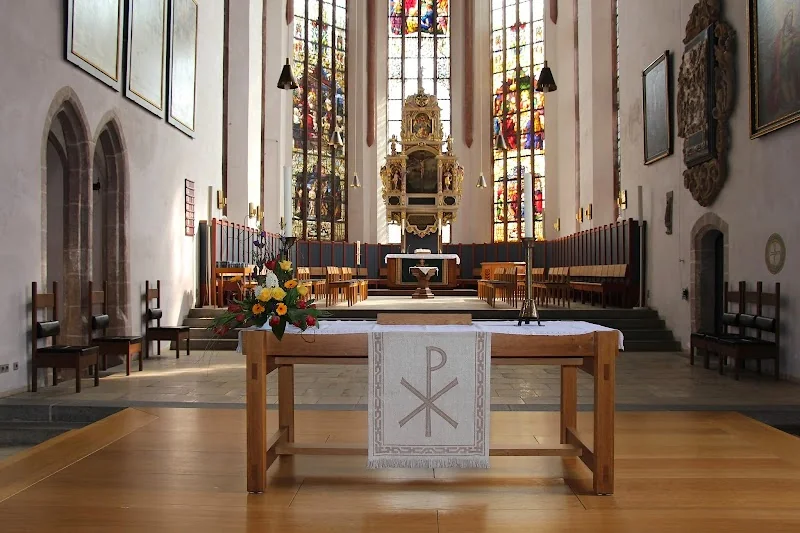
Inside, the stained glass windows and the altar primarily shape the effect of the space. The choir windows depicting Martin Luther, prophets, and evangelists were created in 1903 by the Munich court glass painter Franz Xaver Zettler. They bring colorful light moods into the church space and connect late Gothic architecture with a later, but very carefully embedded artistic design. Equally important is the altar from St. Gumbertus, attributed to the Renaissance sculptor Peter Flötner, which visibly incorporates influences from the Italian Renaissance. This creates an appealing stylistic contrast: medieval building body, reformatory imagery, and Renaissance elements meet in a single space. For visitors, this is particularly exciting because the church thus represents not only a historical shell but also a piece of art history. This mixture of architecture, light, and furnishings makes St. Johannis a place that one does not just pass through but consciously observes. ([stadtkirchen-ansbach-evangelisch.de](https://stadtkirchen-ansbach-evangelisch.de/raeume/kirche-st-johannis))
Organ, Bells, and Church Music
A significant feature of St. Johannis is its musical identity. On the gallery stands a Rieger organ built in 1962, which was revised by Mühleisen in 1991. The instrument is thus not an incidental accessory but part of a developed liturgical and musical tradition. Churches of this kind thrive on the connection between space and sound, and St. Johannis offers a fitting framework with its Gothic hall form. The official chronicle also refers to the oldest bell in Ansbach, which was created around 1400 and has the tone fis. After the world wars, this bell was moved to St. Gumbertus, while new bells were procured for St. Johannis, which ring in the Gloria motif d-e-g. Thus, a sonic renewal is shown that still respects the historical connection of the two inner-city churches. For visitors, this means: The church speaks not only with images and architecture but also with sound. Those who experience a service, a concert, or simply a quiet visit perceive the organ, the bells, and the acoustics as part of the overall effect. ([stadtkirchen-ansbach-evangelisch.de](https://stadtkirchen-ansbach-evangelisch.de/raeume/kirche-st-johannis))
This sound space also plays a role in the cultural life of the city. The city churches explicitly list St. Johannis as a place for services, concerts, and exhibitions; in this way, the church is regularly integrated into a program that goes beyond mere community operations. This makes St. Johannis particularly interesting for those looking for special concert venues or authentic spaces for sacred music. The combination of historical building substance, developed organ tradition, and active use creates a space where church music can be experienced not as a museum piece but as a living entity. Therefore, anyone searching for the keyword organ is not only looking for an instrument here but for an acoustic experience in a listed space with a long tradition. ([stadtkirchen-ansbach-evangelisch.de](https://stadtkirchen-ansbach-evangelisch.de/raeume/kirche-st-johannis))
Photos, Güllbrünnlein, and the Location at Martin-Luther-Platz
For photos, St. Johannis is particularly fruitful because the church offers several strong sightlines and striking details. The two differently designed towers, the clear hall architecture, the choir windows, and the entrance area create a varied motif that works both from close up and from a distance. The tourism site highlights St. Johannis as a highlight, sight, and religious place and describes it as part of a tour through Ansbach. The Güllbrünnlein on the south side of the church is also particularly photogenic. It commemorates Friedrich Wilhelm Güll, whose birthplace is opposite, and refers to his poem Pflaumenregen. Such connections between literature, city history, and church architecture add an additional narrative layer to the place. Therefore, anyone photographing St. Johannis captures not just a building but a piece of Ansbach's cultural history that connects architecture, poetry, and urban memory. ([tourismus-ansbach.de](https://www.tourismus-ansbach.de/detail/id%3D65007cabbd7d6e250d17fd12?utm_source=openai))
Together with St. Gumbertus, St. Johannis forms the Protestant inner-city community of Ansbach and thus belongs to an ensemble that shapes the historical identity of the city. Its location at Martin-Luther-Platz also makes the church an ideal starting or ending point for a walk through the old town. In the vicinity are other significant places such as the market, residence, and town hall, so that culture, history, and short distances can be very well connected. Those looking for a quiet yet meaningful destination will find in St. Johannis exactly this mix: a sacred space with historical depth, an attractive photo motif, and a place where one experiences the inner city of Ansbach from a particularly beautiful perspective. ([innenstadtkirchen-ansbach.de](https://innenstadtkirchen-ansbach.de/?utm_source=openai))
Sources:
Show moreShow less
St. Johannis Church Ansbach | History & Services
The St. Johannis Church in Ansbach is a place where city history, Protestant tradition, and a quiet yet open visitor experience come together. It is located at Martin-Luther-Platz 16 in the heart of the old town, making it an area that can be easily explored on foot. The city churches describe St. Johannis as part of the Protestant inner-city community; at the same time, the church is open daily from 09:00 to 17:00/18:00 at dusk and is accessible for people with disabilities. This makes it suitable not only for believers but also for travelers who wish to understand Ansbach through its most significant buildings. Particularly in conjunction with the town hall, market, and residence, the church has a special effect: it is not an isolated monument but a vibrant part of the cityscape and a central point of contact for all who wish to connect history, architecture, and tranquility. ([innenstadtkirchen-ansbach.de](https://innenstadtkirchen-ansbach.de/kirchen/))
History and Origin of St. Johannis Ansbach
The history of St. Johannis is closely linked to the development of Ansbach and reaches far back into the early history of the city. The official chronicle reminds us that the origin of the ecclesiastical center goes back to a Marian monastery at the confluence of the Rezat and Onoldsbach rivers. For St. Johannis itself, the parish names a probable founding time between 911 and 931 as well as the first documented mention in the year 1139. Particularly important is the expansion between 1410 and 1458, when the church was transformed into a Gothic hall church and consecrated in 1458. As early as 1436, St. Johannis became its own parish, establishing itself as a civic church for the city and the surrounding districts. The fact that the first Protestant service in Ansbach was celebrated here in 1525 further makes the church a symbolic place of the Reformation in the margraviate. From this sequence of monastic origin, late medieval expansion, parish foundation, and reformation history emerges a building that is not only architecturally but also historically of great significance for Ansbach. ([stadtkirchen-ansbach-evangelisch.de](https://stadtkirchen-ansbach-evangelisch.de/raeume/kirche-st-johannis))
Looking at its role within the city also shows why St. Johannis remains so present today. While St. Gumbertus has historically been shaped as a collegiate and later court church of the margraves, the tourism site describes St. Johannis as a civic parish church that emerged relatively uniformly in the 15th century. This civic character is precisely what makes it appealing: St. Johannis represents the faith, self-understanding, and culture of a city community, not courtly representation. The church has thus become a kind of identification place for the Ansbach inner-city community, whose church life remains visible there to this day. Anyone wanting to understand the history of the city will find in St. Johannis not a marginal aspect but a key to the historical core of Ansbach. ([tourismus-ansbach.de](https://www.tourismus-ansbach.de/ansbach-erleben/sehenswuerdigkeiten/sankt-johannis/sankt-johannis))
Directions, Parking, and Accessibility
For visitors, St. Johannis is very well integrated into the pathways of the Ansbach old town. The official tourism and church information lists the address as Martin-Luther-Platz 16, 91522 Ansbach; at the same time, the parish points out that the church is located in close proximity to the most important inner-city places. Those arriving by car can park in the riding arena of the residence palace or on the Rezat meadows, according to the church. The city of Ansbach specifies these hints with the known inner-city parking lots: The riding arena offers 79 parking spaces with a maximum parking duration of three hours, Rezatwiese East/Middle has 324 parking spaces with also three hours maximum parking duration, and Rezatwiese West offers 211 parking spaces with longer parking duration. For a visit to the church, this means: Practical parking options are also available in the city center, and short distances to the pedestrian zone make the location particularly attractive for spontaneous visits. Those additionally planning a city tour can easily combine St. Johannis with other sights of the old town. ([tourismus-ansbach.de](https://www.tourismus-ansbach.de/ansbach-erleben/sehenswuerdigkeiten/sankt-johannis/sankt-johannis))
Another advantage is the barrier-free accessibility. The tourism site explicitly lists St. Johannis as being accessible for people with disabilities, and the churches open their buildings daily from 09:00 to 17:00/18:00 for visitors. This makes the place open to different target groups: for community members, for those interested in cultural history, for older visitors, for families, and for people with limited mobility. Especially for a church located in a historic city center, this is a significant advantage. The combination of a central location, marked parking options, clear opening hours, and barrier-free access greatly facilitates planning. Those who do not just want to stop by briefly but want to consciously absorb the atmosphere will find good conditions for a relaxed and uncomplicated visit. ([innenstadtkirchen-ansbach.de](https://innenstadtkirchen-ansbach.de/kirchen/))
Services, Concerts, and Current Use
St. Johannis is not only a historically significant building but also an active parish church. The official church description emphasizes that services, concerts, and exhibitions take place here. Since 1436, St. Johannis has been an independent parish and civic church for the city and the surrounding districts; this long continuity shows that the space is still used liturgically and communally today. The homepage of the city churches also highlights that the inner-city community regularly offers services, devotions, concerts, educational programs, and various community activities. For visitors, this means: St. Johannis is not a decommissioned monument but a place with an ongoing program where religious practice and cultural events intertwine. Those interested in services will find connections there just as much as those who want to learn about the church's cultural life. The combination of spiritual function and public accessibility is a central characteristic of the church and explains why it remains relevant for both locals and guests alike. ([stadtkirchen-ansbach-evangelisch.de](https://stadtkirchen-ansbach-evangelisch.de/raeume/kirche-st-johannis))
That the use is not only theoretical but currently taking place is shown by the church's schedule. For June 2026, among other things, a service for the old town festival, midday prayers, and further services at St. Johannis are listed. Such entries make it clear that the church is in rhythm with the life of the city and community and does not only play a role during special anniversaries. The proximity to city festivals and musical formats particularly emphasizes how strongly the place is connected to life in Ansbach. Therefore, anyone planning a visit will not only experience architecture but also a space where city, faith, and music regularly meet. This lively use is one of the reasons why St. Johannis continues to evoke strong interest: people are not only looking for history but also for programs, uses, and current dates. ([innenstadtkirchen-ansbach.de](https://innenstadtkirchen-ansbach.de/gottesdienste/?utm_source=openai))
Architecture, Stained Glass Windows, and Flötner Altar
Architecturally, St. Johannis is one of the most impressive church buildings in the Ansbach old town. The church is described as a three-nave pseudo-basilica or stepped hall and was built in the 15th century during a relatively uniform construction phase. The space thus appears clear and balanced, without the architectural breaks that are known from many city churches that have changed over centuries. Particularly characteristic are the two towers, which differ in form and origin. The south tower belongs to an older phase and has a ribbed vault on the ground floor, while the north tower is richly structured with a net vault and stair tower and was only completed in 1508. Additionally, there is the choir building with the foundation stone laid in 1441 and the late medieval consecration of 1458. On the buttresses, there are canopies with statues; part of the original figures and supplementary copies have been preserved to this day. These details make it clear that St. Johannis can be read not only as a space but also as a consciously designed work of art in which construction, tracery, and sculpture work closely together. ([stadtkirchen-ansbach-evangelisch.de](https://stadtkirchen-ansbach-evangelisch.de/raeume/kirche-st-johannis))
Inside, the stained glass windows and the altar primarily shape the effect of the space. The choir windows depicting Martin Luther, prophets, and evangelists were created in 1903 by the Munich court glass painter Franz Xaver Zettler. They bring colorful light moods into the church space and connect late Gothic architecture with a later, but very carefully embedded artistic design. Equally important is the altar from St. Gumbertus, attributed to the Renaissance sculptor Peter Flötner, which visibly incorporates influences from the Italian Renaissance. This creates an appealing stylistic contrast: medieval building body, reformatory imagery, and Renaissance elements meet in a single space. For visitors, this is particularly exciting because the church thus represents not only a historical shell but also a piece of art history. This mixture of architecture, light, and furnishings makes St. Johannis a place that one does not just pass through but consciously observes. ([stadtkirchen-ansbach-evangelisch.de](https://stadtkirchen-ansbach-evangelisch.de/raeume/kirche-st-johannis))
Organ, Bells, and Church Music
A significant feature of St. Johannis is its musical identity. On the gallery stands a Rieger organ built in 1962, which was revised by Mühleisen in 1991. The instrument is thus not an incidental accessory but part of a developed liturgical and musical tradition. Churches of this kind thrive on the connection between space and sound, and St. Johannis offers a fitting framework with its Gothic hall form. The official chronicle also refers to the oldest bell in Ansbach, which was created around 1400 and has the tone fis. After the world wars, this bell was moved to St. Gumbertus, while new bells were procured for St. Johannis, which ring in the Gloria motif d-e-g. Thus, a sonic renewal is shown that still respects the historical connection of the two inner-city churches. For visitors, this means: The church speaks not only with images and architecture but also with sound. Those who experience a service, a concert, or simply a quiet visit perceive the organ, the bells, and the acoustics as part of the overall effect. ([stadtkirchen-ansbach-evangelisch.de](https://stadtkirchen-ansbach-evangelisch.de/raeume/kirche-st-johannis))
This sound space also plays a role in the cultural life of the city. The city churches explicitly list St. Johannis as a place for services, concerts, and exhibitions; in this way, the church is regularly integrated into a program that goes beyond mere community operations. This makes St. Johannis particularly interesting for those looking for special concert venues or authentic spaces for sacred music. The combination of historical building substance, developed organ tradition, and active use creates a space where church music can be experienced not as a museum piece but as a living entity. Therefore, anyone searching for the keyword organ is not only looking for an instrument here but for an acoustic experience in a listed space with a long tradition. ([stadtkirchen-ansbach-evangelisch.de](https://stadtkirchen-ansbach-evangelisch.de/raeume/kirche-st-johannis))
Photos, Güllbrünnlein, and the Location at Martin-Luther-Platz
For photos, St. Johannis is particularly fruitful because the church offers several strong sightlines and striking details. The two differently designed towers, the clear hall architecture, the choir windows, and the entrance area create a varied motif that works both from close up and from a distance. The tourism site highlights St. Johannis as a highlight, sight, and religious place and describes it as part of a tour through Ansbach. The Güllbrünnlein on the south side of the church is also particularly photogenic. It commemorates Friedrich Wilhelm Güll, whose birthplace is opposite, and refers to his poem Pflaumenregen. Such connections between literature, city history, and church architecture add an additional narrative layer to the place. Therefore, anyone photographing St. Johannis captures not just a building but a piece of Ansbach's cultural history that connects architecture, poetry, and urban memory. ([tourismus-ansbach.de](https://www.tourismus-ansbach.de/detail/id%3D65007cabbd7d6e250d17fd12?utm_source=openai))
Together with St. Gumbertus, St. Johannis forms the Protestant inner-city community of Ansbach and thus belongs to an ensemble that shapes the historical identity of the city. Its location at Martin-Luther-Platz also makes the church an ideal starting or ending point for a walk through the old town. In the vicinity are other significant places such as the market, residence, and town hall, so that culture, history, and short distances can be very well connected. Those looking for a quiet yet meaningful destination will find in St. Johannis exactly this mix: a sacred space with historical depth, an attractive photo motif, and a place where one experiences the inner city of Ansbach from a particularly beautiful perspective. ([innenstadtkirchen-ansbach.de](https://innenstadtkirchen-ansbach.de/?utm_source=openai))
Sources:
St. Johannis Church Ansbach | History & Services
The St. Johannis Church in Ansbach is a place where city history, Protestant tradition, and a quiet yet open visitor experience come together. It is located at Martin-Luther-Platz 16 in the heart of the old town, making it an area that can be easily explored on foot. The city churches describe St. Johannis as part of the Protestant inner-city community; at the same time, the church is open daily from 09:00 to 17:00/18:00 at dusk and is accessible for people with disabilities. This makes it suitable not only for believers but also for travelers who wish to understand Ansbach through its most significant buildings. Particularly in conjunction with the town hall, market, and residence, the church has a special effect: it is not an isolated monument but a vibrant part of the cityscape and a central point of contact for all who wish to connect history, architecture, and tranquility. ([innenstadtkirchen-ansbach.de](https://innenstadtkirchen-ansbach.de/kirchen/))
History and Origin of St. Johannis Ansbach
The history of St. Johannis is closely linked to the development of Ansbach and reaches far back into the early history of the city. The official chronicle reminds us that the origin of the ecclesiastical center goes back to a Marian monastery at the confluence of the Rezat and Onoldsbach rivers. For St. Johannis itself, the parish names a probable founding time between 911 and 931 as well as the first documented mention in the year 1139. Particularly important is the expansion between 1410 and 1458, when the church was transformed into a Gothic hall church and consecrated in 1458. As early as 1436, St. Johannis became its own parish, establishing itself as a civic church for the city and the surrounding districts. The fact that the first Protestant service in Ansbach was celebrated here in 1525 further makes the church a symbolic place of the Reformation in the margraviate. From this sequence of monastic origin, late medieval expansion, parish foundation, and reformation history emerges a building that is not only architecturally but also historically of great significance for Ansbach. ([stadtkirchen-ansbach-evangelisch.de](https://stadtkirchen-ansbach-evangelisch.de/raeume/kirche-st-johannis))
Looking at its role within the city also shows why St. Johannis remains so present today. While St. Gumbertus has historically been shaped as a collegiate and later court church of the margraves, the tourism site describes St. Johannis as a civic parish church that emerged relatively uniformly in the 15th century. This civic character is precisely what makes it appealing: St. Johannis represents the faith, self-understanding, and culture of a city community, not courtly representation. The church has thus become a kind of identification place for the Ansbach inner-city community, whose church life remains visible there to this day. Anyone wanting to understand the history of the city will find in St. Johannis not a marginal aspect but a key to the historical core of Ansbach. ([tourismus-ansbach.de](https://www.tourismus-ansbach.de/ansbach-erleben/sehenswuerdigkeiten/sankt-johannis/sankt-johannis))
Directions, Parking, and Accessibility
For visitors, St. Johannis is very well integrated into the pathways of the Ansbach old town. The official tourism and church information lists the address as Martin-Luther-Platz 16, 91522 Ansbach; at the same time, the parish points out that the church is located in close proximity to the most important inner-city places. Those arriving by car can park in the riding arena of the residence palace or on the Rezat meadows, according to the church. The city of Ansbach specifies these hints with the known inner-city parking lots: The riding arena offers 79 parking spaces with a maximum parking duration of three hours, Rezatwiese East/Middle has 324 parking spaces with also three hours maximum parking duration, and Rezatwiese West offers 211 parking spaces with longer parking duration. For a visit to the church, this means: Practical parking options are also available in the city center, and short distances to the pedestrian zone make the location particularly attractive for spontaneous visits. Those additionally planning a city tour can easily combine St. Johannis with other sights of the old town. ([tourismus-ansbach.de](https://www.tourismus-ansbach.de/ansbach-erleben/sehenswuerdigkeiten/sankt-johannis/sankt-johannis))
Another advantage is the barrier-free accessibility. The tourism site explicitly lists St. Johannis as being accessible for people with disabilities, and the churches open their buildings daily from 09:00 to 17:00/18:00 for visitors. This makes the place open to different target groups: for community members, for those interested in cultural history, for older visitors, for families, and for people with limited mobility. Especially for a church located in a historic city center, this is a significant advantage. The combination of a central location, marked parking options, clear opening hours, and barrier-free access greatly facilitates planning. Those who do not just want to stop by briefly but want to consciously absorb the atmosphere will find good conditions for a relaxed and uncomplicated visit. ([innenstadtkirchen-ansbach.de](https://innenstadtkirchen-ansbach.de/kirchen/))
Services, Concerts, and Current Use
St. Johannis is not only a historically significant building but also an active parish church. The official church description emphasizes that services, concerts, and exhibitions take place here. Since 1436, St. Johannis has been an independent parish and civic church for the city and the surrounding districts; this long continuity shows that the space is still used liturgically and communally today. The homepage of the city churches also highlights that the inner-city community regularly offers services, devotions, concerts, educational programs, and various community activities. For visitors, this means: St. Johannis is not a decommissioned monument but a place with an ongoing program where religious practice and cultural events intertwine. Those interested in services will find connections there just as much as those who want to learn about the church's cultural life. The combination of spiritual function and public accessibility is a central characteristic of the church and explains why it remains relevant for both locals and guests alike. ([stadtkirchen-ansbach-evangelisch.de](https://stadtkirchen-ansbach-evangelisch.de/raeume/kirche-st-johannis))
That the use is not only theoretical but currently taking place is shown by the church's schedule. For June 2026, among other things, a service for the old town festival, midday prayers, and further services at St. Johannis are listed. Such entries make it clear that the church is in rhythm with the life of the city and community and does not only play a role during special anniversaries. The proximity to city festivals and musical formats particularly emphasizes how strongly the place is connected to life in Ansbach. Therefore, anyone planning a visit will not only experience architecture but also a space where city, faith, and music regularly meet. This lively use is one of the reasons why St. Johannis continues to evoke strong interest: people are not only looking for history but also for programs, uses, and current dates. ([innenstadtkirchen-ansbach.de](https://innenstadtkirchen-ansbach.de/gottesdienste/?utm_source=openai))
Architecture, Stained Glass Windows, and Flötner Altar
Architecturally, St. Johannis is one of the most impressive church buildings in the Ansbach old town. The church is described as a three-nave pseudo-basilica or stepped hall and was built in the 15th century during a relatively uniform construction phase. The space thus appears clear and balanced, without the architectural breaks that are known from many city churches that have changed over centuries. Particularly characteristic are the two towers, which differ in form and origin. The south tower belongs to an older phase and has a ribbed vault on the ground floor, while the north tower is richly structured with a net vault and stair tower and was only completed in 1508. Additionally, there is the choir building with the foundation stone laid in 1441 and the late medieval consecration of 1458. On the buttresses, there are canopies with statues; part of the original figures and supplementary copies have been preserved to this day. These details make it clear that St. Johannis can be read not only as a space but also as a consciously designed work of art in which construction, tracery, and sculpture work closely together. ([stadtkirchen-ansbach-evangelisch.de](https://stadtkirchen-ansbach-evangelisch.de/raeume/kirche-st-johannis))
Inside, the stained glass windows and the altar primarily shape the effect of the space. The choir windows depicting Martin Luther, prophets, and evangelists were created in 1903 by the Munich court glass painter Franz Xaver Zettler. They bring colorful light moods into the church space and connect late Gothic architecture with a later, but very carefully embedded artistic design. Equally important is the altar from St. Gumbertus, attributed to the Renaissance sculptor Peter Flötner, which visibly incorporates influences from the Italian Renaissance. This creates an appealing stylistic contrast: medieval building body, reformatory imagery, and Renaissance elements meet in a single space. For visitors, this is particularly exciting because the church thus represents not only a historical shell but also a piece of art history. This mixture of architecture, light, and furnishings makes St. Johannis a place that one does not just pass through but consciously observes. ([stadtkirchen-ansbach-evangelisch.de](https://stadtkirchen-ansbach-evangelisch.de/raeume/kirche-st-johannis))
Organ, Bells, and Church Music
A significant feature of St. Johannis is its musical identity. On the gallery stands a Rieger organ built in 1962, which was revised by Mühleisen in 1991. The instrument is thus not an incidental accessory but part of a developed liturgical and musical tradition. Churches of this kind thrive on the connection between space and sound, and St. Johannis offers a fitting framework with its Gothic hall form. The official chronicle also refers to the oldest bell in Ansbach, which was created around 1400 and has the tone fis. After the world wars, this bell was moved to St. Gumbertus, while new bells were procured for St. Johannis, which ring in the Gloria motif d-e-g. Thus, a sonic renewal is shown that still respects the historical connection of the two inner-city churches. For visitors, this means: The church speaks not only with images and architecture but also with sound. Those who experience a service, a concert, or simply a quiet visit perceive the organ, the bells, and the acoustics as part of the overall effect. ([stadtkirchen-ansbach-evangelisch.de](https://stadtkirchen-ansbach-evangelisch.de/raeume/kirche-st-johannis))
This sound space also plays a role in the cultural life of the city. The city churches explicitly list St. Johannis as a place for services, concerts, and exhibitions; in this way, the church is regularly integrated into a program that goes beyond mere community operations. This makes St. Johannis particularly interesting for those looking for special concert venues or authentic spaces for sacred music. The combination of historical building substance, developed organ tradition, and active use creates a space where church music can be experienced not as a museum piece but as a living entity. Therefore, anyone searching for the keyword organ is not only looking for an instrument here but for an acoustic experience in a listed space with a long tradition. ([stadtkirchen-ansbach-evangelisch.de](https://stadtkirchen-ansbach-evangelisch.de/raeume/kirche-st-johannis))
Photos, Güllbrünnlein, and the Location at Martin-Luther-Platz
For photos, St. Johannis is particularly fruitful because the church offers several strong sightlines and striking details. The two differently designed towers, the clear hall architecture, the choir windows, and the entrance area create a varied motif that works both from close up and from a distance. The tourism site highlights St. Johannis as a highlight, sight, and religious place and describes it as part of a tour through Ansbach. The Güllbrünnlein on the south side of the church is also particularly photogenic. It commemorates Friedrich Wilhelm Güll, whose birthplace is opposite, and refers to his poem Pflaumenregen. Such connections between literature, city history, and church architecture add an additional narrative layer to the place. Therefore, anyone photographing St. Johannis captures not just a building but a piece of Ansbach's cultural history that connects architecture, poetry, and urban memory. ([tourismus-ansbach.de](https://www.tourismus-ansbach.de/detail/id%3D65007cabbd7d6e250d17fd12?utm_source=openai))
Together with St. Gumbertus, St. Johannis forms the Protestant inner-city community of Ansbach and thus belongs to an ensemble that shapes the historical identity of the city. Its location at Martin-Luther-Platz also makes the church an ideal starting or ending point for a walk through the old town. In the vicinity are other significant places such as the market, residence, and town hall, so that culture, history, and short distances can be very well connected. Those looking for a quiet yet meaningful destination will find in St. Johannis exactly this mix: a sacred space with historical depth, an attractive photo motif, and a place where one experiences the inner city of Ansbach from a particularly beautiful perspective. ([innenstadtkirchen-ansbach.de](https://innenstadtkirchen-ansbach.de/?utm_source=openai))
Sources:
Upcoming Events
No events found
Frequently Asked Questions
Reviews
david antoun
18. September 2024
gothic medieval church with two towers. the interior has parts that date back to the 18th century. the organ is the newly added piece. monuments of war victims and a fountain featuring a poem are attached to the church's wall.
Juan Pablo Flores
11. May 2026
No signs of opening at any time on a normal Monday before 17:00 and no opening hours posted anywhere. What a spit in the face for believers, pilgrims, and travelers from around the world!
Marek Słomianowski
16. July 2022
Near the church of St. Gumbertus, at Martin Luther Square, stands proudly with its uneven towers the church of St. John the Baptist. According to tradition, the first temple was erected here around 1139 by the then bishop of Würzburg. The current temple dates back to the second decade of the 15th century. It was built by masters E. Embhart and N. Esler the Younger from soft sandstone, giving it the shape of a three-nave pseudo-basilica. The main nave was vaulted in 1435, and it was probably at that time that the construction of the lower church tower was completed and the first of the bells was hung. The construction of the presbytery dragged on for several more years, and the church was finally consecrated in 1458. The higher of the towers, the northern one, was built until 1508. Then came the Reformation, and the margraves sided with the teachings of Martin Luther. Thus, St. John's Church became a congregation and remains so to this day. Under the rich net vault, few art monuments have survived. A small side altar from 1522, attributed to P. Flotner, a few epitaphs, remnants of old frescoes, that’s about it. On the wall of the northern tower, a relief commemorating the fallen in the Great War 1914-1918 was placed. Below it is a plaque with the dates 1939-1945, what for German soldiers, but somehow I can't look at such memorabilia without a feeling of discomfort. As is often the case in Bavaria, the shape of the church is more interesting than its interior.
Michael von Ferrari
3. September 2018
In my opinion, from the inside, it belongs to the rather boring gothic churches I've seen so far. Exception: The ceiling structure, highly interesting. See photos.
Werner Röder
13. February 2020
Worthseeing gothic hall church....we were lucky to hear the organist during rehearsal...great acoustics