
Ansbach
Platenstraße 18, 91522 Ansbach, Deutschland
Kaspar-Hauser-Memorial | Hofgarten & Access
The Kaspar-Hauser-Memorial is one of the most well-known memorial sites in Ansbach and connects history, urban landscape, and garden art in a compact space. It is located on Platenstraße and is presented by the city of Ansbach as a distinctive image motif; at the same time, it is situated in an environment where the Hofgarten, the residence, and other Kaspar-Hauser sites are closely grouped together. Those who pass by here experience not just a single memorial, but a whole historical context of memory culture, walking paths, and Ansbach's urban history. Because the location is so central, it can easily be incorporated into a short walk through the old town or a more extensive cultural stroll. This makes the memorial equally interesting for visitors specifically seeking Kaspar Hauser and for people who want to get to know Ansbach through its sights. ([ansbach.de](https://www.ansbach.de/media/custom/2595_1421_1.PDF))
Where is the Kaspar-Hauser-Memorial located in Ansbach?
The location of the memorial is particularly convenient for visitors as it stands in the middle of the historic city area and is not in a hard-to-reach edge area. Platenstraße is one of the central axes of the city center, and the official cultural guide of the city directly points to the Kaspar-Hauser-Memorial as a fixed part of the Ansbach sightseeing tour. For visitors, this means: The way to the memorial is not a detour but almost automatically fits into a walk between the old town, Hofgarten, and the residence area. This proximity makes the place so attractive because it can be visited without significant organizational effort while simultaneously connecting several historical reference points. ([ansbach.de](https://www.ansbach.de/media/custom/2595_1421_1.PDF))
Even in the larger cityscape, the location has a clear function. Ansbach regularly emphasizes the historical and cultural goals of the city on its homepage, including the Kaspar-Hauser-Memorial, the Hofgarten, and the Orangerie. This means that the memorial is not perceived as an isolated object but as part of an urban memory space that directs attention to the history of the residence and to Kaspar Hauser's life path. Thus, approaching the memorial means moving in an environment where history does not seem abstract but remains visible in public space. This is particularly helpful for first-time visitors, as the place can easily be combined with other destinations and provides an immediate sense of the historical topography of Ansbach. ([ansbach.de](https://www.ansbach.de/?utm_source=openai))
Why the Hofgarten is the right place for the memorial
The Hofgarten is not only a beautiful backdrop for the Kaspar-Hauser-Memorial but also a contextually fitting framework. The Bavarian Palace Administration describes the Hofgarten as part of the Ansbach residence with an Orangerie, a forecourt, and a clear main axis; the park was largely created between 1726 and 1743. The garden itself is therefore a historical place where the residence city makes its Baroque past visible to this day. Those who walk here encounter not just a memorial but a whole park ensemble consisting of architectural order, plant culture, and memory. The Kaspar-Hauser-Memorial logically fits into this structure as it expands the historical depth of the Hofgarten with a personal and simultaneously mythical level. ([schloesser.bayern.de](https://www.schloesser.bayern.de/deutsch/garten/objekte/ansbach.htm?utm_source=openai))
It is particularly important that the Hofgarten in Ansbach is not merely decorative but is described as a place of tranquility, thought, and memory. The Palace Administration emphasizes that memorials and plaques here commemorate Leonhart Fuchs, Johann Peter Uz, Baron von Benkendorff, and Kaspar Hauser. This gives the visit a very clear historical context: the park is a kind of open-air narrative of the city’s history. Additionally, the Hofgarten is freely accessible and is regularly used by the city for guided tours and cultural offerings. This is precisely why the Kaspar-Hauser-Memorial is so effectively placed here. It is not a random art object but part of a vibrant memory space that connects historical themes, walking, and urban experience. ([schloesser.bayern.de](https://www.schloesser.bayern.de/deutsch/garten/objekte/ansbach.htm?utm_source=openai))
Bronze figures, inscription, and origin of the memorial
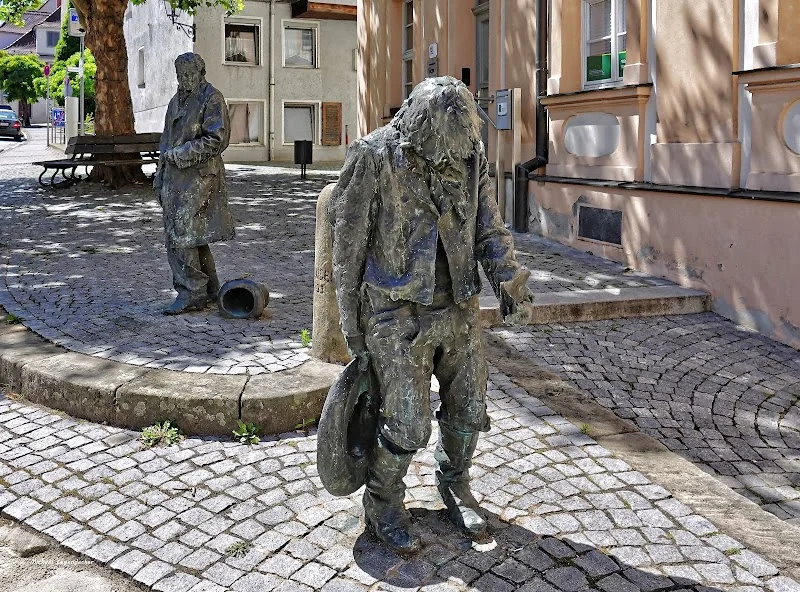
The Kaspar-Hauser-Memorial was created in 1981 based on an idea by Waldemar Fritsch by the artist Friedrich Schelle. The city description makes it clear that the bronze figures depict Kaspar Hauser at two moments in his life: once as a young figure at his appearance in 1828 in Nuremberg and once as an adult Hauser in the clothing of an honorable man of his time, as he was lured into the Hofgarten on December 14, 1833. This doubling is the core of the artistic statement. The memorial does not simply tell a biographical station but a whole life story in the tension between mystery, public life, and tragic end. For visitors, this is particularly impressive because the sculpture immediately makes visible how much Kaspar Hauser has become a figure between reality and myth. ([ansbach.de](https://www.ansbach.de/media/custom/2595_1421_1.PDF))
The origin story itself is also remarkable because it makes civic engagement visible. The two bronze figures were donated by the Ansbach Lions Club, which contributed to the renovation of the old town and to memory culture. On the milestone between the figures is a leaf-shaped bronze plate with a Schiller inscription that emphasizes the human claim and dignity of the individual. The exact wording does not need to be the focus of the visit; what matters more is the effect: the memorial connects literary language, sculpture, and historical interpretation. This creates not a loud monument but a quiet, contemplative sign that invites the viewer to consider the various interpretations of Kaspar Hauser's life. This complexity explains why the memorial has remained so present to this day. ([ansbach.de](https://www.ansbach.de/media/custom/2595_1421_1.PDF))
Photo spot and city walk around Platenstraße, Orangerie, and old town
The Kaspar-Hauser-Memorial is particularly appealing for photos because multiple image layers come together here. The bronze figures appear very three-dimensional in interplay with the historic cityscape, and the Hofgarten provides a clear, calm background with its axes, the forecourt, and the Orangerie. The Bavarian Palace Administration describes the Hofgarten as a facility with Baroque structure, summer container plants, and changing planting, which gives the place a different appearance depending on the season. Therefore, those who photograph the memorial find not just a single motif but a whole walk full of contrasts: art against greenery, memorial against garden, personal history against urban architecture. This is one of the reasons why the place works so well for short, spontaneous photo stops. ([schloesser.bayern.de](https://www.schloesser.bayern.de/deutsch/garten/objekte/ansbach.htm?utm_source=openai))
Another advantage is the proximity to other Ansbach stations. The Hofgarten borders the residence and the Orangerie, which today is not only historically important but also a popular event venue. Additionally, the Markgrafenmuseum with its Kaspar-Hauser department is located at Kaspar-Hauser-Platz 1 and complements the memorial very well in content, as documents, objects, and background information about the history of Kaspar Hauser are displayed there. The city also refers to the Kaspar-Hauser-Festspiele, which will take place in 2026 with around 30 events, combining lectures, theater, music, and visual arts. Therefore, those who start with the memorial motif can easily expand their visit into a small cultural walk. This is precisely what makes the area around Platenstraße, Hofgarten, and old town so interesting: it is compact, historically dense, and very photogenic. ([ansbach.de](https://www.ansbach.de/B%C3%BCrger/Wissen-Bildung/Stadtb%C3%BCcherei/index.php?FID=2595.13.1&La=1&ModID=9&NavID=2595.153&object=tx%7C2595.2&utm_source=openai))
Access, parking, and practical tips for the visit
Getting to the Kaspar-Hauser-Memorial is relatively uncomplicated due to its location in the city center. The city of Ansbach informs that there are currently more than 4,000 parking spaces available in various price categories in the city center. For the area around Platenstraße, it is particularly relevant that it belongs to Zone 3; there, limited parking times apply, and the fees are clearly displayed at the main parking lots in the city. This is important for visitors because it allows the visit to the memorial to be easily combined with a short city walk, a Hofgarten tour, or a detour to the Orangerie. Those who have little time will find practical options in the city center without having to walk long distances to the center. ([ansbach.de](https://www.ansbach.de/B%C3%BCrger/%C3%96PNV-Verkehr/Parken?utm_source=openai))
Additionally, the city offers mobile parking, making spontaneous visits even easier. It is also practical that parking in Ansbach is free on Sundays and public holidays, and the city center is structured so that many destinations remain within walking distance. Therefore, a simple triad is worthwhile for planning the visit: first, view the memorial, then walk through the Hofgarten, and finally complement the old town or the Markgrafenmuseum. Those who want to take photos should consciously take some time, as the effect of the place arises not only from the monument itself but also from the surroundings of paths, green spaces, and historical sightlines. For a peaceful visit, morning or later afternoon hours are often pleasant, as the city walk then feels particularly relaxed. Thus, the visit becomes not just a mere stopover but a small, well-planned cultural moment in Ansbach. ([ansbach.de](https://www.ansbach.de/B%C3%BCrger/%C3%96PNV-Verkehr/Parken?utm_source=openai))
Sources:
Show moreShow less
Kaspar-Hauser-Memorial | Hofgarten & Access
The Kaspar-Hauser-Memorial is one of the most well-known memorial sites in Ansbach and connects history, urban landscape, and garden art in a compact space. It is located on Platenstraße and is presented by the city of Ansbach as a distinctive image motif; at the same time, it is situated in an environment where the Hofgarten, the residence, and other Kaspar-Hauser sites are closely grouped together. Those who pass by here experience not just a single memorial, but a whole historical context of memory culture, walking paths, and Ansbach's urban history. Because the location is so central, it can easily be incorporated into a short walk through the old town or a more extensive cultural stroll. This makes the memorial equally interesting for visitors specifically seeking Kaspar Hauser and for people who want to get to know Ansbach through its sights. ([ansbach.de](https://www.ansbach.de/media/custom/2595_1421_1.PDF))
Where is the Kaspar-Hauser-Memorial located in Ansbach?
The location of the memorial is particularly convenient for visitors as it stands in the middle of the historic city area and is not in a hard-to-reach edge area. Platenstraße is one of the central axes of the city center, and the official cultural guide of the city directly points to the Kaspar-Hauser-Memorial as a fixed part of the Ansbach sightseeing tour. For visitors, this means: The way to the memorial is not a detour but almost automatically fits into a walk between the old town, Hofgarten, and the residence area. This proximity makes the place so attractive because it can be visited without significant organizational effort while simultaneously connecting several historical reference points. ([ansbach.de](https://www.ansbach.de/media/custom/2595_1421_1.PDF))
Even in the larger cityscape, the location has a clear function. Ansbach regularly emphasizes the historical and cultural goals of the city on its homepage, including the Kaspar-Hauser-Memorial, the Hofgarten, and the Orangerie. This means that the memorial is not perceived as an isolated object but as part of an urban memory space that directs attention to the history of the residence and to Kaspar Hauser's life path. Thus, approaching the memorial means moving in an environment where history does not seem abstract but remains visible in public space. This is particularly helpful for first-time visitors, as the place can easily be combined with other destinations and provides an immediate sense of the historical topography of Ansbach. ([ansbach.de](https://www.ansbach.de/?utm_source=openai))
Why the Hofgarten is the right place for the memorial
The Hofgarten is not only a beautiful backdrop for the Kaspar-Hauser-Memorial but also a contextually fitting framework. The Bavarian Palace Administration describes the Hofgarten as part of the Ansbach residence with an Orangerie, a forecourt, and a clear main axis; the park was largely created between 1726 and 1743. The garden itself is therefore a historical place where the residence city makes its Baroque past visible to this day. Those who walk here encounter not just a memorial but a whole park ensemble consisting of architectural order, plant culture, and memory. The Kaspar-Hauser-Memorial logically fits into this structure as it expands the historical depth of the Hofgarten with a personal and simultaneously mythical level. ([schloesser.bayern.de](https://www.schloesser.bayern.de/deutsch/garten/objekte/ansbach.htm?utm_source=openai))
It is particularly important that the Hofgarten in Ansbach is not merely decorative but is described as a place of tranquility, thought, and memory. The Palace Administration emphasizes that memorials and plaques here commemorate Leonhart Fuchs, Johann Peter Uz, Baron von Benkendorff, and Kaspar Hauser. This gives the visit a very clear historical context: the park is a kind of open-air narrative of the city’s history. Additionally, the Hofgarten is freely accessible and is regularly used by the city for guided tours and cultural offerings. This is precisely why the Kaspar-Hauser-Memorial is so effectively placed here. It is not a random art object but part of a vibrant memory space that connects historical themes, walking, and urban experience. ([schloesser.bayern.de](https://www.schloesser.bayern.de/deutsch/garten/objekte/ansbach.htm?utm_source=openai))
Bronze figures, inscription, and origin of the memorial
The Kaspar-Hauser-Memorial was created in 1981 based on an idea by Waldemar Fritsch by the artist Friedrich Schelle. The city description makes it clear that the bronze figures depict Kaspar Hauser at two moments in his life: once as a young figure at his appearance in 1828 in Nuremberg and once as an adult Hauser in the clothing of an honorable man of his time, as he was lured into the Hofgarten on December 14, 1833. This doubling is the core of the artistic statement. The memorial does not simply tell a biographical station but a whole life story in the tension between mystery, public life, and tragic end. For visitors, this is particularly impressive because the sculpture immediately makes visible how much Kaspar Hauser has become a figure between reality and myth. ([ansbach.de](https://www.ansbach.de/media/custom/2595_1421_1.PDF))
The origin story itself is also remarkable because it makes civic engagement visible. The two bronze figures were donated by the Ansbach Lions Club, which contributed to the renovation of the old town and to memory culture. On the milestone between the figures is a leaf-shaped bronze plate with a Schiller inscription that emphasizes the human claim and dignity of the individual. The exact wording does not need to be the focus of the visit; what matters more is the effect: the memorial connects literary language, sculpture, and historical interpretation. This creates not a loud monument but a quiet, contemplative sign that invites the viewer to consider the various interpretations of Kaspar Hauser's life. This complexity explains why the memorial has remained so present to this day. ([ansbach.de](https://www.ansbach.de/media/custom/2595_1421_1.PDF))
Photo spot and city walk around Platenstraße, Orangerie, and old town
The Kaspar-Hauser-Memorial is particularly appealing for photos because multiple image layers come together here. The bronze figures appear very three-dimensional in interplay with the historic cityscape, and the Hofgarten provides a clear, calm background with its axes, the forecourt, and the Orangerie. The Bavarian Palace Administration describes the Hofgarten as a facility with Baroque structure, summer container plants, and changing planting, which gives the place a different appearance depending on the season. Therefore, those who photograph the memorial find not just a single motif but a whole walk full of contrasts: art against greenery, memorial against garden, personal history against urban architecture. This is one of the reasons why the place works so well for short, spontaneous photo stops. ([schloesser.bayern.de](https://www.schloesser.bayern.de/deutsch/garten/objekte/ansbach.htm?utm_source=openai))
Another advantage is the proximity to other Ansbach stations. The Hofgarten borders the residence and the Orangerie, which today is not only historically important but also a popular event venue. Additionally, the Markgrafenmuseum with its Kaspar-Hauser department is located at Kaspar-Hauser-Platz 1 and complements the memorial very well in content, as documents, objects, and background information about the history of Kaspar Hauser are displayed there. The city also refers to the Kaspar-Hauser-Festspiele, which will take place in 2026 with around 30 events, combining lectures, theater, music, and visual arts. Therefore, those who start with the memorial motif can easily expand their visit into a small cultural walk. This is precisely what makes the area around Platenstraße, Hofgarten, and old town so interesting: it is compact, historically dense, and very photogenic. ([ansbach.de](https://www.ansbach.de/B%C3%BCrger/Wissen-Bildung/Stadtb%C3%BCcherei/index.php?FID=2595.13.1&La=1&ModID=9&NavID=2595.153&object=tx%7C2595.2&utm_source=openai))
Access, parking, and practical tips for the visit
Getting to the Kaspar-Hauser-Memorial is relatively uncomplicated due to its location in the city center. The city of Ansbach informs that there are currently more than 4,000 parking spaces available in various price categories in the city center. For the area around Platenstraße, it is particularly relevant that it belongs to Zone 3; there, limited parking times apply, and the fees are clearly displayed at the main parking lots in the city. This is important for visitors because it allows the visit to the memorial to be easily combined with a short city walk, a Hofgarten tour, or a detour to the Orangerie. Those who have little time will find practical options in the city center without having to walk long distances to the center. ([ansbach.de](https://www.ansbach.de/B%C3%BCrger/%C3%96PNV-Verkehr/Parken?utm_source=openai))
Additionally, the city offers mobile parking, making spontaneous visits even easier. It is also practical that parking in Ansbach is free on Sundays and public holidays, and the city center is structured so that many destinations remain within walking distance. Therefore, a simple triad is worthwhile for planning the visit: first, view the memorial, then walk through the Hofgarten, and finally complement the old town or the Markgrafenmuseum. Those who want to take photos should consciously take some time, as the effect of the place arises not only from the monument itself but also from the surroundings of paths, green spaces, and historical sightlines. For a peaceful visit, morning or later afternoon hours are often pleasant, as the city walk then feels particularly relaxed. Thus, the visit becomes not just a mere stopover but a small, well-planned cultural moment in Ansbach. ([ansbach.de](https://www.ansbach.de/B%C3%BCrger/%C3%96PNV-Verkehr/Parken?utm_source=openai))
Sources:
Kaspar-Hauser-Memorial | Hofgarten & Access
The Kaspar-Hauser-Memorial is one of the most well-known memorial sites in Ansbach and connects history, urban landscape, and garden art in a compact space. It is located on Platenstraße and is presented by the city of Ansbach as a distinctive image motif; at the same time, it is situated in an environment where the Hofgarten, the residence, and other Kaspar-Hauser sites are closely grouped together. Those who pass by here experience not just a single memorial, but a whole historical context of memory culture, walking paths, and Ansbach's urban history. Because the location is so central, it can easily be incorporated into a short walk through the old town or a more extensive cultural stroll. This makes the memorial equally interesting for visitors specifically seeking Kaspar Hauser and for people who want to get to know Ansbach through its sights. ([ansbach.de](https://www.ansbach.de/media/custom/2595_1421_1.PDF))
Where is the Kaspar-Hauser-Memorial located in Ansbach?
The location of the memorial is particularly convenient for visitors as it stands in the middle of the historic city area and is not in a hard-to-reach edge area. Platenstraße is one of the central axes of the city center, and the official cultural guide of the city directly points to the Kaspar-Hauser-Memorial as a fixed part of the Ansbach sightseeing tour. For visitors, this means: The way to the memorial is not a detour but almost automatically fits into a walk between the old town, Hofgarten, and the residence area. This proximity makes the place so attractive because it can be visited without significant organizational effort while simultaneously connecting several historical reference points. ([ansbach.de](https://www.ansbach.de/media/custom/2595_1421_1.PDF))
Even in the larger cityscape, the location has a clear function. Ansbach regularly emphasizes the historical and cultural goals of the city on its homepage, including the Kaspar-Hauser-Memorial, the Hofgarten, and the Orangerie. This means that the memorial is not perceived as an isolated object but as part of an urban memory space that directs attention to the history of the residence and to Kaspar Hauser's life path. Thus, approaching the memorial means moving in an environment where history does not seem abstract but remains visible in public space. This is particularly helpful for first-time visitors, as the place can easily be combined with other destinations and provides an immediate sense of the historical topography of Ansbach. ([ansbach.de](https://www.ansbach.de/?utm_source=openai))
Why the Hofgarten is the right place for the memorial
The Hofgarten is not only a beautiful backdrop for the Kaspar-Hauser-Memorial but also a contextually fitting framework. The Bavarian Palace Administration describes the Hofgarten as part of the Ansbach residence with an Orangerie, a forecourt, and a clear main axis; the park was largely created between 1726 and 1743. The garden itself is therefore a historical place where the residence city makes its Baroque past visible to this day. Those who walk here encounter not just a memorial but a whole park ensemble consisting of architectural order, plant culture, and memory. The Kaspar-Hauser-Memorial logically fits into this structure as it expands the historical depth of the Hofgarten with a personal and simultaneously mythical level. ([schloesser.bayern.de](https://www.schloesser.bayern.de/deutsch/garten/objekte/ansbach.htm?utm_source=openai))
It is particularly important that the Hofgarten in Ansbach is not merely decorative but is described as a place of tranquility, thought, and memory. The Palace Administration emphasizes that memorials and plaques here commemorate Leonhart Fuchs, Johann Peter Uz, Baron von Benkendorff, and Kaspar Hauser. This gives the visit a very clear historical context: the park is a kind of open-air narrative of the city’s history. Additionally, the Hofgarten is freely accessible and is regularly used by the city for guided tours and cultural offerings. This is precisely why the Kaspar-Hauser-Memorial is so effectively placed here. It is not a random art object but part of a vibrant memory space that connects historical themes, walking, and urban experience. ([schloesser.bayern.de](https://www.schloesser.bayern.de/deutsch/garten/objekte/ansbach.htm?utm_source=openai))
Bronze figures, inscription, and origin of the memorial
The Kaspar-Hauser-Memorial was created in 1981 based on an idea by Waldemar Fritsch by the artist Friedrich Schelle. The city description makes it clear that the bronze figures depict Kaspar Hauser at two moments in his life: once as a young figure at his appearance in 1828 in Nuremberg and once as an adult Hauser in the clothing of an honorable man of his time, as he was lured into the Hofgarten on December 14, 1833. This doubling is the core of the artistic statement. The memorial does not simply tell a biographical station but a whole life story in the tension between mystery, public life, and tragic end. For visitors, this is particularly impressive because the sculpture immediately makes visible how much Kaspar Hauser has become a figure between reality and myth. ([ansbach.de](https://www.ansbach.de/media/custom/2595_1421_1.PDF))
The origin story itself is also remarkable because it makes civic engagement visible. The two bronze figures were donated by the Ansbach Lions Club, which contributed to the renovation of the old town and to memory culture. On the milestone between the figures is a leaf-shaped bronze plate with a Schiller inscription that emphasizes the human claim and dignity of the individual. The exact wording does not need to be the focus of the visit; what matters more is the effect: the memorial connects literary language, sculpture, and historical interpretation. This creates not a loud monument but a quiet, contemplative sign that invites the viewer to consider the various interpretations of Kaspar Hauser's life. This complexity explains why the memorial has remained so present to this day. ([ansbach.de](https://www.ansbach.de/media/custom/2595_1421_1.PDF))
Photo spot and city walk around Platenstraße, Orangerie, and old town
The Kaspar-Hauser-Memorial is particularly appealing for photos because multiple image layers come together here. The bronze figures appear very three-dimensional in interplay with the historic cityscape, and the Hofgarten provides a clear, calm background with its axes, the forecourt, and the Orangerie. The Bavarian Palace Administration describes the Hofgarten as a facility with Baroque structure, summer container plants, and changing planting, which gives the place a different appearance depending on the season. Therefore, those who photograph the memorial find not just a single motif but a whole walk full of contrasts: art against greenery, memorial against garden, personal history against urban architecture. This is one of the reasons why the place works so well for short, spontaneous photo stops. ([schloesser.bayern.de](https://www.schloesser.bayern.de/deutsch/garten/objekte/ansbach.htm?utm_source=openai))
Another advantage is the proximity to other Ansbach stations. The Hofgarten borders the residence and the Orangerie, which today is not only historically important but also a popular event venue. Additionally, the Markgrafenmuseum with its Kaspar-Hauser department is located at Kaspar-Hauser-Platz 1 and complements the memorial very well in content, as documents, objects, and background information about the history of Kaspar Hauser are displayed there. The city also refers to the Kaspar-Hauser-Festspiele, which will take place in 2026 with around 30 events, combining lectures, theater, music, and visual arts. Therefore, those who start with the memorial motif can easily expand their visit into a small cultural walk. This is precisely what makes the area around Platenstraße, Hofgarten, and old town so interesting: it is compact, historically dense, and very photogenic. ([ansbach.de](https://www.ansbach.de/B%C3%BCrger/Wissen-Bildung/Stadtb%C3%BCcherei/index.php?FID=2595.13.1&La=1&ModID=9&NavID=2595.153&object=tx%7C2595.2&utm_source=openai))
Access, parking, and practical tips for the visit
Getting to the Kaspar-Hauser-Memorial is relatively uncomplicated due to its location in the city center. The city of Ansbach informs that there are currently more than 4,000 parking spaces available in various price categories in the city center. For the area around Platenstraße, it is particularly relevant that it belongs to Zone 3; there, limited parking times apply, and the fees are clearly displayed at the main parking lots in the city. This is important for visitors because it allows the visit to the memorial to be easily combined with a short city walk, a Hofgarten tour, or a detour to the Orangerie. Those who have little time will find practical options in the city center without having to walk long distances to the center. ([ansbach.de](https://www.ansbach.de/B%C3%BCrger/%C3%96PNV-Verkehr/Parken?utm_source=openai))
Additionally, the city offers mobile parking, making spontaneous visits even easier. It is also practical that parking in Ansbach is free on Sundays and public holidays, and the city center is structured so that many destinations remain within walking distance. Therefore, a simple triad is worthwhile for planning the visit: first, view the memorial, then walk through the Hofgarten, and finally complement the old town or the Markgrafenmuseum. Those who want to take photos should consciously take some time, as the effect of the place arises not only from the monument itself but also from the surroundings of paths, green spaces, and historical sightlines. For a peaceful visit, morning or later afternoon hours are often pleasant, as the city walk then feels particularly relaxed. Thus, the visit becomes not just a mere stopover but a small, well-planned cultural moment in Ansbach. ([ansbach.de](https://www.ansbach.de/B%C3%BCrger/%C3%96PNV-Verkehr/Parken?utm_source=openai))
Sources:
Upcoming Events
No events found
Frequently Asked Questions
Reviews
Mike Stuchbery
22. November 2023
A very touching memorial to one of the most enigmatic figures in German history.
Ouroboros
28. October 2025
It's quite a successful ensemble. The figures depicted are well modeled after the known historical images. For a person who is quite controversial, it's a worthy memorial. The person is said to have spent his childhood in a dungeon in the Oberpfalz, near the border to Franconia, and was a disowned prince from Baden.
Andre Hoffmann
3. January 2026
Nice ensemble. However, the place has nothing to do with Kaspar Hauser. The inscription refers to the now-disproven hereditary prince theory, which suggests that Hauser was a prince from the House of Baden who was swapped as a baby to help a cadet branch to the throne. A relation of Hauser to the House of Baden has now been ruled out by genetic testing.
Frank Pieper
23. October 2025
Unfortunately a bit lacking in meaning. The story of Kaspar Hauser, on the other hand, is very interesting and still mysterious. You definitely should read the book by Jakob Wassermann.
Alex einfach nur Alex
4. October 2023
Unfortunately, the plaque on the pillar is hardly legible.