Ev.-Luth. Heilig-Kreuz-Kirche
(36 Reviews)

Ansbach

Heilig-Kreuz-Straße 35, 91522 Ansbach, Deutschland

Ev.-Luth. Heilig-Kreuz-Kirche | Photos & History

The Heilig-Kreuz-Kirche in Ansbach is a place where city history, faith, and memory come together in a small space. The Evangelical Lutheran congregation describes its church as a vibrant community with services, events, groups, and pastoral care. At the same time, the virtual tour points out that it is a small hall church located at the city cemetery in the southern part of Ansbach, offering more than just a classic church space with its Gothic portal, epitaphs, artworks, and a room of silence. Therefore, those looking for impressions, history, and practical information will find a church here with a clear identity and much historical depth. The location at the city cemetery is also significant, as the church and cemetery together form an ensemble that has been important to Ansbach for centuries. This connection makes the Heilig-Kreuz-Kirche interesting for visitors, congregation members, and for those seeking a quiet, historically rich place in the city. ([heiligkreuz-ansbach.de](https://heiligkreuz-ansbach.de/?utm_source=openai))

History of the Heilig-Kreuz-Kirche in Ansbach

The history of the Heilig-Kreuz-Kirche dates back to the 15th century. The cornerstone with the date June 14, 1461 is still embedded in the south wall of the church; the church was completed in 1478. The congregation describes its origin as a pilgrimage chapel that was built outside the city walls of the time. From here, the people of Ansbach went on pilgrimages, and the path was symbolically connected to the Passion of Jesus. The exact connection to the Stations of the Cross in Jerusalem was part of the original idea to create the chapel as a place of devotion and reflection. The brief history also makes it clear that the church initially belonged to the parish of St. Johannis and was later used as a pilgrimage chapel and finally as a cemetery church. After 1522, it served as a cemetery church after the Johannis cemetery was moved outside the city gates due to the danger of epidemics. Thus, the small chapel gradually became a place where the spiritual life of the city was connected to dealing with death and burial. ([heiligkreuz-ansbach.de](https://heiligkreuz-ansbach.de/geschichte-unserer-kirche/))

Over the centuries, the Heilig-Kreuz-Kirche has been altered and reinterpreted several times. The congregation mentions expansions in 1564 and 1607, a baroque interior from 1623 or 1624, and the reconstruction in the 19th century in the neo-Gothic style by city architect Weiß. The brief history also notes that in 1860 a neo-Gothic altar with sacristy and altar furnishings by the Ansbach painter Friedrich Bischoff was created, that the pulpit and gallery were added in 1868, and that the Weigle organ is mentioned in 1981. The later section of church history shows further renovations in 1950 and 1988, as well as the rededication as a cemetery church before the church became a parish church in 1992. This development is particularly interesting for visitors because it explains why historical layers remain visible in the church: Gothic basic form, baroque and neo-Gothic elements, memorial signs of cemetery use, and at the same time the current role as a parish church. The Heilig-Kreuz-Kirche is thus not a static monument but a building that has responded to the religious and urban changes in Ansbach over centuries. ([heiligkreuz-ansbach.de](https://heiligkreuz-ansbach.de/geschichte-unserer-kirche/))

Tour of the Hall Church, the Altarpiece, and the Artworks

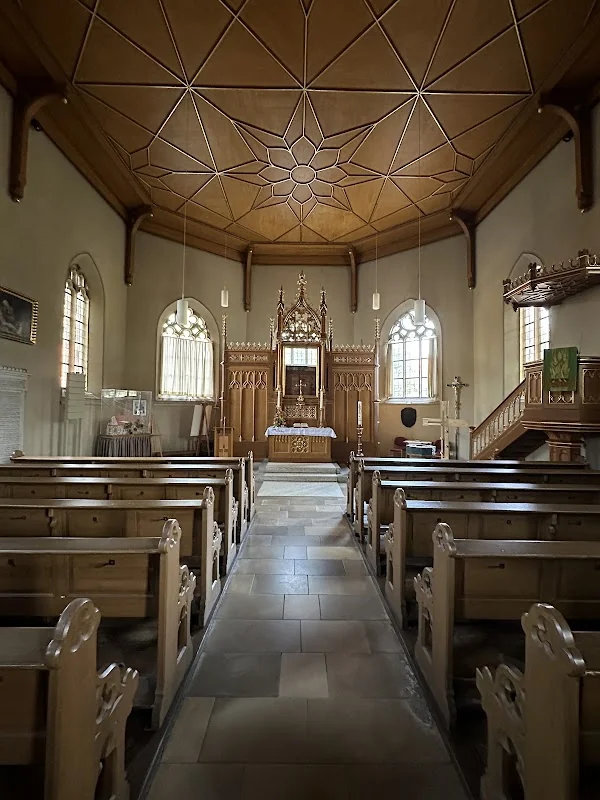
The virtual tour of the congregation makes it clear how distinctively the Heilig-Kreuz-Kirche appears architecturally. Upon entering the church, one passes through a Gothic portal adorned with tracery. The congregation explicitly describes the building as a small hall church and explains that churches are generally oriented towards the east. Accordingly, the altar area is located in the east, while the tower and the entrance hall under the organ gallery are situated in the west. Inside, the first things that stand out are the images and epitaphs on the walls, which are typical for a cemetery church. The differently designed tracery windows in the Gothic style and the memorial plaques for the fallen of the Franco-Prussian War of 1870/71 are also described. These first impressions already show that the church is not only shaped by its history but also by its consciously readable spatial arrangement. Visitors encounter a sacred space that connects theology, memory, and architecture. This fits well with what many expect when searching for photos and impressions of the church: a historical interior with clear details and an atmosphere that promotes calm and attention. ([heiligkreuz-ansbach.de](https://heiligkreuz-ansbach.de/geschichte-unserer-kirche/rundgang/))

Particularly defining is the decoration of the altar area. The altar wall was designed by Franz Herterich in the Gothic style and richly adorned with gilded ornaments and carvings; the star-shaped ornamented wooden ceiling is also attributed to him. The altarpiece is by Georg Friedrich Bischoff from Ansbach and depicts a resurrected and blessing Christ. The altar is described as the center of the table fellowship with Christ, adorned with a white cloth, candles, and flowers. A processional cross stands against the wall, used during burials and ceremonial entries. The baptismal font was adapted to the style of the church and created by Reinhart Fuchs; the silver baptismal bowl bears the fish symbol of early Christians, which the congregation explains with the Greek confession Ichthys. The tour also mentions a room of silence and prayer in the west wall, where light can be lit. Under the organ gallery is a large baroque cross, presumably from the workshop of Georg Brenck. These details make the church particularly valuable for the tour, as they are not only beautiful to look at but also remain theologically and art-historically readable. ([heiligkreuz-ansbach.de](https://heiligkreuz-ansbach.de/geschichte-unserer-kirche/rundgang/))

City Cemetery Ansbach and the Culture of Remembrance Surrounding Heilig Kreuz

The Heilig-Kreuz-Kirche cannot be understood without the city cemetery. The website of the city cemetery describes the cemetery at Heilig Kreuz as one of the most beautiful burial grounds in Bavaria. It also states that the cemetery carries almost 500 years of city history within it and, with its crypts, inscriptions, and graves, is one of the most significant places of remembrance in Ansbach. The church itself is located in close proximity to this cemetery and has been used as a cemetery church for centuries. The city cemetery project also explains the origin of the site: After a plague epidemic and the prohibition of further burials in the city, a new cemetery was established outside the walls. Subsequently, the well-known crypt square was created, which was later planned by Johann David Steingruber. Today, numerous traces of local history are still visible in the city cemetery, and the congregation emphasizes that inscriptions on gravestones and in the church ensure that the lives of many Ansbach citizens do not fade into oblivion. This creates a cultural space around Heilig Kreuz where religious, historical, and biographical levels come together. ([stadtfriedhof-ansbach.de](https://www.stadtfriedhof-ansbach.de/der-friedhof/))

This culture of remembrance is also practically experienced by visitors. The tourist city tour program of the city of Ansbach names the Heilig-Kreuz-Kirche as a meeting point for a tour that deals with the city cemetery and the crypt square. The program explicitly points out that the ensemble is among the most beautiful cemeteries in Bavaria and that the structural design there was created by Johann David Steingruber. The city cemetery is thus not only a quiet area but also part of the active communication of city history. Therefore, those who come to the Heilig-Kreuz-Kirche today encounter a starting point for historical tours, a place of devotion, and a space of collective memory. The fact that well-known names such as Kaspar Hauser, Johann Peter Uz, Johann Christian von Schmaltz, or Krafft Graf von Crailsheim are mentioned in the cemetery further underscores the significance of the site. For inquiries about photos, history, and special places in Ansbach, this combination of church, cemetery, and city history is particularly relevant, as it forms an unusually dense and well-documented ensemble. ([tourismus-ansbach.de](https://www.tourismus-ansbach.de/fileadmin/user_upload/PDFs/Ansbach_Stadtfuehrungen-2025_WEB.pdf))

Services, Confirmation, Weddings, and Funerals

The Heilig-Kreuz-Kirchengemeinde sees itself as an active community with clear offerings for various life situations. On the homepage, it invites to services on Sunday mornings and to other events. The page on confirmation explains that the instruction is organized as a one-and-a-half-year course. In the first year, the confirmands meet from the beginning of the new school year until the parish festival in the following year every Wednesday from 5:00 PM to 6:00 PM; in the second year, the confirmation group meets once a month on a Saturday morning until the confirmation. The confirmation itself always takes place in the congregation on the Sunday of Jubilate. Additionally, the navigation structure of the website shows that the congregation offers many groups and formats, including storytelling café, parent-child group, folklore dance meeting, church choir, confirmation group, and preparatory group. This makes it clear that Heilig Kreuz is not only a historical building but also a place with a vibrant community life and broad participation from different generations. ([heiligkreuz-ansbach.de](https://heiligkreuz-ansbach.de/?utm_source=openai))

For weddings and funerals, the congregation's pages also provide concrete information. Regarding weddings, the congregation states that it focuses on the service for marriage, the blessing, and the support of the couple; it is also noted that due to personnel reasons, no external weddings can be accepted on some weekends during school holidays. In describing funerals, the congregation depicts the burial as an interplay of service and action at the grave, where mourning, lamentation, and hope for resurrection are given space together. The texts make it clear that Heilig Kreuz is there for people in important life phases and that the church is used not only for Sunday services but also for transitions, farewells, and family celebrations. This practical dimension is particularly relevant for the user intention behind the search queries: those searching for the church often look not only for architecture but also for contacts, rituals, dates, and the question of what actually takes place at this location. The congregation's pages respond to this with concrete, easily findable information. ([heiligkreuz-ansbach.de](https://heiligkreuz-ansbach.de/lebensstufen/trauung/?utm_source=openai))

Address, Directions, and Parking at Heilig-Kreuz-Kirche

For practical planning, the location of the church is clear: The Heilig-Kreuz-Kirche is located at Heilig-Kreuz-Straße 35, 91522 Ansbach. The tourist entry of the city explicitly mentions this address and also refers to its location at the city cemetery. The congregation itself provides the parish office at Welserstr. 3, 91522 Ansbach; there, Pastor Hermann Spingler can be reached by phone at 0981 / 9 62 62 and by email at Pfarramt.Ansbach-Heilig-Kreuz@elkb.de. For visitors, this combination is useful as it clarifies the difference between the church location and the parish office. The church is located in the southern part of Ansbach and thus in an area closely connected to the city cemetery. Therefore, anyone planning a visit, a wedding, a funeral, or a community event has reliable orientation with the official information. The Heilig-Kreuz-Kirche is thus not a hard-to-find individual location but a clearly named point in the urban structure of Ansbach. ([tourismus-ansbach.de](https://www.tourismus-ansbach.de/detail/id%3D6a61c26ef4a4848106f13b82))

Regarding parking, the city of Ansbach provides additional helpful information. The barrier-free city map designates three disabled parking spaces in the area of Heilig-Kreuz-Straße or the city cemetery. For the city center, the city also mentions its public parking system, which includes the parking garage at Mühlbach and the parking garage at the train station. Therefore, those arriving by car can orient themselves to the city's parking offerings while also considering the proximity to the cemetery and church area. The fact that the city lists the Heilig Kreuz area separately in its barrier-free directory shows the practical importance of the site for visitors with mobility needs. Additionally, it is important for orientation on-site that the church lies in the context of the city cemetery and the southern city center. This provides a realistic picture for the approach: The Heilig-Kreuz-Kirche is well embedded in the city, clearly findable via the official address, and well planned with city information on parking and accessibility. ([ansbach.de](https://www.ansbach.de/media/custom/2595_3708_1.PDF?1618478063=&La=1&NavID=2595.117))

Sources:

Mehr anzeigen

Ev.-Luth. Heilig-Kreuz-Kirche | Photos & History

The Heilig-Kreuz-Kirche in Ansbach is a place where city history, faith, and memory come together in a small space. The Evangelical Lutheran congregation describes its church as a vibrant community with services, events, groups, and pastoral care. At the same time, the virtual tour points out that it is a small hall church located at the city cemetery in the southern part of Ansbach, offering more than just a classic church space with its Gothic portal, epitaphs, artworks, and a room of silence. Therefore, those looking for impressions, history, and practical information will find a church here with a clear identity and much historical depth. The location at the city cemetery is also significant, as the church and cemetery together form an ensemble that has been important to Ansbach for centuries. This connection makes the Heilig-Kreuz-Kirche interesting for visitors, congregation members, and for those seeking a quiet, historically rich place in the city. ([heiligkreuz-ansbach.de](https://heiligkreuz-ansbach.de/?utm_source=openai))

History of the Heilig-Kreuz-Kirche in Ansbach

The history of the Heilig-Kreuz-Kirche dates back to the 15th century. The cornerstone with the date June 14, 1461 is still embedded in the south wall of the church; the church was completed in 1478. The congregation describes its origin as a pilgrimage chapel that was built outside the city walls of the time. From here, the people of Ansbach went on pilgrimages, and the path was symbolically connected to the Passion of Jesus. The exact connection to the Stations of the Cross in Jerusalem was part of the original idea to create the chapel as a place of devotion and reflection. The brief history also makes it clear that the church initially belonged to the parish of St. Johannis and was later used as a pilgrimage chapel and finally as a cemetery church. After 1522, it served as a cemetery church after the Johannis cemetery was moved outside the city gates due to the danger of epidemics. Thus, the small chapel gradually became a place where the spiritual life of the city was connected to dealing with death and burial. ([heiligkreuz-ansbach.de](https://heiligkreuz-ansbach.de/geschichte-unserer-kirche/))

Over the centuries, the Heilig-Kreuz-Kirche has been altered and reinterpreted several times. The congregation mentions expansions in 1564 and 1607, a baroque interior from 1623 or 1624, and the reconstruction in the 19th century in the neo-Gothic style by city architect Weiß. The brief history also notes that in 1860 a neo-Gothic altar with sacristy and altar furnishings by the Ansbach painter Friedrich Bischoff was created, that the pulpit and gallery were added in 1868, and that the Weigle organ is mentioned in 1981. The later section of church history shows further renovations in 1950 and 1988, as well as the rededication as a cemetery church before the church became a parish church in 1992. This development is particularly interesting for visitors because it explains why historical layers remain visible in the church: Gothic basic form, baroque and neo-Gothic elements, memorial signs of cemetery use, and at the same time the current role as a parish church. The Heilig-Kreuz-Kirche is thus not a static monument but a building that has responded to the religious and urban changes in Ansbach over centuries. ([heiligkreuz-ansbach.de](https://heiligkreuz-ansbach.de/geschichte-unserer-kirche/))

Tour of the Hall Church, the Altarpiece, and the Artworks

The virtual tour of the congregation makes it clear how distinctively the Heilig-Kreuz-Kirche appears architecturally. Upon entering the church, one passes through a Gothic portal adorned with tracery. The congregation explicitly describes the building as a small hall church and explains that churches are generally oriented towards the east. Accordingly, the altar area is located in the east, while the tower and the entrance hall under the organ gallery are situated in the west. Inside, the first things that stand out are the images and epitaphs on the walls, which are typical for a cemetery church. The differently designed tracery windows in the Gothic style and the memorial plaques for the fallen of the Franco-Prussian War of 1870/71 are also described. These first impressions already show that the church is not only shaped by its history but also by its consciously readable spatial arrangement. Visitors encounter a sacred space that connects theology, memory, and architecture. This fits well with what many expect when searching for photos and impressions of the church: a historical interior with clear details and an atmosphere that promotes calm and attention. ([heiligkreuz-ansbach.de](https://heiligkreuz-ansbach.de/geschichte-unserer-kirche/rundgang/))

Particularly defining is the decoration of the altar area. The altar wall was designed by Franz Herterich in the Gothic style and richly adorned with gilded ornaments and carvings; the star-shaped ornamented wooden ceiling is also attributed to him. The altarpiece is by Georg Friedrich Bischoff from Ansbach and depicts a resurrected and blessing Christ. The altar is described as the center of the table fellowship with Christ, adorned with a white cloth, candles, and flowers. A processional cross stands against the wall, used during burials and ceremonial entries. The baptismal font was adapted to the style of the church and created by Reinhart Fuchs; the silver baptismal bowl bears the fish symbol of early Christians, which the congregation explains with the Greek confession Ichthys. The tour also mentions a room of silence and prayer in the west wall, where light can be lit. Under the organ gallery is a large baroque cross, presumably from the workshop of Georg Brenck. These details make the church particularly valuable for the tour, as they are not only beautiful to look at but also remain theologically and art-historically readable. ([heiligkreuz-ansbach.de](https://heiligkreuz-ansbach.de/geschichte-unserer-kirche/rundgang/))

City Cemetery Ansbach and the Culture of Remembrance Surrounding Heilig Kreuz

The Heilig-Kreuz-Kirche cannot be understood without the city cemetery. The website of the city cemetery describes the cemetery at Heilig Kreuz as one of the most beautiful burial grounds in Bavaria. It also states that the cemetery carries almost 500 years of city history within it and, with its crypts, inscriptions, and graves, is one of the most significant places of remembrance in Ansbach. The church itself is located in close proximity to this cemetery and has been used as a cemetery church for centuries. The city cemetery project also explains the origin of the site: After a plague epidemic and the prohibition of further burials in the city, a new cemetery was established outside the walls. Subsequently, the well-known crypt square was created, which was later planned by Johann David Steingruber. Today, numerous traces of local history are still visible in the city cemetery, and the congregation emphasizes that inscriptions on gravestones and in the church ensure that the lives of many Ansbach citizens do not fade into oblivion. This creates a cultural space around Heilig Kreuz where religious, historical, and biographical levels come together. ([stadtfriedhof-ansbach.de](https://www.stadtfriedhof-ansbach.de/der-friedhof/))

This culture of remembrance is also practically experienced by visitors. The tourist city tour program of the city of Ansbach names the Heilig-Kreuz-Kirche as a meeting point for a tour that deals with the city cemetery and the crypt square. The program explicitly points out that the ensemble is among the most beautiful cemeteries in Bavaria and that the structural design there was created by Johann David Steingruber. The city cemetery is thus not only a quiet area but also part of the active communication of city history. Therefore, those who come to the Heilig-Kreuz-Kirche today encounter a starting point for historical tours, a place of devotion, and a space of collective memory. The fact that well-known names such as Kaspar Hauser, Johann Peter Uz, Johann Christian von Schmaltz, or Krafft Graf von Crailsheim are mentioned in the cemetery further underscores the significance of the site. For inquiries about photos, history, and special places in Ansbach, this combination of church, cemetery, and city history is particularly relevant, as it forms an unusually dense and well-documented ensemble. ([tourismus-ansbach.de](https://www.tourismus-ansbach.de/fileadmin/user_upload/PDFs/Ansbach_Stadtfuehrungen-2025_WEB.pdf))

Services, Confirmation, Weddings, and Funerals

The Heilig-Kreuz-Kirchengemeinde sees itself as an active community with clear offerings for various life situations. On the homepage, it invites to services on Sunday mornings and to other events. The page on confirmation explains that the instruction is organized as a one-and-a-half-year course. In the first year, the confirmands meet from the beginning of the new school year until the parish festival in the following year every Wednesday from 5:00 PM to 6:00 PM; in the second year, the confirmation group meets once a month on a Saturday morning until the confirmation. The confirmation itself always takes place in the congregation on the Sunday of Jubilate. Additionally, the navigation structure of the website shows that the congregation offers many groups and formats, including storytelling café, parent-child group, folklore dance meeting, church choir, confirmation group, and preparatory group. This makes it clear that Heilig Kreuz is not only a historical building but also a place with a vibrant community life and broad participation from different generations. ([heiligkreuz-ansbach.de](https://heiligkreuz-ansbach.de/?utm_source=openai))

For weddings and funerals, the congregation's pages also provide concrete information. Regarding weddings, the congregation states that it focuses on the service for marriage, the blessing, and the support of the couple; it is also noted that due to personnel reasons, no external weddings can be accepted on some weekends during school holidays. In describing funerals, the congregation depicts the burial as an interplay of service and action at the grave, where mourning, lamentation, and hope for resurrection are given space together. The texts make it clear that Heilig Kreuz is there for people in important life phases and that the church is used not only for Sunday services but also for transitions, farewells, and family celebrations. This practical dimension is particularly relevant for the user intention behind the search queries: those searching for the church often look not only for architecture but also for contacts, rituals, dates, and the question of what actually takes place at this location. The congregation's pages respond to this with concrete, easily findable information. ([heiligkreuz-ansbach.de](https://heiligkreuz-ansbach.de/lebensstufen/trauung/?utm_source=openai))

Address, Directions, and Parking at Heilig-Kreuz-Kirche

For practical planning, the location of the church is clear: The Heilig-Kreuz-Kirche is located at Heilig-Kreuz-Straße 35, 91522 Ansbach. The tourist entry of the city explicitly mentions this address and also refers to its location at the city cemetery. The congregation itself provides the parish office at Welserstr. 3, 91522 Ansbach; there, Pastor Hermann Spingler can be reached by phone at 0981 / 9 62 62 and by email at Pfarramt.Ansbach-Heilig-Kreuz@elkb.de. For visitors, this combination is useful as it clarifies the difference between the church location and the parish office. The church is located in the southern part of Ansbach and thus in an area closely connected to the city cemetery. Therefore, anyone planning a visit, a wedding, a funeral, or a community event has reliable orientation with the official information. The Heilig-Kreuz-Kirche is thus not a hard-to-find individual location but a clearly named point in the urban structure of Ansbach. ([tourismus-ansbach.de](https://www.tourismus-ansbach.de/detail/id%3D6a61c26ef4a4848106f13b82))

Regarding parking, the city of Ansbach provides additional helpful information. The barrier-free city map designates three disabled parking spaces in the area of Heilig-Kreuz-Straße or the city cemetery. For the city center, the city also mentions its public parking system, which includes the parking garage at Mühlbach and the parking garage at the train station. Therefore, those arriving by car can orient themselves to the city's parking offerings while also considering the proximity to the cemetery and church area. The fact that the city lists the Heilig Kreuz area separately in its barrier-free directory shows the practical importance of the site for visitors with mobility needs. Additionally, it is important for orientation on-site that the church lies in the context of the city cemetery and the southern city center. This provides a realistic picture for the approach: The Heilig-Kreuz-Kirche is well embedded in the city, clearly findable via the official address, and well planned with city information on parking and accessibility. ([ansbach.de](https://www.ansbach.de/media/custom/2595_3708_1.PDF?1618478063=&La=1&NavID=2595.117))

Sources:

Upcoming Events

No events found

Frequently Asked Questions

Reviews

HC

Holger Cran

3. October 2019

The grave of my father, whom I unfortunately lost far too early. I can't go there often for emotional reasons. I need to inquire tomorrow about a marble slab to cover the grave, which is missing and I miss him a lot. I never really had a role model.

KR

Kerstin Rumpke

11. June 2022

By the way, Kaspar Hauser is buried at this place! Many old crypts, interesting to look at!

AL

Alex

7. November 2021

In 1461, the foundation stone for a pilgrimage chapel was laid. When the space for burials in the old town of Ansbach was no longer sufficient in the 16th century, it was also used as a cemetery church from 1564. Over the following times, there were always renovations. Interesting: The church tower clock was donated in 1760 by Margravine Friederike Luise. She was the daughter of the Prussian King Friedrich Wilhelm I. (Soldier King) and sister of King Friedrich II. (Frederick the Great).

SL

Sabine Lierhammer

4. May 2022

Beautiful little church. Unfortunately, I was there for a sad occasion. The cemetery next to it is definitely worth a visit.

WL

Willi Löffler

15. June 2022

A place for reflection, for a conversation with God or with Pastor Spingler. Pastor Spingler is a dedicated pastor and does it really well. He is close to the people, simply great 🙏👌