
Ansbach
91522 Ansbach, Germany
Anscavallo | Horse Sculpture & Castle Square
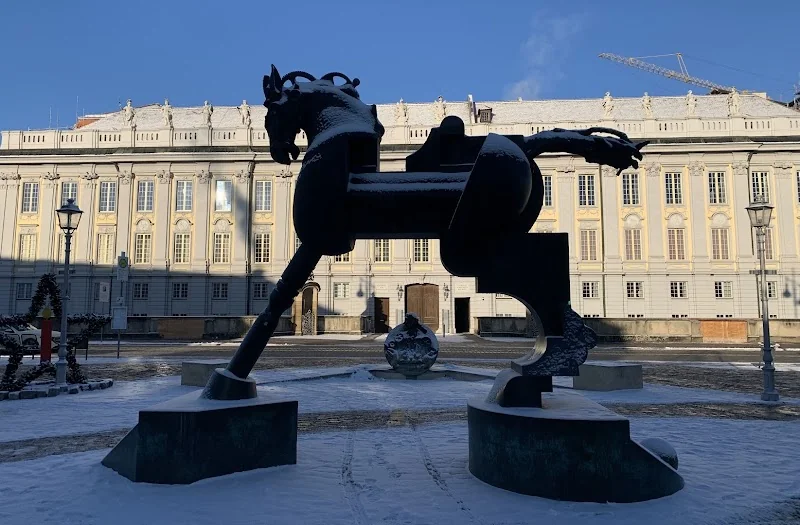
Anscavallo is much more than a single art object in public space: The horse sculpture at Castle Square in Ansbach is a distinctive landmark, a much-discussed city symbol, and at the same time a fixed part of the historical ensemble in front of the residence. Those searching for Anscavallo Ansbach, for images of Anscavallo Ansbach, or for the horse sculpture at Castle Square will find a work that has visibly contributed to the character of the city center since 1993. The official tourism website describes the sculpture as a bronze horse by Jürgen Goertz and emphasizes that it has become an integral part of the cityscape. The city of Ansbach also regularly uses the location as a meeting point for tours and events. ([tourismus-ansbach.de](https://www.tourismus-ansbach.de/detail/id%3D64f9b4211bebef2ffcb2fe6f))
Horse Sculpture Anscavallo in Ansbach: Origin, Impact, and Recognition
The story of Anscavallo begins with an artistic intervention in a particularly sensitive urban environment. The work was installed at Castle Square in 1993 and created by Jürgen Goertz. Early on, the sculpture sparked conversation because it breaks with the traditional notion of a horse and does not fit into classical monument forms. This is precisely what makes it appealing: it combines materiality, humor, irritation, and self-confidence. The city of Ansbach describes it as a large sculpture full of allusions to social and artistic freedoms. Thus, Anscavallo stands not only for horse representation but also for a consciously modern interpretation of the place. ([tourismus-ansbach.de](https://www.tourismus-ansbach.de/detail/id%3D64f9b4211bebef2ffcb2fe6f))
The impact of the sculpture is particularly strong because it stands in the midst of urban everyday life and not in a closed museum space. People encounter it while walking, on their way to the residence, or during a city tour. The city's tourism site emphasizes that opinions were initially divided about the sculpture and that what began as a dispute has turned into acceptance over time. Today, Anscavallo is regarded as a firmly established landmark of Castle Square. This development is typical for the perception of many public artworks: what initially seems unusual later becomes an integral part of the place. This is precisely where a significant part of Anscavallo's special cultural significance lies. ([tourismus-ansbach.de](https://www.tourismus-ansbach.de/detail/id%3D64f9b4211bebef2ffcb2fe6f))
For SEO searches related to Anscavallo, Ancava, or Anvasco, it is also important that the sculpture functions as an open, well-visible object. It requires no admission ticket, no hall plan, and no fixed event date, but is present as a city motif at any time. So, anyone searching for a horse sculpture in Ansbach is actually looking for a place that connects art, city history, and tourism. The official representation makes it clear that Anscavallo was deliberately set as a contrast to the historical residence facade. This very contrast between old and new, courtly and contemporary, quiet and provocative is the reason why the work continues to be photographed, described, and discussed to this day. ([tourismus-ansbach.de](https://www.tourismus-ansbach.de/detail/id%3D64f9b4211bebef2ffcb2fe6f))
Images of Anscavallo Ansbach: Why the Bronze Horse is so Photogenic
Those searching for images of Anscavallo Ansbach quickly discover that the sculpture functions strongly through its form. The official tourism description highlights unusual details: a single twisted front leg, a distinctive chest area, a three-eyed horse head, and a mane with gear-like elements. This mixture of organic and technical forms ensures that the work appears differently from various angles. Up close, it seems sculptural, playful, and almost collage-like; from a distance, it creates a clear, recognizable silhouette effect. This is ideal for photographs because the motif not only documents but also functions as a symbolic image. ([tourismus-ansbach.de](https://www.tourismus-ansbach.de/detail/id%3D64f9b4211bebef2ffcb2fe6f))
Additionally, Anscavallo is located in the open space of Castle Square. This changes its effect with light, shadow, season, and visitor movement. The tourism site describes the ensemble around the sculpture as an appealing contrast to the historical facade of the Margrave's residence. This means for photo captures: at dawn, in the afternoon, or in the evening mood, different image effects are created. Particularly interesting is the transition between the clear lines of the residence and the expressive, almost ironic language of forms of the sculpture. Therefore, those photographing Anscavallo are not only capturing an object but also a dialogue between baroque architecture and modern art. ([tourismus-ansbach.de](https://www.tourismus-ansbach.de/detail/id%3D64f9b4211bebef2ffcb2fe6f))
Many city tours and walks start right here or use Castle Square as a meeting point. This keeps the horse sculpture constantly visible in the tourist context. This increases the number of search queries for images, impressions, and views. For content, social media, and travel planning, Anscavallo is therefore a strong visual anchor: a motif that is quickly recognized, immediately tells a story, and connects well with terms like Castle Square, residence, Ansbach cityscape, and sculpture tour. The official city page also shows that the location is not isolated but remains part of a vibrant flow of visitors. This is exactly what makes the image search so relevant. ([tourismus-ansbach.de](https://www.tourismus-ansbach.de/detail/id%3D64f9b4211bebef2ffcb2fe6f))
Castle Square Ansbach and Residence: The Historical Context of Anscavallo
Anscavallo stands at Castle Square in 91522 Ansbach and thus in close proximity to the Margrave's residence. This is crucial for the perception of the work, as the sculpture thrives on the contrast to the historical surroundings. The Bavarian Palace Administration describes the Ansbach residence as a palace with particularly high-quality interior design, which was mainly created between 1734 and 1745 under the artistic direction of Leopoldo Retti. At the same time, the tourism site emphasizes that Anscavallo unfolds its effect precisely in interplay with the facade of the residence. Thus, the artwork and architecture do not exist randomly side by side but create a deliberately tension-filled image in the center of the city. ([schloesser.bayern.de](https://www.schloesser.bayern.de/deutsch/schloss/objekte/ansbach.htm))
The residence itself is a historically significant place that experienced an important political turning point with the end of the margravial rule in 1791 and the transfer to Prussia. Today, Castle Square is therefore not just a traffic or recreational area but part of an ensemble that makes the history of Ansbach visible. In this context, Anscavallo acts as a modern counterstatement to the courtly past: not smaller, not more decorative, but deliberately independent. The sculpture does not occupy the space to overshadow it but to reinterpret it. This is where its quality as a public art point lies. Thus, when visiting Castle Square, one experiences not just a single figure but a historical and cultural overall picture. ([schloesser.bayern.de](https://www.schloesser.bayern.de/deutsch/schloss/objekte/ansbach.htm))
A tourist and cultural network has also developed around the location. The city of Ansbach regularly uses Castle Square and Anscavallo as starting and meeting points for tours. This makes the horse sculpture particularly useful for visitors: one can easily find their way, can continue from there to the old town, to the residence, or to the courtyard garden, and experiences the square in a context of history, art, and urban experience. The combination of central location, prominent architecture, and public visibility ensures that Anscavallo is not just a single motif but a hub in the urban tour. ([tourismus-ansbach.de](https://www.tourismus-ansbach.de/detail/id%3D64f9b4211bebef2ffcb2fe6f))
Directions and Parking at Anscavallo: How to Reach Castle Square
The official information from the Bavarian Palace Administration is particularly practical for getting to Anscavallo. For the Ansbach residence, it mentions travel advice via Ansbach, a train reference via bahn.de, the bus to “Castle Square,” as well as short- and long-term parking near the castle. It is clear: Castle Square is very well integrated and can be reached both by public transport and by car. Therefore, those specifically searching for directions to Castle Square Ansbach or parking at Castle Square Ansbach receive reliable guidance directly from the responsible authority. This is especially important for day visitors planning a short stay and wanting to use Castle Square as a starting point. ([schloesser.bayern.de](https://www.schloesser.bayern.de/deutsch/schloss/objekte/ansbach.htm))
The location is also established as a meeting point in city life. The official tourism site of the city of Ansbach regularly lists city tours there, and the horse sculpture is also mentioned as a meeting point in municipal event notices. This means for visitors: those arriving at Anscavallo are not standing at a hidden edge point but at a clear, public, and easily findable location. This is particularly important for first-time visits, as one can use the square as a starting point for further paths. The connection with walks to the residence, through the courtyard garden, or towards the old town is particularly convenient. Thus, Castle Square is not just a destination but a logistical and cultural starting point. ([tourismus-ansbach.de](https://www.tourismus-ansbach.de/detail/id%3D64f9b4211bebef2ffcb2fe6f))
Even though Anscavallo itself is not a building with opening hours, tickets, or capacity limits, a visit is worthwhile considering the surroundings. The proximity to the residence, the bus connections, and the parking options near the castle make the journey relatively uncomplicated. Those coming from the city can easily incorporate the location into a short walk; those traveling from further away will find a clear starting point in the area of the residence. The practical recommendation is therefore: set Castle Square as a destination, use the official map or navigation function, and combine the visit with a walk through the historic center. This is how Anscavallo unfolds its full effect as a public artwork. ([schloesser.bayern.de](https://www.schloesser.bayern.de/deutsch/schloss/objekte/ansbach.htm))
Special Features, Equestrian Tradition, and Cityscape: Why Anscavallo is More than an Art Object
The tourism site of Ansbach explicitly describes Anscavallo as a reminiscence of the city's equestrian tradition. It also mentions the Dragoon Regiment founded in 1676, which deepens the historical reference. This is an important point for all those who ask about significance and not just appearance. Anscavallo is not randomly placed as a horse sculpture in Ansbach but picks up a local memory and translates it into a modern language of forms. Thus, a striking work of art becomes a piece of urban self-interpretation. It recalls the past without becoming historicizing and tradition without appearing museum-like. This very mixture makes the place exciting for art enthusiasts, city explorers, and cultural travelers alike. ([tourismus-ansbach.de](https://www.tourismus-ansbach.de/detail/id%3D64f9b4211bebef2ffcb2fe6f))
Part of the special effect also includes the ensemble with the “Ansbacchantin,” who enjoys her wine on the fountain, as well as the two bus shelters designed with bird sculptures. The city describes this overall picture as an appealing contrast to the historical facade of the Margrave's residence. This creates a detailed, almost narrative urban space image at Castle Square: horse, fountain figure, waiting shelters, and palace facade do not tell the same story, but they visibly belong together. For visitors, this means that Anscavallo should not be viewed in isolation. Only in conjunction with the rest of the square does it become clear how consciously symbols, humor, and city identity have been worked with here. ([tourismus-ansbach.de](https://www.tourismus-ansbach.de/detail/id%3D64f9b4211bebef2ffcb2fe6f))
The current popularity is also part of the story. The initial rejection, which the city reports, has long since given way to a broader understanding. Today, Anscavallo is part of the normal image of an Ansbach walk, an old town visit, or a tourist tour for many. This is a typical feature of successful public art: it remains in conversation, even decades after its installation. Therefore, anyone searching for the name, for images, or for the location is ultimately looking for a work of art that has inscribed itself into the city. Thus, Anscavallo is not just an object in Castle Square but a recognizable part of the cultural memory of Ansbach. ([tourismus-ansbach.de](https://www.tourismus-ansbach.de/detail/id%3D64f9b4211bebef2ffcb2fe6f))
Sources:
Mehr anzeigenWeniger anzeigen
Anscavallo | Horse Sculpture & Castle Square
Anscavallo is much more than a single art object in public space: The horse sculpture at Castle Square in Ansbach is a distinctive landmark, a much-discussed city symbol, and at the same time a fixed part of the historical ensemble in front of the residence. Those searching for Anscavallo Ansbach, for images of Anscavallo Ansbach, or for the horse sculpture at Castle Square will find a work that has visibly contributed to the character of the city center since 1993. The official tourism website describes the sculpture as a bronze horse by Jürgen Goertz and emphasizes that it has become an integral part of the cityscape. The city of Ansbach also regularly uses the location as a meeting point for tours and events. ([tourismus-ansbach.de](https://www.tourismus-ansbach.de/detail/id%3D64f9b4211bebef2ffcb2fe6f))
Horse Sculpture Anscavallo in Ansbach: Origin, Impact, and Recognition
The story of Anscavallo begins with an artistic intervention in a particularly sensitive urban environment. The work was installed at Castle Square in 1993 and created by Jürgen Goertz. Early on, the sculpture sparked conversation because it breaks with the traditional notion of a horse and does not fit into classical monument forms. This is precisely what makes it appealing: it combines materiality, humor, irritation, and self-confidence. The city of Ansbach describes it as a large sculpture full of allusions to social and artistic freedoms. Thus, Anscavallo stands not only for horse representation but also for a consciously modern interpretation of the place. ([tourismus-ansbach.de](https://www.tourismus-ansbach.de/detail/id%3D64f9b4211bebef2ffcb2fe6f))
The impact of the sculpture is particularly strong because it stands in the midst of urban everyday life and not in a closed museum space. People encounter it while walking, on their way to the residence, or during a city tour. The city's tourism site emphasizes that opinions were initially divided about the sculpture and that what began as a dispute has turned into acceptance over time. Today, Anscavallo is regarded as a firmly established landmark of Castle Square. This development is typical for the perception of many public artworks: what initially seems unusual later becomes an integral part of the place. This is precisely where a significant part of Anscavallo's special cultural significance lies. ([tourismus-ansbach.de](https://www.tourismus-ansbach.de/detail/id%3D64f9b4211bebef2ffcb2fe6f))
For SEO searches related to Anscavallo, Ancava, or Anvasco, it is also important that the sculpture functions as an open, well-visible object. It requires no admission ticket, no hall plan, and no fixed event date, but is present as a city motif at any time. So, anyone searching for a horse sculpture in Ansbach is actually looking for a place that connects art, city history, and tourism. The official representation makes it clear that Anscavallo was deliberately set as a contrast to the historical residence facade. This very contrast between old and new, courtly and contemporary, quiet and provocative is the reason why the work continues to be photographed, described, and discussed to this day. ([tourismus-ansbach.de](https://www.tourismus-ansbach.de/detail/id%3D64f9b4211bebef2ffcb2fe6f))
Images of Anscavallo Ansbach: Why the Bronze Horse is so Photogenic
Those searching for images of Anscavallo Ansbach quickly discover that the sculpture functions strongly through its form. The official tourism description highlights unusual details: a single twisted front leg, a distinctive chest area, a three-eyed horse head, and a mane with gear-like elements. This mixture of organic and technical forms ensures that the work appears differently from various angles. Up close, it seems sculptural, playful, and almost collage-like; from a distance, it creates a clear, recognizable silhouette effect. This is ideal for photographs because the motif not only documents but also functions as a symbolic image. ([tourismus-ansbach.de](https://www.tourismus-ansbach.de/detail/id%3D64f9b4211bebef2ffcb2fe6f))
Additionally, Anscavallo is located in the open space of Castle Square. This changes its effect with light, shadow, season, and visitor movement. The tourism site describes the ensemble around the sculpture as an appealing contrast to the historical facade of the Margrave's residence. This means for photo captures: at dawn, in the afternoon, or in the evening mood, different image effects are created. Particularly interesting is the transition between the clear lines of the residence and the expressive, almost ironic language of forms of the sculpture. Therefore, those photographing Anscavallo are not only capturing an object but also a dialogue between baroque architecture and modern art. ([tourismus-ansbach.de](https://www.tourismus-ansbach.de/detail/id%3D64f9b4211bebef2ffcb2fe6f))
Many city tours and walks start right here or use Castle Square as a meeting point. This keeps the horse sculpture constantly visible in the tourist context. This increases the number of search queries for images, impressions, and views. For content, social media, and travel planning, Anscavallo is therefore a strong visual anchor: a motif that is quickly recognized, immediately tells a story, and connects well with terms like Castle Square, residence, Ansbach cityscape, and sculpture tour. The official city page also shows that the location is not isolated but remains part of a vibrant flow of visitors. This is exactly what makes the image search so relevant. ([tourismus-ansbach.de](https://www.tourismus-ansbach.de/detail/id%3D64f9b4211bebef2ffcb2fe6f))
Castle Square Ansbach and Residence: The Historical Context of Anscavallo
Anscavallo stands at Castle Square in 91522 Ansbach and thus in close proximity to the Margrave's residence. This is crucial for the perception of the work, as the sculpture thrives on the contrast to the historical surroundings. The Bavarian Palace Administration describes the Ansbach residence as a palace with particularly high-quality interior design, which was mainly created between 1734 and 1745 under the artistic direction of Leopoldo Retti. At the same time, the tourism site emphasizes that Anscavallo unfolds its effect precisely in interplay with the facade of the residence. Thus, the artwork and architecture do not exist randomly side by side but create a deliberately tension-filled image in the center of the city. ([schloesser.bayern.de](https://www.schloesser.bayern.de/deutsch/schloss/objekte/ansbach.htm))
The residence itself is a historically significant place that experienced an important political turning point with the end of the margravial rule in 1791 and the transfer to Prussia. Today, Castle Square is therefore not just a traffic or recreational area but part of an ensemble that makes the history of Ansbach visible. In this context, Anscavallo acts as a modern counterstatement to the courtly past: not smaller, not more decorative, but deliberately independent. The sculpture does not occupy the space to overshadow it but to reinterpret it. This is where its quality as a public art point lies. Thus, when visiting Castle Square, one experiences not just a single figure but a historical and cultural overall picture. ([schloesser.bayern.de](https://www.schloesser.bayern.de/deutsch/schloss/objekte/ansbach.htm))
A tourist and cultural network has also developed around the location. The city of Ansbach regularly uses Castle Square and Anscavallo as starting and meeting points for tours. This makes the horse sculpture particularly useful for visitors: one can easily find their way, can continue from there to the old town, to the residence, or to the courtyard garden, and experiences the square in a context of history, art, and urban experience. The combination of central location, prominent architecture, and public visibility ensures that Anscavallo is not just a single motif but a hub in the urban tour. ([tourismus-ansbach.de](https://www.tourismus-ansbach.de/detail/id%3D64f9b4211bebef2ffcb2fe6f))
Directions and Parking at Anscavallo: How to Reach Castle Square
The official information from the Bavarian Palace Administration is particularly practical for getting to Anscavallo. For the Ansbach residence, it mentions travel advice via Ansbach, a train reference via bahn.de, the bus to “Castle Square,” as well as short- and long-term parking near the castle. It is clear: Castle Square is very well integrated and can be reached both by public transport and by car. Therefore, those specifically searching for directions to Castle Square Ansbach or parking at Castle Square Ansbach receive reliable guidance directly from the responsible authority. This is especially important for day visitors planning a short stay and wanting to use Castle Square as a starting point. ([schloesser.bayern.de](https://www.schloesser.bayern.de/deutsch/schloss/objekte/ansbach.htm))
The location is also established as a meeting point in city life. The official tourism site of the city of Ansbach regularly lists city tours there, and the horse sculpture is also mentioned as a meeting point in municipal event notices. This means for visitors: those arriving at Anscavallo are not standing at a hidden edge point but at a clear, public, and easily findable location. This is particularly important for first-time visits, as one can use the square as a starting point for further paths. The connection with walks to the residence, through the courtyard garden, or towards the old town is particularly convenient. Thus, Castle Square is not just a destination but a logistical and cultural starting point. ([tourismus-ansbach.de](https://www.tourismus-ansbach.de/detail/id%3D64f9b4211bebef2ffcb2fe6f))
Even though Anscavallo itself is not a building with opening hours, tickets, or capacity limits, a visit is worthwhile considering the surroundings. The proximity to the residence, the bus connections, and the parking options near the castle make the journey relatively uncomplicated. Those coming from the city can easily incorporate the location into a short walk; those traveling from further away will find a clear starting point in the area of the residence. The practical recommendation is therefore: set Castle Square as a destination, use the official map or navigation function, and combine the visit with a walk through the historic center. This is how Anscavallo unfolds its full effect as a public artwork. ([schloesser.bayern.de](https://www.schloesser.bayern.de/deutsch/schloss/objekte/ansbach.htm))
Special Features, Equestrian Tradition, and Cityscape: Why Anscavallo is More than an Art Object
The tourism site of Ansbach explicitly describes Anscavallo as a reminiscence of the city's equestrian tradition. It also mentions the Dragoon Regiment founded in 1676, which deepens the historical reference. This is an important point for all those who ask about significance and not just appearance. Anscavallo is not randomly placed as a horse sculpture in Ansbach but picks up a local memory and translates it into a modern language of forms. Thus, a striking work of art becomes a piece of urban self-interpretation. It recalls the past without becoming historicizing and tradition without appearing museum-like. This very mixture makes the place exciting for art enthusiasts, city explorers, and cultural travelers alike. ([tourismus-ansbach.de](https://www.tourismus-ansbach.de/detail/id%3D64f9b4211bebef2ffcb2fe6f))
Part of the special effect also includes the ensemble with the “Ansbacchantin,” who enjoys her wine on the fountain, as well as the two bus shelters designed with bird sculptures. The city describes this overall picture as an appealing contrast to the historical facade of the Margrave's residence. This creates a detailed, almost narrative urban space image at Castle Square: horse, fountain figure, waiting shelters, and palace facade do not tell the same story, but they visibly belong together. For visitors, this means that Anscavallo should not be viewed in isolation. Only in conjunction with the rest of the square does it become clear how consciously symbols, humor, and city identity have been worked with here. ([tourismus-ansbach.de](https://www.tourismus-ansbach.de/detail/id%3D64f9b4211bebef2ffcb2fe6f))
The current popularity is also part of the story. The initial rejection, which the city reports, has long since given way to a broader understanding. Today, Anscavallo is part of the normal image of an Ansbach walk, an old town visit, or a tourist tour for many. This is a typical feature of successful public art: it remains in conversation, even decades after its installation. Therefore, anyone searching for the name, for images, or for the location is ultimately looking for a work of art that has inscribed itself into the city. Thus, Anscavallo is not just an object in Castle Square but a recognizable part of the cultural memory of Ansbach. ([tourismus-ansbach.de](https://www.tourismus-ansbach.de/detail/id%3D64f9b4211bebef2ffcb2fe6f))
Sources:
Anscavallo | Horse Sculpture & Castle Square
Anscavallo is much more than a single art object in public space: The horse sculpture at Castle Square in Ansbach is a distinctive landmark, a much-discussed city symbol, and at the same time a fixed part of the historical ensemble in front of the residence. Those searching for Anscavallo Ansbach, for images of Anscavallo Ansbach, or for the horse sculpture at Castle Square will find a work that has visibly contributed to the character of the city center since 1993. The official tourism website describes the sculpture as a bronze horse by Jürgen Goertz and emphasizes that it has become an integral part of the cityscape. The city of Ansbach also regularly uses the location as a meeting point for tours and events. ([tourismus-ansbach.de](https://www.tourismus-ansbach.de/detail/id%3D64f9b4211bebef2ffcb2fe6f))
Horse Sculpture Anscavallo in Ansbach: Origin, Impact, and Recognition
The story of Anscavallo begins with an artistic intervention in a particularly sensitive urban environment. The work was installed at Castle Square in 1993 and created by Jürgen Goertz. Early on, the sculpture sparked conversation because it breaks with the traditional notion of a horse and does not fit into classical monument forms. This is precisely what makes it appealing: it combines materiality, humor, irritation, and self-confidence. The city of Ansbach describes it as a large sculpture full of allusions to social and artistic freedoms. Thus, Anscavallo stands not only for horse representation but also for a consciously modern interpretation of the place. ([tourismus-ansbach.de](https://www.tourismus-ansbach.de/detail/id%3D64f9b4211bebef2ffcb2fe6f))
The impact of the sculpture is particularly strong because it stands in the midst of urban everyday life and not in a closed museum space. People encounter it while walking, on their way to the residence, or during a city tour. The city's tourism site emphasizes that opinions were initially divided about the sculpture and that what began as a dispute has turned into acceptance over time. Today, Anscavallo is regarded as a firmly established landmark of Castle Square. This development is typical for the perception of many public artworks: what initially seems unusual later becomes an integral part of the place. This is precisely where a significant part of Anscavallo's special cultural significance lies. ([tourismus-ansbach.de](https://www.tourismus-ansbach.de/detail/id%3D64f9b4211bebef2ffcb2fe6f))
For SEO searches related to Anscavallo, Ancava, or Anvasco, it is also important that the sculpture functions as an open, well-visible object. It requires no admission ticket, no hall plan, and no fixed event date, but is present as a city motif at any time. So, anyone searching for a horse sculpture in Ansbach is actually looking for a place that connects art, city history, and tourism. The official representation makes it clear that Anscavallo was deliberately set as a contrast to the historical residence facade. This very contrast between old and new, courtly and contemporary, quiet and provocative is the reason why the work continues to be photographed, described, and discussed to this day. ([tourismus-ansbach.de](https://www.tourismus-ansbach.de/detail/id%3D64f9b4211bebef2ffcb2fe6f))
Images of Anscavallo Ansbach: Why the Bronze Horse is so Photogenic
Those searching for images of Anscavallo Ansbach quickly discover that the sculpture functions strongly through its form. The official tourism description highlights unusual details: a single twisted front leg, a distinctive chest area, a three-eyed horse head, and a mane with gear-like elements. This mixture of organic and technical forms ensures that the work appears differently from various angles. Up close, it seems sculptural, playful, and almost collage-like; from a distance, it creates a clear, recognizable silhouette effect. This is ideal for photographs because the motif not only documents but also functions as a symbolic image. ([tourismus-ansbach.de](https://www.tourismus-ansbach.de/detail/id%3D64f9b4211bebef2ffcb2fe6f))
Additionally, Anscavallo is located in the open space of Castle Square. This changes its effect with light, shadow, season, and visitor movement. The tourism site describes the ensemble around the sculpture as an appealing contrast to the historical facade of the Margrave's residence. This means for photo captures: at dawn, in the afternoon, or in the evening mood, different image effects are created. Particularly interesting is the transition between the clear lines of the residence and the expressive, almost ironic language of forms of the sculpture. Therefore, those photographing Anscavallo are not only capturing an object but also a dialogue between baroque architecture and modern art. ([tourismus-ansbach.de](https://www.tourismus-ansbach.de/detail/id%3D64f9b4211bebef2ffcb2fe6f))
Many city tours and walks start right here or use Castle Square as a meeting point. This keeps the horse sculpture constantly visible in the tourist context. This increases the number of search queries for images, impressions, and views. For content, social media, and travel planning, Anscavallo is therefore a strong visual anchor: a motif that is quickly recognized, immediately tells a story, and connects well with terms like Castle Square, residence, Ansbach cityscape, and sculpture tour. The official city page also shows that the location is not isolated but remains part of a vibrant flow of visitors. This is exactly what makes the image search so relevant. ([tourismus-ansbach.de](https://www.tourismus-ansbach.de/detail/id%3D64f9b4211bebef2ffcb2fe6f))
Castle Square Ansbach and Residence: The Historical Context of Anscavallo
Anscavallo stands at Castle Square in 91522 Ansbach and thus in close proximity to the Margrave's residence. This is crucial for the perception of the work, as the sculpture thrives on the contrast to the historical surroundings. The Bavarian Palace Administration describes the Ansbach residence as a palace with particularly high-quality interior design, which was mainly created between 1734 and 1745 under the artistic direction of Leopoldo Retti. At the same time, the tourism site emphasizes that Anscavallo unfolds its effect precisely in interplay with the facade of the residence. Thus, the artwork and architecture do not exist randomly side by side but create a deliberately tension-filled image in the center of the city. ([schloesser.bayern.de](https://www.schloesser.bayern.de/deutsch/schloss/objekte/ansbach.htm))
The residence itself is a historically significant place that experienced an important political turning point with the end of the margravial rule in 1791 and the transfer to Prussia. Today, Castle Square is therefore not just a traffic or recreational area but part of an ensemble that makes the history of Ansbach visible. In this context, Anscavallo acts as a modern counterstatement to the courtly past: not smaller, not more decorative, but deliberately independent. The sculpture does not occupy the space to overshadow it but to reinterpret it. This is where its quality as a public art point lies. Thus, when visiting Castle Square, one experiences not just a single figure but a historical and cultural overall picture. ([schloesser.bayern.de](https://www.schloesser.bayern.de/deutsch/schloss/objekte/ansbach.htm))
A tourist and cultural network has also developed around the location. The city of Ansbach regularly uses Castle Square and Anscavallo as starting and meeting points for tours. This makes the horse sculpture particularly useful for visitors: one can easily find their way, can continue from there to the old town, to the residence, or to the courtyard garden, and experiences the square in a context of history, art, and urban experience. The combination of central location, prominent architecture, and public visibility ensures that Anscavallo is not just a single motif but a hub in the urban tour. ([tourismus-ansbach.de](https://www.tourismus-ansbach.de/detail/id%3D64f9b4211bebef2ffcb2fe6f))
Directions and Parking at Anscavallo: How to Reach Castle Square
The official information from the Bavarian Palace Administration is particularly practical for getting to Anscavallo. For the Ansbach residence, it mentions travel advice via Ansbach, a train reference via bahn.de, the bus to “Castle Square,” as well as short- and long-term parking near the castle. It is clear: Castle Square is very well integrated and can be reached both by public transport and by car. Therefore, those specifically searching for directions to Castle Square Ansbach or parking at Castle Square Ansbach receive reliable guidance directly from the responsible authority. This is especially important for day visitors planning a short stay and wanting to use Castle Square as a starting point. ([schloesser.bayern.de](https://www.schloesser.bayern.de/deutsch/schloss/objekte/ansbach.htm))
The location is also established as a meeting point in city life. The official tourism site of the city of Ansbach regularly lists city tours there, and the horse sculpture is also mentioned as a meeting point in municipal event notices. This means for visitors: those arriving at Anscavallo are not standing at a hidden edge point but at a clear, public, and easily findable location. This is particularly important for first-time visits, as one can use the square as a starting point for further paths. The connection with walks to the residence, through the courtyard garden, or towards the old town is particularly convenient. Thus, Castle Square is not just a destination but a logistical and cultural starting point. ([tourismus-ansbach.de](https://www.tourismus-ansbach.de/detail/id%3D64f9b4211bebef2ffcb2fe6f))
Even though Anscavallo itself is not a building with opening hours, tickets, or capacity limits, a visit is worthwhile considering the surroundings. The proximity to the residence, the bus connections, and the parking options near the castle make the journey relatively uncomplicated. Those coming from the city can easily incorporate the location into a short walk; those traveling from further away will find a clear starting point in the area of the residence. The practical recommendation is therefore: set Castle Square as a destination, use the official map or navigation function, and combine the visit with a walk through the historic center. This is how Anscavallo unfolds its full effect as a public artwork. ([schloesser.bayern.de](https://www.schloesser.bayern.de/deutsch/schloss/objekte/ansbach.htm))
Special Features, Equestrian Tradition, and Cityscape: Why Anscavallo is More than an Art Object
The tourism site of Ansbach explicitly describes Anscavallo as a reminiscence of the city's equestrian tradition. It also mentions the Dragoon Regiment founded in 1676, which deepens the historical reference. This is an important point for all those who ask about significance and not just appearance. Anscavallo is not randomly placed as a horse sculpture in Ansbach but picks up a local memory and translates it into a modern language of forms. Thus, a striking work of art becomes a piece of urban self-interpretation. It recalls the past without becoming historicizing and tradition without appearing museum-like. This very mixture makes the place exciting for art enthusiasts, city explorers, and cultural travelers alike. ([tourismus-ansbach.de](https://www.tourismus-ansbach.de/detail/id%3D64f9b4211bebef2ffcb2fe6f))
Part of the special effect also includes the ensemble with the “Ansbacchantin,” who enjoys her wine on the fountain, as well as the two bus shelters designed with bird sculptures. The city describes this overall picture as an appealing contrast to the historical facade of the Margrave's residence. This creates a detailed, almost narrative urban space image at Castle Square: horse, fountain figure, waiting shelters, and palace facade do not tell the same story, but they visibly belong together. For visitors, this means that Anscavallo should not be viewed in isolation. Only in conjunction with the rest of the square does it become clear how consciously symbols, humor, and city identity have been worked with here. ([tourismus-ansbach.de](https://www.tourismus-ansbach.de/detail/id%3D64f9b4211bebef2ffcb2fe6f))
The current popularity is also part of the story. The initial rejection, which the city reports, has long since given way to a broader understanding. Today, Anscavallo is part of the normal image of an Ansbach walk, an old town visit, or a tourist tour for many. This is a typical feature of successful public art: it remains in conversation, even decades after its installation. Therefore, anyone searching for the name, for images, or for the location is ultimately looking for a work of art that has inscribed itself into the city. Thus, Anscavallo is not just an object in Castle Square but a recognizable part of the cultural memory of Ansbach. ([tourismus-ansbach.de](https://www.tourismus-ansbach.de/detail/id%3D64f9b4211bebef2ffcb2fe6f))
Sources:
Upcoming Events
No events found
Frequently Asked Questions
Reviews
david antoun
16. September 2024
Horse sculpture facing the entrance square of the residence.
Jürgen Hubrich
12. January 2026
Since antiquity, proud horses, with or without riders, have been immortalized in sculptural masterpieces. Apparently, the author Jürgen Goertz's ideals of beauty are somewhat different. Or perhaps he simply ran out of money for the materials to complete the nag.
Ouroboros
28. October 2025
An impressive and contemporary work of art for a horse, nice to look at in the forecourt of the residence in Ansbach in Middle Franconia.
Martin Wening
5. June 2021
A (in my opinion) very beautiful modern sculpture by Jürgen Goertz, the result of an ideas competition for the design of the square in front of the Residenz. The horse's many different details are beautiful metaphors, and the overall work is also something special. It could easily be on the cover of a book about Ansbach. The bronze is a beautiful, uniform black, and the golden horse droppings are a nice touch.
Hey Miss Daisy
28. February 2026
😬