
Robert Gernhardt
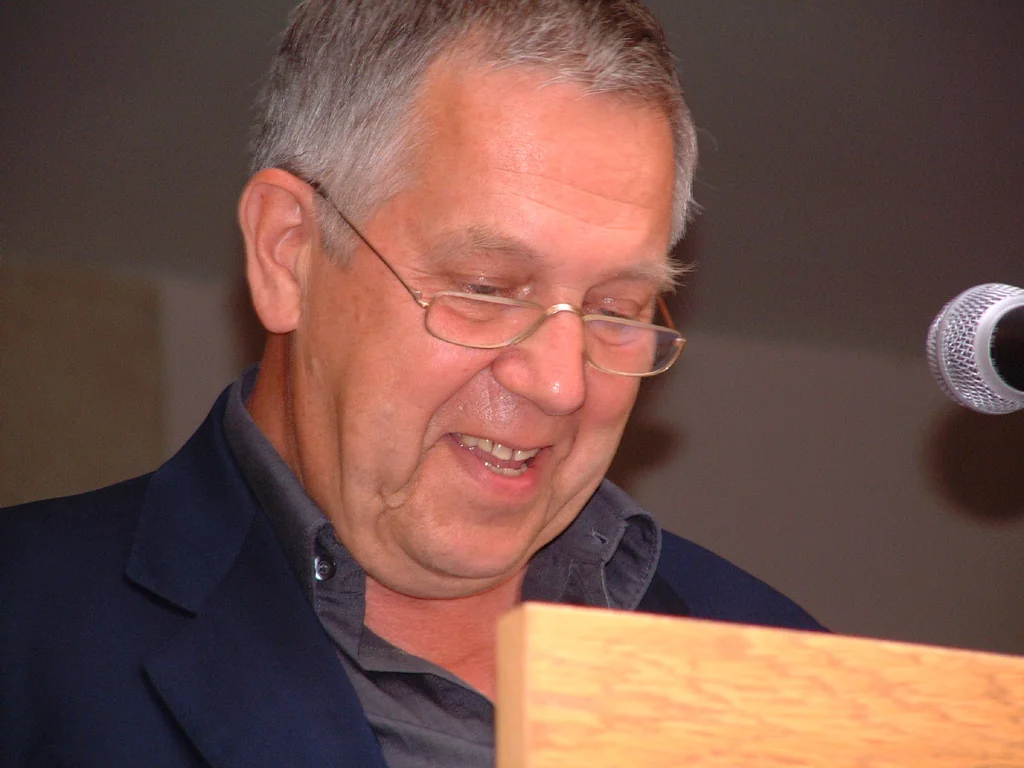
Image from Wikipedia
Image from Wikipedia
Robert Gernhardt – Masterfully Uniting Satire, Poetry, and Drawing
An artist who took humor seriously – and gave seriousness a sense of humor
Robert Gernhardt was that rare boundary-crosser who combined his music career? No – his comprehensive artistic career between poetry, satire, drawing, and prose with a stage presence in readings that captivated both audiences and critics alike. Born in 1937 in Tallinn, he shaped contemporary German-language literature as a poet, illustrator, caricaturist, and co-founder of the Neue Frankfurter Schule. His artistic development ranged from his early years at Pardon to the founding of the satire magazine Titanic, culminating in significant poetry cycles that transformed personal crises into high poetry. Gernhardt blended the composition and arrangement of language, rhythm, and imagery – a production of the comic that sparkled intellectually and shaped styles.
His work, often read in the tradition of Wilhelm Busch and in dialogue with Heine, Morgenstern, and Brecht, unfolds as a multivocal discography of comedy – better yet, a bibliography of poetry collections, illustrated narratives, essays, and audiobooks that captured the tone of an era. He received significant awards including the Deutscher Jugendliteraturpreis, the Heinrich-Heine-Preis, and the Wilhelm-Busch-Preis. Until his death in 2006 in Frankfurt am Main, he remained an author who took laughter seriously as a form of knowledge.
Early Years and Education: From the Baltics to Frankfurt
Growing up as the son of a judge, Gernhardt early on experienced the upheavals of the 20th century: resettlement during the war, the loss of his father, and fleeing westward. After graduating from high school in 1956, he studied painting at the academies in Stuttgart and Berlin, as well as German studies at the Free University. This dual artistic training – image and word – shaped his entire artistic development. Since 1964, he lived as a freelance artist in Frankfurt am Main; in 1972, he acquired a home in Tuscany, which became a second space for work and contemplation.
Even here, Gernhardt's experience is evident: he not only worked on texts, but he also composed language images. His drawings and poems arose from the interplay of form and punchline; his poetics aimed for precise placements – much like a musical arrangement: tempo, meter, internal rhyme, assonance, and consonance as instruments of comedy.
Editor at Pardon: The School of Satirical Craft
In 1964/65, Gernhardt was an editor at Pardon. Together with F. W. Bernstein and F. K. Waechter, he invented the legendary nonsense supplement "Welt im Spiegel" (WiM S), a school of satirical montage, parody, and intertextuality. In this atelier-like workshop, he refined the composition and production of text-image combinations: picture poems, riddles, newspaper parodies. This phase marked his breakthrough as a voice of Neue Komik, countering the cultural discourse with humor, punchlines, and structural wit.
The experience gained at Pardon became the foundation of his later authority: one who skillfully mixes text types, speech situations, and genres demonstrates expertise both in content and form. Gernhardt mastered the range from pun to elegy, from cartoon gag to sonnet.
Neue Frankfurter Schule and Titanic: The Comic Theory as Practice
In 1979, Gernhardt was one of the co-founders of Titanic. Together with colleagues such as Hans Traxler, F. W. Bernstein, F. K. Waechter, Bernd Eilert, Pit Knorr, Eckhard Henscheid, and Chlodwig Poth, he formed the Neue Frankfurter Schule – a group that subversively reflected the tradition of the Frankfurt School. Their artistic development made comedy a means of knowledge. Gernhardt was considered the "top student" of the punchline in this circle: precise, elegant, with a wicked gentleness instead of cynicism.
The cultural impact was far-reaching: Titanic redefined a German satirical culture after 1968 – playful, analytical, and media-savvy. In Gernhardt's hands, poetry became a laboratory for language criticism, the cartoon a magnifying glass for societal poses.
Authors' Collective GEK and Popular Culture: Texts for Otto
Together with Peter Knorr and Bernd Eilert, Gernhardt formed the GEK group – a professional trio of authors that conceptualized sketches, radio, and TV formats starting in the 1970s and wrote for Otto Waalkes. Many iconic punchlines from the Otto shows bear the signature of this workshop. This shows Gernhardt's experience with audience resonance: he could control timing, recognition, and audience expectation in such a way that popular culture and literary ambition did not exclude one another.
This intersection – feuilleton and mass stage – made Gernhardt a cultural mediator. His stage presence in readings, his audiobook-ready recitations, and sharp screenplay work demonstrated expertise in the production and arrangement of the comic across media boundaries.
Poetic Masterpieces: From Wörtersee to Lichte Gedichte
Gernhardt's "discography" in the literary sense includes key volumes that document his artistic development. "Die Wahrheit über Arnold Hau" (1966, co-authored with Waechter/Weigle) parodies literary scholarship. "Wörtersee" (1981) is considered a breakthrough in lyrical work: word games, parodies, and poetic self-observation. "Reim und Zeit" (1990) consolidates three decades of poetry and showcases his compositional mastery in handling form and rhythm.
"Lichte Gedichte" (1997) poetically processed a severe heart operation; "Herz in Not" (2004) and the "K-Gedichte" (2004) turned their attention to illness, war, and vulnerability. The late volume "Später Spagat" marks the last, reflective phase. Reviews from quality media acknowledged this tonal shift: the nonsense poet became a recognized contemporary poet who distilled existential experiences into precise formal language.
Style, Poetics, and Technique: How Gernhardt Conducted the Sound of Language
Gernhardt wrote poems as a composer lays out scores. He utilized internal rhymes, alliterations, assonances, syncopated line breaks, surprising cadences, and formal genres from sonnet to illustrated story. His "arrangements" combine semantic ambiguities with graphic punchlines; the cartoon provides the visual line, the verse flow the rhythm – a finely tuned interplay of text and image.
His satirical stance remained humanistic. He did not mock people, but poses; he did not ridicule weakness, but rather self-aggrandizement. The authority of his voice grew because it was based on verifiable observation and formal competence: he analyzed media gestures, advertising language, and political pathos – and answered them with literary means.
Teaching, Awards, Public Presence: Authority Through Continuous Quality
Guest lectures, poetics professorships, and public readings document Gernhardt's experience as a reflective practitioner. In 2005/06, he held lectures ("Leiden, Lieben, Lachen – A Tour Through the House of Poetry") and appeared as a clever commentator on his own workshop. Awards such as the Deutscher Jugendliteraturpreis (1983), the Kasseler Literaturpreis (1991), the Bertolt-Brecht-Literaturpreis (1998), the Rheingau Literature Prize (2002), the Heinrich-Heine-Preis (2004), and the Wilhelm-Busch-Preis (2006) confirm his authority within the canon of contemporary literature.
Public perception peaked in 2006: obituaries in leading literary supplements celebrated his oeuvre as a symbiosis of lightness and depth. At the same time, his estate and work preservation were institutionally anchored – an important signal for cultural sustainability.
Legacy, Exhibition, Award: Gernhardt Today
Frankfurt preserves his drawings in the Caricatura Museum – a venue that regularly showcases the Neue Frankfurter Schule in its cabinets. The literary collections were transferred to the Deutsches Literaturarchiv; publishers like S. Fischer and Kunstmann keep key editions available, while audiobook publishers spread readings and poetics lectures. Currently, the Robert Gernhardt Prize – supported by the state of Hesse and its economic and infrastructure bank – continues his legacy by promoting unpublished projects and supporting literary work in the present.
This vibrant reception shows Gernhardt's cultural influence: he shapes German humor, the poetics of the comic, and the notion that poetry can provide both entertainment and insight. In museums, newspapers, radio, and digital catalogs, his tone remains present – approachable, pointed, and precise.
Placement in Literary History: From Busch's Heir to Contemporary Classic
Gernhardt stands in line with Busch, Morgenstern, Ringelnatz – and yet he breaks with traditional nonsense by incorporating media-critical reflection. He updates the comic poem for a media society: the punchline is not only a joke, but a point of insight. His poetic technique – a strict awareness of form – positions him as a counterbalance to clean irony and pathetic rhetoric. In this lies his lasting contribution to the poetics of modernity.
As a drawer and poet, he always emphasized the intermedial connection between line and sound. This principle of dual talent – vision and sound – explains why his verses are so readable and performable. He wrote for the eye and the ear, for the page and the stage – a versatility that solidified his authority in the literary and artistic scene.
Reception and Impact: A Favorite of the Public and Critics
With readers, Gernhardt scored with recognizable motifs: observations of everyday life, traces of love and suffering, elegance of rhyme, and subversive serenity. Critics highlighted his ability to carry the lightness weightlessly and to make the heavy sound light. Late poetry collections that address illness and mortality are considered masterpieces of "serious cheerfulness" – an attitude that comforts without embellishing.
Gernhardt's work continues to resonate curatorially: exhibitions, thematic cabinets in the Caricatura Museum, and commemorative articles for anniversaries keep his image and text worlds in conversation. Thus, an image of a classic of the post-war period emerges, whose humor is historically aware and whose sense of form remains modern.
Conclusion: Why Robert Gernhardt Must Be Read, Heard, and Seen Today
Robert Gernhardt is exciting because he approached the art of comedy as serious work on language, form, and perception. His artistic development shows how one can swing from cartoon to elegy, from satire to sonnet and back again without losing authenticity. His discography of poems – from Wörtersee to Lichte Gedichte – proves the comic as an instrument of truth.
Those who wish to experience him "live" can turn to readings and audiobooks: there, lecture, timing, and tone color merge into that overall arrangement that characterizes his work. A call to all literature lovers: Treat yourself to the experience of a Gernhardt reading – on recordings, in media libraries, in museums. This encounter with form, wit, and humanity is always worthwhile.
Official Channels of Robert Gernhardt:
- Instagram: No official profile found
- Facebook: No official profile found
- YouTube: No official profile found
- Spotify: No official profile found
- TikTok: No official profile found
Sources:
- Wikipedia – Robert Gernhardt
- S. Fischer Verlage – Robert Gernhardt: Biography
- Antje Kunstmann Publishing – Robert Gernhardt
- DIE ZEIT – Farewell to Robert Gernhardt (2006)
- DIE ZEIT – Obituary: Satirist Driven by Pleasure (2006)
- FAZ – Robert Gernhardt: Articles, Legacy, and Reception
- Caricatura Museum Frankfurt – Robert Gernhardt (Exhibition Archive)
- Hessian Ministry – Robert Gernhardt Prize 2025
- Poetry Foundation – Robert Gernhardt
- Wikipedia: Image and text source
Upcoming Events
The Poet's Suitcase - Bright and Fast - Humorous Poems from Five Centuries
City Tour: Literary Tour – In the Footsteps of Platen, Uz & Co.