
Markus (Evangelist)
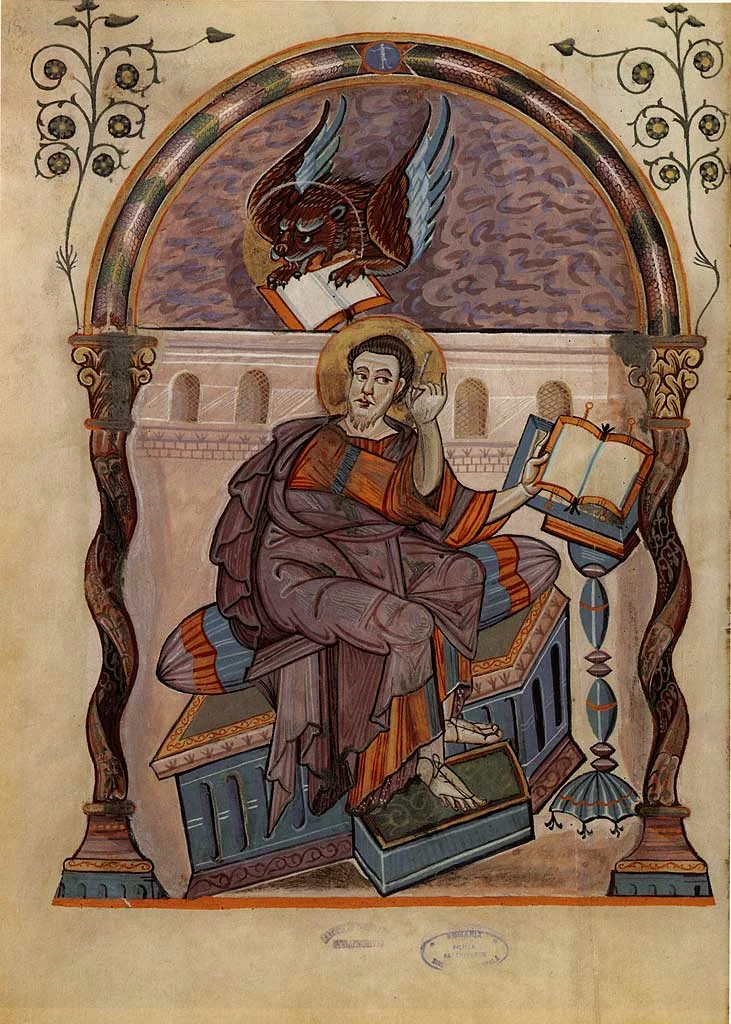
Image from Wikipedia
Image from Wikipedia
Markus (Evangelist) – The Power of the Oldest Gospel and the Birth of a Defining Tradition
A Name, a Text, a Symbol: Markus as a Key Figure in Early Christian Tradition
Markus, venerated in ecclesiastical tradition as the Evangelist, represents one of the most impactful texts in the history of Christian literature: the Gospel named after him. The author does not mention his name in the text itself; the attribution to "Markus" is an early church convention and not a secured biographical self-designation. It is precisely this tension between tradition, research, and transmission that makes Markus one of the most fascinating figures in religious and cultural history.
His significance extends far beyond mere authorship. The Gospel of Markus is considered the oldest of the four canonical Gospels and serves as a fundamental source for understanding Jesus' ministry. In Christian iconography, Markus is symbolized by the Lion of Markus, the winged lion—a sign that makes his historical presence visible to this day in art, architecture, and liturgy.
The Origins of the Markus Tradition: Name, Convention, and Early Interpretation
The name Markus is not a Jewish name but a Roman one. When scholarly literature refers to the author of the Gospel as Markus, it is a scientific and ecclesiastical naming tradition, not a definitive biographical identification. This distinction is central because it differentiates between the literary text and the later attribution to a historical person.
In early church tradition, Markus was closely associated with Peter, whose preaching he is said to have recorded according to traditional interpretations. Britannica describes the Gospel of Markus as the shortest and earliest of the four Gospels, likely written before the destruction of Jerusalem in 70 A.D. and used by the Evangelists Matthew and Luke. Thus, Markus occupies a starting position in the history of New Testament transmission.
The Gospel of Markus as a Literary Breakthrough
The Gospel of Markus possesses a unique literary energy. Britannica emphasizes its simple, direct style, its focus on the deeds of Jesus, and its clear passion narrative. The text depicts Jesus' ministry in Galilee, the journey to Jerusalem, his suffering and crucifixion, as well as the resurrection—concise, dynamic, and without rhetorical embellishment. It is this condensation that gives the Gospel its tremendous impact.
For researchers, Markus is thus not only a religious text but also a key literary work. The Gospel was evidently written for a Gentile audience, likely especially for Christians in Rome. The explanation of Jewish customs and the translation of Aramaic terms point to an author who sought to provide cultural mediation and addressed readers needing a clear, accessible approach to the Jesus tradition.
Historical Attributions and Open Questions in Research
Modern biblical scholarship views the authorship of the Gospel of Markus with nuance. Traditional church tradition links the Evangelist with John Markus, the companion of Paul and Barnabas. Domradio describes Markus as someone who was likely led to Christianity by Peter, accompanied Barnabas and Paul on their missionary journey, and later worked in Rome, Ephesus, and, according to tradition, Alexandria.
At the same time, research points out that the Gospel is anonymous and the attribution to Markus cannot be definitively established. Wikipedia and Britannica refer to the uncertainty of authorship and the debate over whether the author is identical to the John Markus mentioned in the Acts of the Apostles. This tension between tradition and historical-critical method is central to the reception of Markus and makes his figure worthy of discussion to this day.
Alexandria, Martyrdom, and the Expansion of Veneration
According to church tradition, Markus founded the episcopal see of Alexandria and is regarded as the first bishop of this significant early Christian metropolis. Wikipedia notes that the Coptic, Greek Orthodox, and Coptic Catholic Churches trace their origins back to this original community. Thus, Markus is remembered not only as an Evangelist but also as a church founder and spiritual progenitor.
His end of life is also surrounded by legends and traditions. Later traditions report a martyr’s death in 68, while historical certainty remains limited. Domradio cautiously states that the founding of Alexandria and a martyr’s death there are uncertain. It is precisely this mixture of historical openness and liturgical certainty that shapes the perception of the Evangelist to this day.
The Symbolism of the Lion of Markus: Iconography, Art, and Cultural Presence
The Lion of Markus is one of the strongest symbols in Christian iconography. Wikipedia cites the winged lion as the symbol of the Evangelist, and Britannica refers to the depiction of Markus in illuminated manuscripts and in Christian art. The lion represents dignity, strength, and the majestic voice of the Gospel—qualities that have accompanied Markus as an author figure for centuries.
Particularly in Venice, this symbolism has firmly imprinted itself. The Lion of Markus is not only a religious motif there but also an urban emblem and a sign of cultural identity. In art history, Markus is often depicted with the Gospel book, sometimes seated, writing, or with his gaze directed towards divine inspiration. Thus, the literary authority of the Gospel has been translated into a visual language that remains present to this day.
The Theological Handwriting of Markus: Tempo, Drama, and Condensation
The Gospel of Markus is distinguished by its narrative density and dramatic rhythm. It employs short scenes, sharp transitions, and a strong lead-up to suffering and the cross. Britannica highlights that the text emphasizes the power and determination of Jesus against evil while illuminating the passion particularly strongly. This is exactly where its theological uniqueness lies.
Even the closing tradition of the Gospel shows how complex the text history is. Britannica points out that the conclusion of Markus 16:9–20 is missing in some manuscripts and was likely added later. These layers of text make Markus a fascinating field of research where theology, philology, and church history intertwine.
Reception, Significance, and Continuing Authority
The impact of the Gospel of Markus extends from liturgy to modern exegesis. It serves as a key text for reconstructing primitive Christian proclamation and, according to scholarly consensus, influenced the Gospels of Matthew and Luke. In this way, Markus occupies a sort of starting position in the canon: concise, early, formative, and at the same time open to different interpretations.
In ecclesiastical contexts, Markus remains the Evangelist with clear spiritual authority. His feast day on April 25, his connection to Peter, and his role as a possible founder of the Alexandrian Church solidify his profile as a connecting figure between Jerusalem, Rome, and Egypt. This transcultural reach makes him a figure of enduring historical and spiritual significance.
Current Classification and Ongoing Relevance
Even without modern publications in the popular cultural sense, Markus remains relevant because his impact continues in theological debates, church practice, and cultural history. Research continues to discuss his identity, the literary genesis of the Gospel, and the question of what historical traces lie behind the tradition. Thus, Markus is not only a subject of the past but a living reference point for scholarly and religious discourse.
For readers seeking access to the origins of the Gospel, Markus is an indispensable name. His work connects simplicity and depth, historical closeness and theological interpretation, narrative power and symbolism. For this reason, the Evangelist Markus remains one of the most intriguing figures in Christian tradition.
Conclusion: Why Markus Continues to Fascinate Today
Markus captivates because behind the name stands an entire tradition: the oldest Gospel, a formative ecclesiastical tradition, a powerful symbol, and a still unresolved historical question. He represents the condensation of early Christian memory in a language that is immediate, powerful, and timeless. Those who engage with Markus encounter a foundation of the New Testament and a figure that connects faith, history, and culture.
It is precisely this mixture of literary precision, theological depth, and iconic presence that makes Markus so significant. His story invites the rediscovery of the beginnings of Christian tradition and an understanding of the power of narrative. Those who read the Gospel of Markus or follow its symbolism in churches, art, and tradition experience one of the most powerful origins of Western culture.
Official Channels of Markus (Evangelist):
- Instagram: No official profile found
- Facebook: No official profile found
- YouTube: No official profile found
- Spotify: No official profile found
- TikTok: No official profile found