
Johannes Brahms
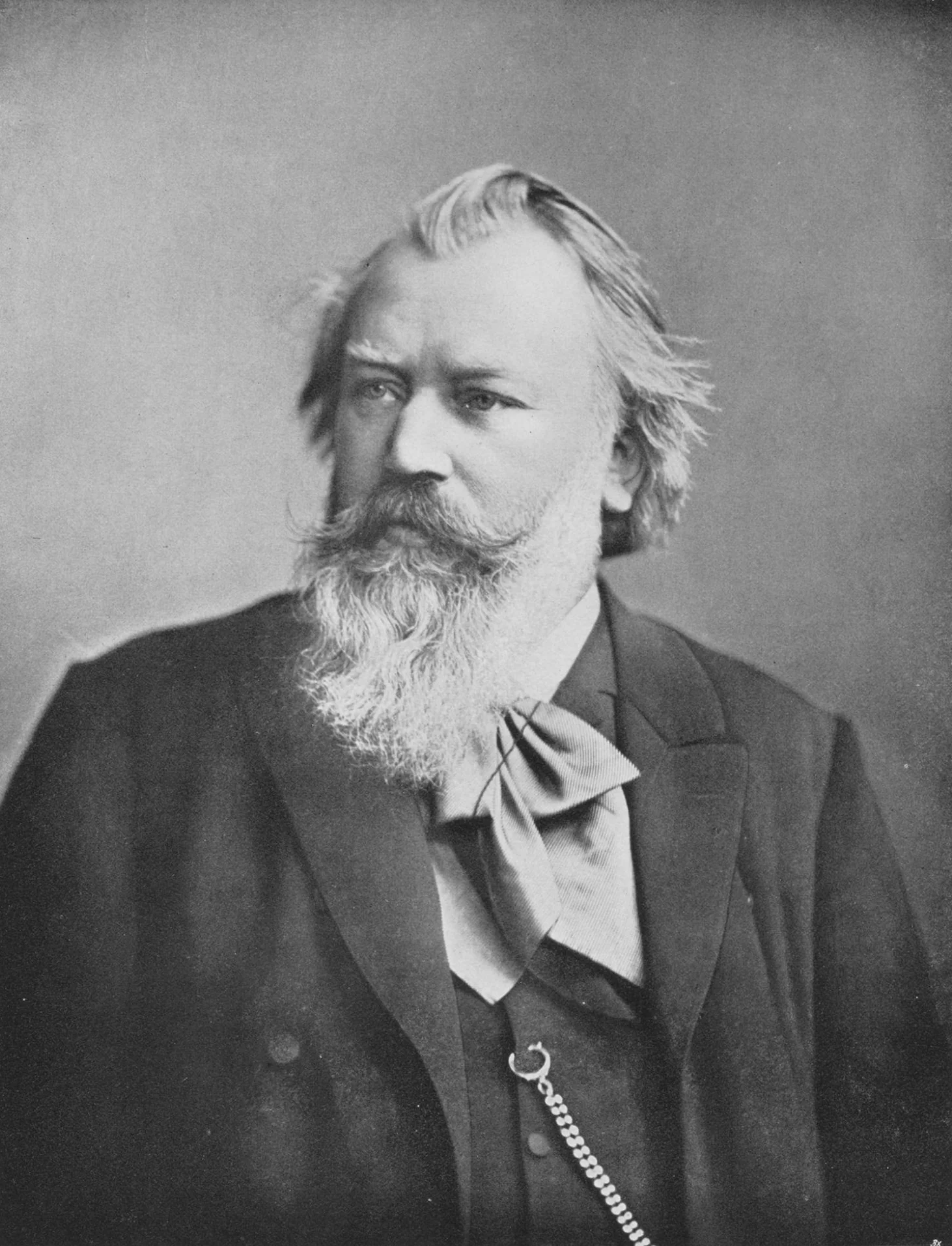
Image from Wikipedia
Image from Wikipedia
Johannes Brahms – The Master Between Classicism and Romanticism
A Composer Who Redefined Musical Tradition
Johannes Brahms is one of the defining figures in the music history of the 19th century. Born on May 7, 1833, in Hamburg and dying on April 3, 1897, in Vienna, he combined the expressive world of the late Romantic period with the strict forms of Classicism to create a distinctive sound ideal. His works range from symphonies and chamber music to piano pieces, choral works, and songs; only opera remained the large field he consciously avoided. ([britannica.com](https://www.britannica.com/biography/Johannes-Brahms))
What makes Brahms exceptional even today is the tension between inner discipline and emotional depth. His music never appears decorative for its own sake but is constructed, compacted, supported by motivic work, and suffused with a warm, often melancholic tone. This blend of craftsmanship, character, and expressiveness explains why Brahms is regarded not only as a Romantic composer but also as a renovator of tradition. ([britannica.com](https://www.britannica.com/biography/Johannes-Brahms))
From Hamburg to the Great Musical Centers
Brahms came from humble beginnings. His father, Jakob Brahms, was a horn player and double bassist; from him and later from F. W. Cossel and Eduard Marxsen, the young Johannes received his early piano lessons. As a child and teenager, he performed publicly, played in Hamburg venues, and earned money early on with the piano while also composing and refining his musical language. ([britannica.com](https://www.britannica.com/biography/Johannes-Brahms))
The decisive turning point came in 1853 when Brahms went on tour with the Hungarian violinist Eduard Reményi. During this time, he met Joseph Joachim, who recommended him to Robert Schumann; Schumann's enthusiastic article in the Neue Zeitschrift für Musik suddenly made Brahms well-known. The still barely established young artist quickly became a figure discussed in the musical centers of Germany. ([britannica.com](https://www.britannica.com/biography/Johannes-Brahms))
The Breakthrough: Recognition, Pressure, and Self-Criticism
The early fame brought Brahms not only opportunities but also burdens. The sudden attention from the music world placed high internal demands on a self-critical artist; he was known to be extremely meticulous, often hesitant, and merciless in revising his works. This very attitude explains why his oeuvre seems comparatively narrower than that of other great masters but is extraordinarily concentrated in substance. ([britannica.com](https://www.britannica.com/biography/Johannes-Brahms))
By the premiere of the German Requiem in 1868 in Bremen, Brahms had arrived at the center of European musical culture. The work marked an artistic breakthrough of historical significance: spiritual in tone, humanistic in content, monumental in structure, and simultaneously deeply personal in its sound language. Here, Brahms proved to be a composer who not only mastered large forms but also endowed them with new dignity. ([ellert-richter.de](https://www.ellert-richter.de/Buchkategorien/Architektur-Kunst-Musik/Johannes-Brahms.html?utm_source=openai))
The Works: Symphony, Chamber Music, and Song Art
Brahms composed in almost all genres except opera and created exemplary works of the Romantic era. Among his most famous compositions are the symphonies, concertos, chamber music, piano works, choral pieces, and well over 200 songs. Particularly the symphonies and the chamber music showcase his mastery in form development, motivic work, and aural density. ([britannica.com](https://www.britannica.com/biography/Johannes-Brahms))
His most popular pieces, such as the Lullaby, the Hungarian Dances, or the Third Symphony, stand alongside works of high compositional complexity. Brahms repeatedly demonstrated that catchiness and structural depth are not contradictory. In the large works of his mature years, thematic development, counterpoint art, and emotional economy converge into a musical language that is still regarded as the epitome of serious, organic form creation. ([britannica.com](https://www.britannica.com/biography/Johannes-Brahms))
Style and Musical Signature
At the core of Brahms’ style is the engagement with the classical tradition. He drew inspiration from Haydn, Mozart, and Beethoven without imitating them historically; instead, he transformed classical forms into a romantic expression that thrives on dense work with the smallest motifs. His music often feels rigorously constructed yet imbued with deep, sometimes skeptical inner emotions. ([britannica.com](https://www.britannica.com/biography/Johannes-Brahms))
Britannica describes that his larger works exhibit an increasing mastery of movement as well as greater economy and concentration. This is precisely where Brahms’ greatness lies: he unfolds great emotions not through excess, but through reduction, tension, and architectural clarity. The influence of folk music is also audible, particularly in rhythmic turns, dance impulses, and melodic gestures that lend his music a special human closeness. ([britannica.com](https://www.britannica.com/biography/Johannes-Brahms))
The German Requiem and the Spiritual Dimension
The German Requiem holds a key position within Brahms’ oeuvre. It is not a liturgical requiem in the traditional sense but a work of solace-seeking, remembrance, and existential reflection. With this perspective, Brahms shifted the focus from dogmatic ritual to a universal, profoundly human form of spiritual music. ([ellert-richter.de](https://www.ellert-richter.de/Buchkategorien/Architektur-Kunst-Musik/Johannes-Brahms.html?utm_source=openai))
This connection of personal seriousness and formal sovereignty made Brahms incredibly significant for his contemporaries and later generations. In an era when music was torn between faith in progress and adherence to tradition, he maintained a third path: modern in substance, classical in structure, romantic in expression. Thus, his music remains not just a historical document but a living benchmark of musical integrity. ([britannica.com](https://www.britannica.com/biography/Johannes-Brahms))
Controversies and Cultural Influence
Brahms became a central figure in the aesthetic debates of his time. He found himself in conflict between conservative music views and the New German School under Richard Wagner and Franz Liszt, which sought different paths in music theatre and program music. Brahms stood for the belief that the future of music could lie not necessarily in dissolving form but also in its refinement. ([ellert-richter.de](https://www.ellert-richter.de/Buchkategorien/Architektur-Kunst-Musik/Johannes-Brahms.html?utm_source=openai))
His influence extends far beyond the 19th century. Brahms became a reference point for generations of composers, performers, and musicologists, embodying a compositional ethic that combines technical precision, thematic density, and emotional authenticity. The fact that his works remain present in concert halls, festivals, academic projects, and digital platforms today demonstrates the enduring vitality of his oeuvre. ([brahms-hamburg.de](https://brahms-hamburg.de/nachrichten/))
Current Brahms Reception and Living Legacy
Although Brahms himself has not lived since 1897, his work is highly relevant in 2025 and 2026. The Brahms Portal of the Brahms Institute at the Lübeck University of Music has been made accessible online, providing 43,000 digitized letters, photographs, and musical manuscripts; all works can also be listened to in excerpts in collaboration with Deutsche Grammophon. Meanwhile, institutions like the Brahms Hamburg Project celebrate the composer’s legacy with special exhibitions and events. ([brahms-hamburg.de](https://brahms-hamburg.de/nachrichten/))
In the concert and recording market, Brahms remains a cornerstone: The Berlin Philharmonic released a new edition of Brahms under Kirill Petrenko in 2025, including the First Symphony and the Tragic Overture. Such projects showcase how present Brahms remains in today's musical life and how his symphonic works continue to serve as a benchmark for interpretation. ([berliner-philharmoniker.de](https://www.berliner-philharmoniker.de/en/news/brahms-edition/))
Discography Evaluation and Central Masterpieces
A classic "discography" in the popular sense does not exist for Brahms, but his oeuvre forms a canon that is continually being recorded and interpreted anew. Essential works include the four symphonies, the German Requiem, the violin concertos, the piano concertos, chamber music, the Hungarian Dances, the Lullaby, and the great choral works. These pieces form the backbone of his fame and highlight the spectrum between public monumentality and intimate lyricism. ([britannica.com](https://www.britannica.com/biography/Johannes-Brahms))
In the music press and musicological literature, Brahms is regularly described as a composer of extraordinary formal control and emotional intensity. His art lies not in effect but in concentration; not in quick access but in lasting impact. This is why his work remains a challenge for performers and a source of continual discovery for listeners. ([britannica.com](https://www.britannica.com/biography/Johannes-Brahms))
Conclusion: Why Johannes Brahms Continues to Fascinate Today
Johannes Brahms is captivating because he does not smooth out contrasts but makes them productive: tradition and progress, rigor and passion, public greatness and private restraint. His music possesses substance, depth, and a rare inner logic that unfolds with every listening. Those who experience Brahms live or in grand performances encounter not only classical mastery but an emotional cosmos of enduring greatness. ([britannica.com](https://www.britannica.com/biography/Johannes-Brahms))
Official Channels of Johannes Brahms:
- Instagram: No official profile found
- Facebook: No official profile found
- YouTube: No official profile found
- Spotify: No official profile found
- TikTok: No official profile found
Sources:
- Britannica – Johannes Brahms
- Wikipedia – Johannes Brahms
- Brahms Hamburg – News and Projects
- Berlin Philharmonic – New edition: Kirill Petrenko conducts Johannes Brahms
- International Johannes Brahms Competition – Brahmscompetition 2025
- Brahms Portal – Brahms Institute at the Lübeck University of Music
Upcoming Events
A German Requiem in the Town Church of Bayreuth
Opening Gala of the AMMERSEErenade Classical Festival
10th Chamber Concert: Clarinet Quintet
Brahms-Requiem by University Music of FAU
Brahms – A German Requiem
Brahms - A German Requiem
A German Requiem op. 45 by Johannes Brahms
Concert: A German Requiem by Brahms
Johannes Brahms: A German Requiem op. 45 with the Windsbacher Boys Choir