
Ingmar Stadelmann
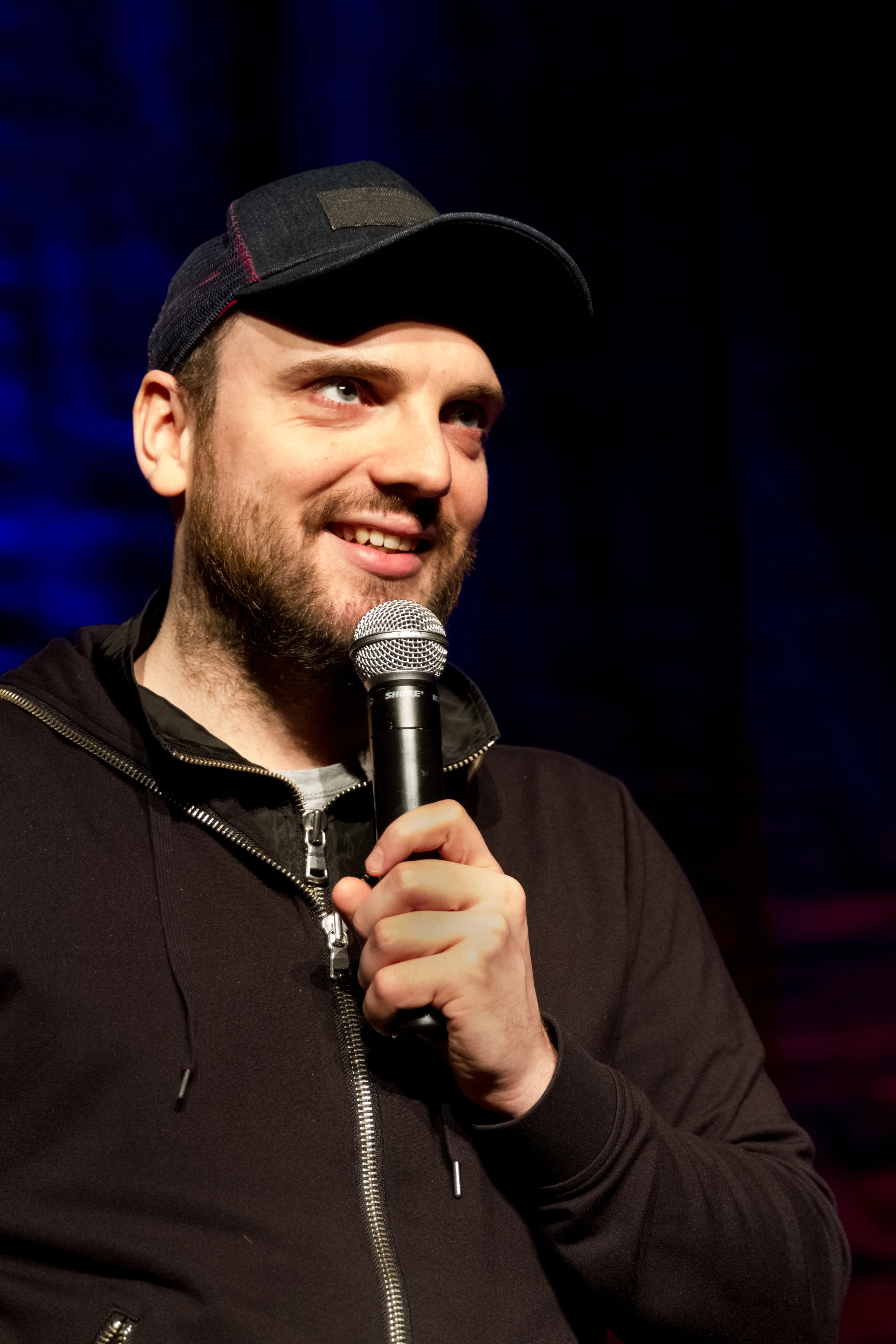
Image from Wikipedia
Image from Wikipedia
Ingmar Stadelmann – Stand-up, Satire, and Sharp Punchlines from East Germany
From the “Childlike Empress” of LateLine to the Award-Winning Stage Phenomenon: The Musical Career of a Comedian? No – the Stage Presence of a Style-Shaping Stand-up Artist who Arranges Comedy as an Art Form
Ingmar Stadelmann, born on September 4, 1980, in Salzwedel, embodies a generation of German stand-up comedians who compose their material with precision, arrange it dramatically, and present it on stage with clear artistic development. Moving from northern Saxony-Anhalt to Berlin, he early on combined radio, television, podcasting, and live comedy into a broad career trajectory akin to music, but in humor, timing, and text. His stage presence thrives on pace, rhythm, and a sensitivity to societal friction that he has consistently sharpened for over a decade, making it accessible to a large audience.
Stadelmann’s career includes hosting at major radio stations, a pointed TV era at rbb, several solo shows with notable titles, and podcasts that reflect his diverse themes. He received the German Comedy Award in 2014 as “Best Newcomer,” won competitions in the cabaret scene, and established himself as an author, speaker, and host with a recognizable voice. This biography illustrates how a comedian earns authority through a clear artistic signature, precise production, and continuous touring work – with cultural relevance, media competence, and the courage to provoke controversy.
Early Years and First Steps: From the Everyday Life in Salzwedel to “One Man, One Mic”
Growing up in Salzwedel, Stadelmann approaches the stage through everyday observations, East/West perspectives, and the school of radio. His East German background shapes his tone and choice of themes; it provides him with a perspective that he sharply contrasts with the Berlin reality. This origin story is more than folklore: It serves as a dramatic guide for his programs and enhances the credibility of his stand-up persona. His artistic development leads from the local microcosm to a nationwide presence – first audibly on the radio, later visually on television, and finally multimedia online.
During this phase, the comedian shapes the core elements of his stage work: a clear setup/punchline architecture, rapid-fire delivery, surprising taglines, and timing that directs the audience's rhythm. The early radio and hosting jobs serve as a rehearsal space: Here, he refines his pacing, emphasis, and the dramatic arc of his bits – the foundation for later live tours.
Radio and Hosting: Format Competence, Live Reflexes, and Audience Sensitivity
Stadelmann hosted for years at major broadcasters in the ARD family and private radio stations; significant roles included 1LIVE (WDR) and the nationwide talk show LateLine on Tuesday evenings. Live communication, spontaneous interaction, and the need to arrange content in real time sharpen his stage economy. The nickname “Childlike Empress” from the LateLine era stands not only as a comedic brand but also as a striking recognition among the listeners. This radio backbone conveys him confidence in dealing with pauses, audience reactions, and the unexpected – an advantage that structures his stand-up performance to this day.
For Stadelmann, radio competence means understanding formats, cleanly structured hosting arcs, and precise "hooks." He transfers these skills to his live shows, which he conceives like broadcast programs – with an opener, a climactic middle, and a final worthy closer. The musicality of speech, varying dynamics, and shifts between punchy jokes and narrative bridges create a dramatically orchestrated set.
Television and “Abendshow”: Satire on a Weekly Basis
In October 2019, Stadelmann took over the hosting of the rbb “Abendshow,” a weekly satire program from Berlin. The format demanded a newsroom-like editorial rhythm: finding topics, writing scripts, arranging bits, and final performance – week after week. Critical press reviews praised the relaunch attempt while also addressing the challenge of maintaining linear satire slots in a fragmented market. That Stadelmann simultaneously remained present as a stand-up comedian and TV guest during this period showcases his wide toolbox of hosting, commentary, and precisely cut one-liners.
The “Abendshow” demonstrates his ability to encapsulate societal debates in satirical narratives – with clear perspectives but without a moralizing finger-pointing. For comedians, the TV studio offers an acoustically and visually different setting than the club; Stadelmann varied visual gags, focal points, and speaking tempo – an artistic development that afforded him additional reach and strengthened his authority as a satirical voice.
Stage Programs: From “#humorphob” to “Kommt ihr klar?”
Stadelmann’s live discography – in the sense of a catalog of works – resembles a constantly renewed repertoire: “What’s wrong with people?”, “#humorphob,” “Freedom of Speech,” “Worryism,” the anniversary show “It’s not like anyone else is doing it!” and most recently “Kommt ihr klar?” mark stations of a signature that blends sharpness and self-irony. #humorphob was also released as a download special, showcasing Stadelmann's production understanding beyond traditional TV evaluation. “Kommt ihr klar?” frames the present in a post-escapist stand-up dramaturgy – straightforward content with a twist, thematic condensation instead of escapism.
Formally, he works with recurring motifs: everyday observations, media logic, political pop, East/West discourses. The set structure utilizes contrasts (private/public, city/country, seriousness/absurdity) and culminates in closers that succinctly condense the thematic field. Like in a well-produced album, he varies tempos, volume, and tone – a performance that not only entertains but also intellectually engages the audience.
Podcasts and Digital Culture: IIS, 2Life, and Solo Formats
With Idil Baydar, Stadelmann launched the podcast “IIS – The Idil & Ingmar Show” in 2019, whose hybrid topics of pop culture and politics extend the stage persona: improvised, clear in attitude, with spontaneous jabs at zeitgeist phenomena. Alongside this, Stadelmann played a role in the podcast ecosystem as a host, conversational partner, and solo voice – including newer solo approaches and talk formats that showcase his curatorial qualities. In 2023, referencing earlier radio times, he collaborated with Luke Mockridge on a joint podcast (“2Life”), opening outreach beyond the traditional stand-up bubble.
Podcasting functions for Stadelmann like a rehearsal space with immediate feedback: short takes, recurring segments, a tonality that oscillates between cabaret-style analysis and clear punchlines. The technical side – recording, editing, distribution on platforms – is expertly managed by his team; content-wise, his signature remains recognizable: personal stance, consistent setup-punch mechanics, and a curious perspective on what constitutes “the small” in Germany.
Style, Composition, and Artistic Development: Stand-up as Arrangement
Stadelmann's stand-up employs classical compositional principles: recapitulation (refrain-like callbacks), dynamic escalation (crescendo of jokes), surprising modulation (shifts in tonal range from cynical to tender), and sonic precision (articulation, alliteration, speaking pace). This “production” of his performances – quite literally, the creation of a live experience – contributes to a consistent signature sound. Content-wise, he finds pop culture references, political observations, and everyday miniatures into a narrative unity that rarely panders and often resonates.
His stage presence is energetic but not reliant on sheer volume. He works with focus direction, physical comedy, and timing at the end of sentences: The audience is guided like a good band – tighter groove, clear breaks, a finale that concludes the thematic arc. This expertise makes him adaptable to TV, radio, and live venues alike, explaining why his tours generate widespread resonance.
Awards and Reception
The breakthrough was cemented in 2014 by the German Comedy Award (“Best Newcomer”) as well as winning the “RTL Comedy Grand Prix.” Prior to this, he had excelled in competitions such as the Stuttgart Comedy Clash and the Mannheim Comedy Contest. Press and industry observers categorized him as a “bitterly funny urban satirist” with a clear edge, whose TV work at rbb sparked discussions on ratings while simultaneously sharpening the satirical weekly chronicle from the capital. This combination of jury, audience, and media resonance establishes his authority in the German-speaking comedy scene.
Importantly for the scene: Stadelmann's successes were not achieved in isolation but alongside his presence on radio and TV. This created a resonance space between studio, stream, and venue – a network that reinforced his programs and frequently highlighted the quality of material, arrangements of sets, and precise timing in critiques.
Current Projects 2024–2026: “Kommt ihr klar?” and “Stadelmann reads Höcke”
After the gratitude and anniversary period (“It’s not like anyone else is doing it!”), Stadelmann launched “Kommt ihr klar?”, a post-escapist show that montages crises, media noise, and personal perspectives. Since September 11, 2025, “Stadelmann reads Höcke – A Satirical Discourse Just Before the Seizure of Power” has been running as a new tour concept that dissects political rhetoric and transforms it into a sarcastic reading. The tour dates for 2025/2026 mark Stadelmann’s enduring stage presence – precisely timed evenings with dramatic bite and a performance that expands his repertoire.
Simultaneously, he maintains his visibility on TV and media libraries and nurtures podcast formats that serve as an idea laboratory for new bits. Thus, his output remains current: live programs with fresh content, audio series with improvisational wit, and media appearances that underline his authority as a socially conscious comedian.
Cultural Influence and Context
Ingmar Stadelmann stands in a stand-up tradition that combines American directness with German reality observation – less clowning, more text, attitude, and rhythm. He uses the stage as a space for discourse where controversies are permitted as long as the punchline holds. In music, one would say: honest sound, well-mixed, with courage for dissonances – and it is precisely these dissonances that make his sets culturally relevant.
His influence is also evident in that he maintains a fluid boundary between cabaret and comedy. He engages with political themes without becoming preachy, and with daily humor without tipping into banality. This balance secures him a place in the current stand-up topography: as a voice from the East that confidently intertwines German-speaking pop culture, politics, and media logic.
Conclusion: Why Experience Ingmar Stadelmann Live?
Because he takes stand-up seriously as an artisanal craft: precise language, strong dramaturgy, bold content. His artistic development from radio to stage authority demonstrates how timing, arrangement, and production work together in live comedy. Those who see Stadelmann live experience not just jokes but a curated show – with dramatic arcs, surprising modulations, and a closer that sticks. In short: Anyone wanting to know what the present sounds like on a German stage should treat themselves to an evening with Ingmar Stadelmann.
Official Channels of Ingmar Stadelmann:
- Instagram: No official profile found
- Facebook: No official profile found
- YouTube: No official profile found
- Spotify: No official profile found
- TikTok: No official profile found
Sources:
- Wikipedia – Ingmar Stadelmann
- Official Website – Ingmar Stadelmann (Homepage, Tour Info)
- Official Website – About/Über Ingmar (Biography, Programs, Awards)
- Official Website – Dates/Tour (“Stadelmann reads Höcke”, Program Notes)
- W&V – German Comedy Award 2014: Winners (Best Newcomer)
- Der Tagesspiegel – RBB “Abendshow” with Ingmar Stadelmann (Analysis and Context)
- Wikipedia – Abendshow (Format, Hosting, History)
- ViacomCBS/Cision – Podcast Announcements (IIS – The Idil & Ingmar Show)
- Theaterhaus Stuttgart – “Kommt ihr klar?” (Program Text)
- LateLine – Tuesday with Ingmar Stadelmann (Hosting Profile)
- Amazon Music – “#humorphob” (Track/Release Note)
- ARD Mediathek – “How Do You Live? Asks Ingmar Stadelmann” (Show from July 10, 2025)
- Wikipedia: Image and Text Source
Upcoming Events
Ingmar Stadelmann – Satirical Discourse with Höcke
Ingmar Stadelmann: Stadelmann reads Höcke – a satirical discourse
Ingmar Stadelmann - Stadelmann reads Höcke
Ingmar Stadelmann - Stadelmann reads Hoecke