
Bochumer Symphoniker
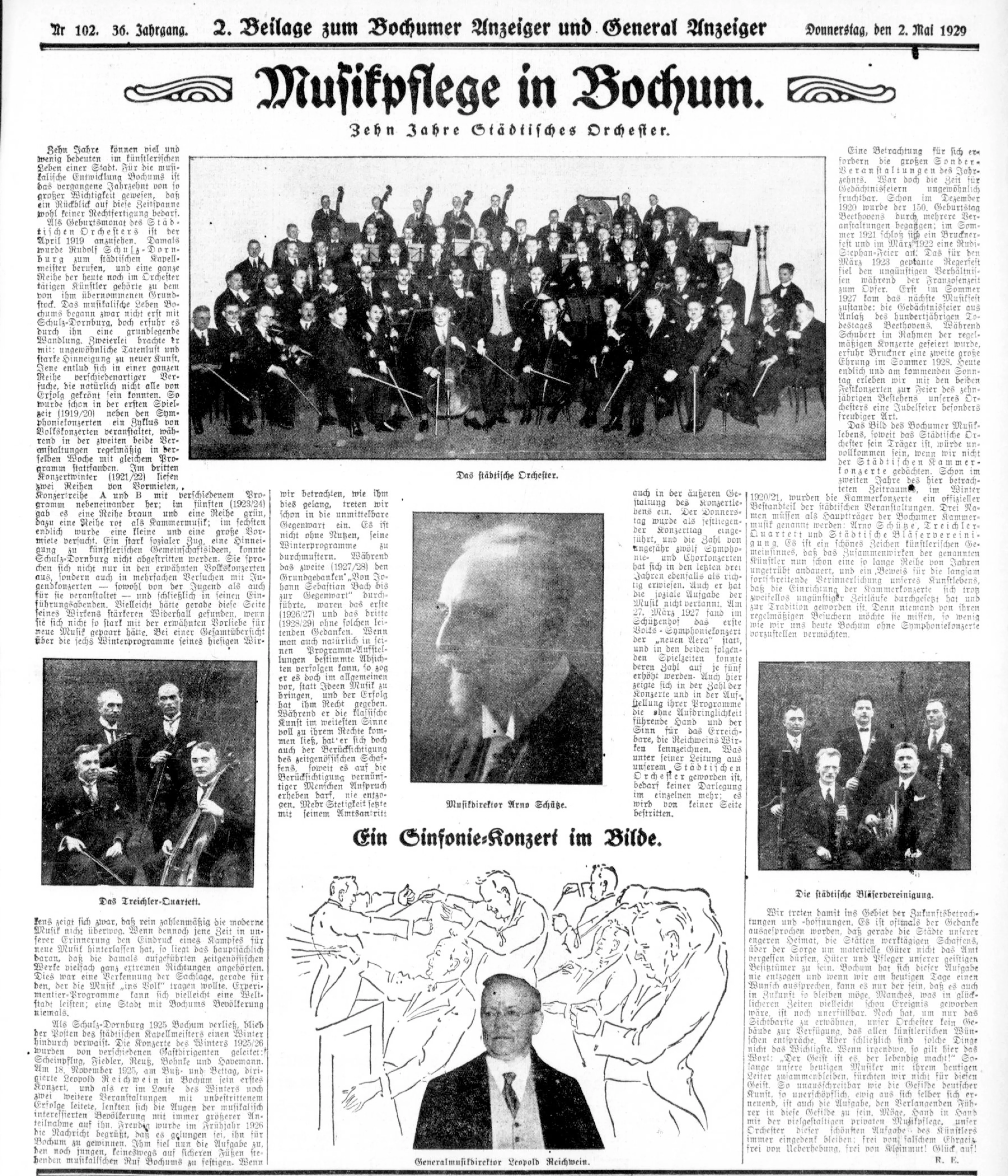
Image from Wikipedia
Image from Wikipedia
Bochumer Symphoniker – Orchestra Portrait, History, Discography
An ensemble with character: How the Bochumer Symphoniker shapes the Ruhr area and the classical music scene
For over a century, the Bochumer Symphoniker – affectionately known as BoSy – have represented a music career at the orchestral level, combining artistic development with a societal foundation. Founded in 1918 as a city orchestra, a concert ensemble with its own distinctive sound, excellent stage presence, and international appeal emerged from its accompanying tasks for the Schauspielhaus Bochum. With the opening of the Anneliese Brost Musikforum Ruhr on October 27, 2016, the orchestra gained an acoustically and architecturally outstanding home that makes its programmatic diversity even more audible. The BoSy cultivate a repertoire ranging from the symphonic core to music theater and crossover projects – setting benchmarks in music education, youth promotion, and contemporary production.
Biography: From theater tradition to concert profile
The orchestra's biography begins in 1918/1919 as the Städtisches Orchester Bochum. Strong general music directors early on shaped the sound and artistic development: Rudolf Schulz-Dornburg (1919–1926), Leopold Reichwein (1926–1938), and Klaus Nessträter (1938–1944) positioned the ensemble regionally, particularly in music theater. After the war, Hermann Meißner (1945–1956) solidified the foundation, while Franz-Paul Decker (1956–1964) and Yvon Baarspul (1964–1970) professionalized the sound and instrumentation. Under Othmar Mága (1971–1982), Gabriel Chmura (1982–1988), and Eberhard Kloke (1988–1994), the orchestra gained a sharper symphonic profile – a development continued by Steven Sloane from 1994 with programmatic courage, collaborations, and tours.
The Bochumer Symphoniker were awarded “Best Concert Program” by the German Music Publishers Association in the seasons 1996/1997 and 2004/2005. At the same time, the orchestra established a diverse discography and expanded international networking – from Israel to the USA. The decisive infrastructural leap occurred with the opening of the Anneliese Brost Musikforum Ruhr on October 27, 2016, with a community concert, anchoring the BoSy sound in a tailor-made concert hall.
Artistic Direction: From Steven Sloane to Tung-Chieh Chuang – and the next step
After 27 formative years, Sloane's era ended in 2021: Tung-Chieh Chuang took over as General Music Director (GMD) and concurrently as the director of the Musikforum beginning in the 2021/2022 season. The award-winning Taiwanese conductor accentuates sound culture, transparency, and dramaturgically thoughtful program structures – with precise conducting technique, fine sound balance, and a sense for contemporary perspectives. The next generational change is confirmed for the 2026/2027 season: In October 2025, Aurel Dawidiuk was appointed as the designated General Music Director and director, starting in August 2026. This marks the strategic continuation of an artistic line that connects renewal with continuity.
The transition phase is consciously curated: Chuang is responsible for a farewell season with a broad stylistic range until summer 2026, while Dawidiuk already sets impulses for the next chapter. This creates a seamless baton exchange that provides the orchestra with planning security and artistic drive.
The Musikforum as a sound laboratory: Architecture, acoustics, identity
The Anneliese Brost Musikforum Ruhr serves as a center of identity. The architectural integration of the former St. Mary’s Church as a foyer, modern hall architecture, and precise acoustics create optimal conditions for symphonic large forms, chamber formats, and music educational projects. The venue is not just a performance space, but a laboratory for program and format development: from thematic cycles and cross-genre evenings to educational series with a participatory approach. These spatial resources have further sharpened the stage presence of the BoSy and refined the programmatic quality.
The Bochumer Symphoniker gain special visibility as partners in the cultural ecosystem of the region: close ties to Ruhrtriennale, Klavier-Festival Ruhr, and Philharmonie Essen, collaborations with choirs and universities, and an active role in sustainability initiatives such as “Orchester des Wandels.” The Musikforum provides the ideal infrastructure for this.
Musical fingerprint and repertoire: Core, edges, and new territory
In the symphonic core – Beethoven, Brahms, Bruckner, Mahler – the BoSy combine tonal flexibility with structural clarity. In Brahms’ piano concertos, for example, the orchestra fascinates with chamber music-like alertness in interaction with the soloist, a dense but never heavy middle voice and a finely balanced brass section. Additionally, the interpretative curiosity for the 20th century is evident: Works by Schreker, Zimmermann, or Antheil are not excursions but part of its DNA. In music theater, the range spans from classics to advanced material; in crossover, the orchestra has repeatedly demonstrated stylistic versatility – such as in projects with Sting, Ian Anderson (Jethro Tull), and Herbert Grönemeyer.
Characteristic is the program dramaturgy: thematic brackets, dialogical juxtapositions, and world premieres/first performances complement the classical cycles. Thus, a concert design emerges that narrates repertoire history, sharpens series concepts, and simultaneously ignites curiosity for unknown scores.
Lighthouse projects: The Soldiers and international recognition
An artistic milestone is the Ruhrtriennale production of Bernd Alois Zimmermann’s “The Soldiers” (2006), which achieved international attention due to its impact and scenically musical consistency. The revival led to New York in 2008, where the work opened the Lincoln Center Festival. Reviews praised the precision and energy of the Bochumer Symphoniker, who modeled the complex score – with a massive percussion setup, spatial disposition, and incisive expression – exemplarily. This production still symbolizes the BoSy's self-image: artistic courage, logistical skill, cross-platform collaboration.
In parallel, the orchestra developed long-term cycles in their home region (including Mahler) and established themselves with regular festival appearances. The fact that the BoSy received “Best Concert Program” honors twice reflects this connection between repertoire maintenance and curatorial innovation.
Discography and reception: From Joseph Marx to Schreker and Antheil
The discography of the Bochumer Symphoniker is an independent chapter of its authority. For ASV, the complete recording of Joseph Marx’s orchestral works was produced: Vol. 1 with the “Nature Trilogy” (Symphonic Night Music, Idyll, Spring Music) received international recognition, while Vol. 2 with the orchestral songs was nominated for a Grammy. The BoSy’s recording teams impress with colorful strings, breathing woodwind lines, and brass that never confuses brilliance with volume – qualities that reviewers repeatedly describe as “intense, radiant, differentiated.”
Recent releases showcase the stylistic range: Schreker is prominently represented with orchestral works, as well as the desire for rediscovery with George Antheil (“Venus in Africa,” 2025, cpo). Additionally, there are collaborations with outstanding soloists and editions that make the edges of the repertoire audible. This discography is not just a catalog but a resonant statement about the orchestra's programmatic stance.
Collaborations, awards, and pop-symphonic moments
The Bochumer Symphoniker are a learning and connected orchestra. Collaborations with Ruhrtriennale and Klavier-Festival Ruhr are part of the brand's core, as are projects with choirs and cultural institutions in the region. A recurring theme is the productive friction with popular music: As early as 2011, the BoSy took the stage for several “Symphonicities” concerts with Sting; in 2025, Herbert Grönemeyer conducted symphonic adaptations of his own songs – an evening that combined orchestral color palette with pop phrasing and delighted the audience.
The outreach to the audience is not conducted solely through repertoire, but through music education: Podcasts, introduction talks, formats for families, schools, and young adults create experiential spaces where composition, arrangement, and performance practice become understandable – building trust in artistic processes.
Current projects 2024–2026: Sharpening profiles, building futures
In the 2024/2025 and 2025/2026 seasons, the BoSy will accentuate their profile in several lines: on the one hand, through significant symphonic works with high-profile solos (including Brahms highlights), and on the other hand, through repertoire renewal (Schreker cycle) and discoveries of the 20th century (Antheil). Format innovations such as the “Slam Symphony,” which unites music and spoken art, will also emerge. Season journals, monthly programs, and podcasts will open the workshop: rehearsal processes, instrumentation questions, production logistics – the listeners will gain insights into the aesthetic and organizational mechanics of an orchestra.
The GMD change is the central future project: With the contract signing of Aurel Dawidiuk in October 2025 and taking office in the 2026/2027 season, the Bochumer Symphoniker will set the course for the next chapter. Continuity and new impulses go hand in hand – a perfect moment to recalibrate the sound, review repertoire axes, and expand partnerships.
Cultural influence in the Ruhr area
The Bochumer Symphoniker are a cultural anchor institution in the Ruhr area. Their programming connects urban presence with historical depth, their music education fosters participation, and their youth projects secure artistic resilience. In a region familiar with transformation, the orchestra acts as a resonance space: it negotiates in sound what moves urban society – from identity and migration to sustainability. This grounding makes the BoSy an orchestra of significance far beyond concert dates.
Voices of the Fans
Fan reactions clearly show: The Bochumer Symphoniker excite people in the Ruhr area and beyond. On Instagram, a listener raves: “So much energy and colors – every concert is a discovery.” On YouTube, it is said: “Precise, transparent, emotional – an orchestra with a distinctive character.” On Facebook, a listener comments: “Program dramaturgy to think along with, sound to feel along with – thank you, BoSy!”
Conclusion: Why experience the BoSy now?
Those seeking symphonic excellence with curious dramaturgy will find an orchestra with personality in the Bochumer Symphoniker. The combination of finely nuanced sound direction, bold repertoire policy, experiential music education, and an inspiring home in the Musikforum results in an artistic profile with compelling appeal. Especially in the phase between Tung-Chieh Chuang’s farewell season and Aurel Dawidiuk’s appointment, it is worth experiencing the BoSy live: Here, the future is being created – with every phrase, every phrase ending, every risky fermata.
Official channels of Bochumer Symphoniker:
- Instagram: https://www.instagram.com/bochumersymphoniker/
- Facebook: https://www.facebook.com/BochumerSymphoniker/
- YouTube: https://www.youtube.com/@BochumerSymphoniker
- Spotify: No official profile found
- TikTok: No official profile found
Sources:
- Bochumer Symphoniker – Official Website
- City of Bochum – Contract Signing Aurel Dawidiuk (Press)
- DIE ZEIT – Grönemeyer conducts Bochumer Symphoniker (News, 28.06.2025)
- WAZ – Schedule Highlights and Social Media Reach (2026)
- Apple Music – Bochumer Symphoniker (New Releases 2024/2025)
- cpo via iMusic – Antheil: Venus in Africa (Release 07.02.2025)
- Wikipedia (DE) – Bochumer Symphoniker
- Wikipedia (EN) – Bochumer Symphoniker
- Ruhrtriennale Archive – Artist Profile/Press Reviews
- Wikipedia: Image and text source
Upcoming Events
Life and Destiny
BoSy CONCERT – FATEFUL
Celestial Fog
2026/2027 Season Presentation of the Bochum Symphony
Guided Tour at the Music Forum
BoSy Masterpieces: Radiant with Joy
Tangomania
BoSy Family Concert “Five Wins”
Five Wins