Augsburger Puppenkiste
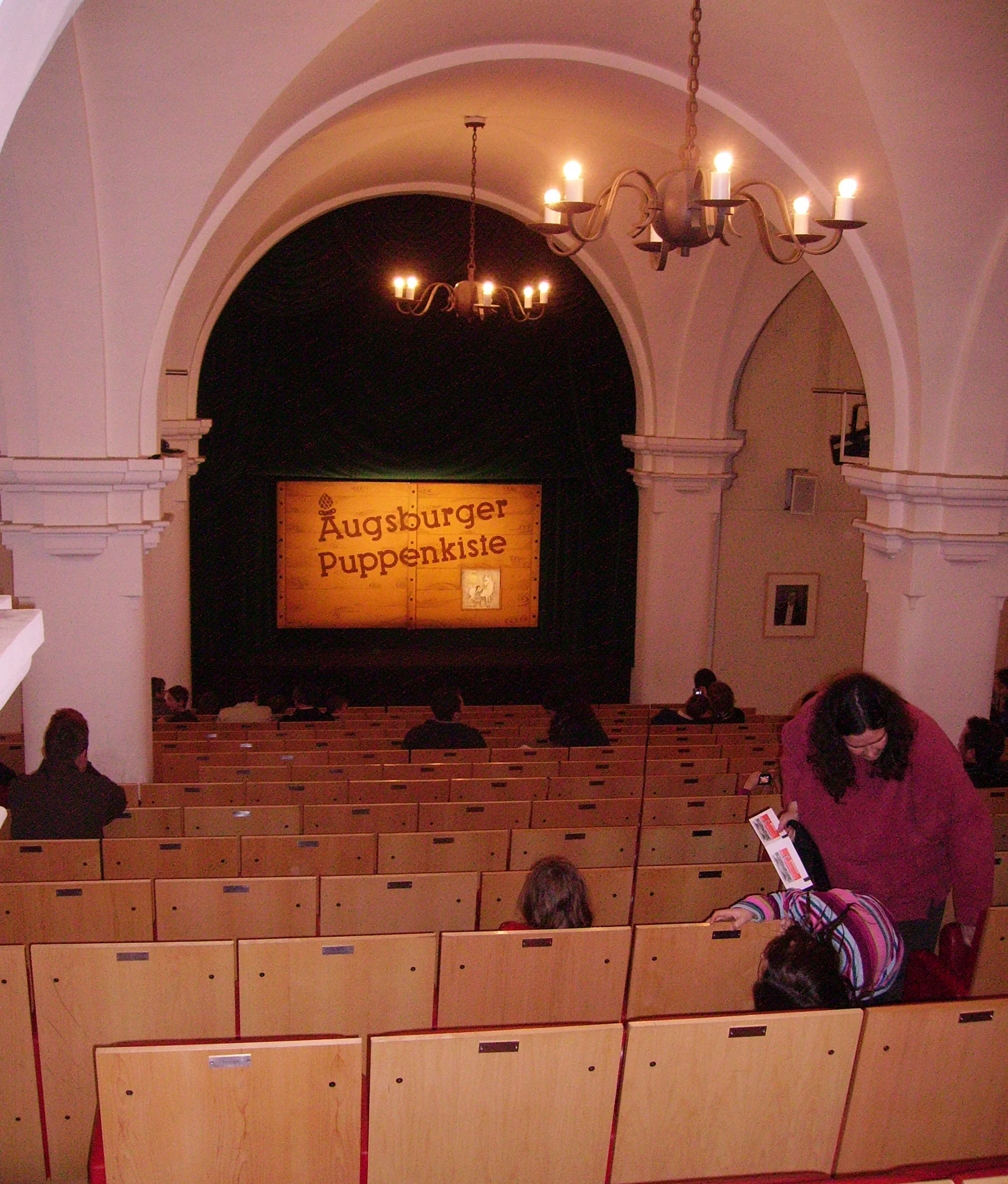
Image from Wikipedia
Image from Wikipedia
Augsburger Puppenkiste – The legendary stage where wood comes to life
From the Augsburg Old Town into the collective memory: A cultural institution full of magic
The Augsburger Puppenkiste has been one of the most defining stages in Germany since 1948. In the historic Heilig-Geist-Spital, the famous box lids opened for the first time for fairy tales and serious dramas – a moment that changed the history of German theater and television. With iconic television productions such as Jim Knopf und Lukas der Lokomotivführer and Urmel aus dem Eis, the stage created a repertoire that has accompanied generations. To this day, the Puppenkiste captivates with artistic development, exquisite craftsmanship, and a stage presence that mesmerizes both children and adults alike.
Foundation, location, and artistic signature
Founded in 1948 in the Heilig-Geist-Spital, a historic site in Augsburg's Old Town, the Puppenkiste quickly developed a distinctive aesthetic. The characteristic image of opening box lids became its trademark – a dramatic invitation and promise at once. From the very beginning, the stage focused on exquisite puppet craftsmanship, intricate composition of set pieces, and a clear dramaturgy in which music, language, and movement work together in a finely tuned manner. This artistic development shaped the ensemble, which, with a keen sense of timing, humor, and emotions, redefined the magic of puppet theater.
Breakthrough in television: From black-and-white images to the color era
The media breakthrough occurred starting in 1953 when the Puppenkiste transferred its art to television. Initially in black and white, later from the mid-1960s in color, productions emerged with long-lasting impact. The Löwen-Trilogie, Der Räuber Hotzenplotz, Bill Bo und seine Kumpane, and Urmel aus dem Eis set standards in direction, arrangement, and voice direction. The collaboration with Hessischer Rundfunk marked a productive era: Elaborately arranged sequences, precise cutting dramaturgy, and a sound design that sensitively mixed voices, sounds, and music made the series classics in German television history.
Icons of the puppet world: Jim Knopf, Urmel, Kater Mikesch, and others
Jim Knopf und Lukas, Urmel, Kater Mikesch, das Sams, or Schlupp vom grünen Stern – the characters of the Puppenkiste are part of the collective memory. Their "stage presence" is created through millimeter-precise manipulation of strings, spot-on dialogues, and musical motifs that intensify the emotionality of scenes. From a music journalistic perspective, the strong leitmotif technique impresses: Recurring themes – such as the Lummerlandlied – sonically anchor characters and places in the audience's minds. Thus, the Puppenkiste has been writing cultural history for decades while also conveying theatrical craftsmanship at the highest level.
From television studio to cinema screen: Expansion of formats
After numerous TV productions, the Puppenkiste took the leap into cinema. The story of Monty Spinnerratz opened a new chapter in visual language in 1997, utilizing larger spaces, refined lighting design, and cinematic editing. Another milestone was 2016's Die Weihnachtsgeschichte, a carefully produced adaptation that made the ensemble's dramaturgical qualities palpable on the big screen. Both projects demonstrate the Puppenkiste's ability to transform material media-appropriately – from the intimate studio stage to the cinematic widescreen aesthetic.
Music, songs, and discography: From the Lummerlandlied to new editions
Music is part of the DNA of the Puppenkiste. Composers like Hermann Amann have shaped the sound language of the productions with memorable melodies. The Lummerlandlied and other title songs show how important composition, arrangement, and sound design are for making atmosphere and character psychology audible. The timelessness of these songs is proven by regular re-releases and collections: The album “Die schönsten Originallieder” (released on December 20, 2024, label Timezone) compiles central songs in carefully curated order. Beyond the classic repertoire, the Puppenkiste also made music history: The dance version of “Eine Insel mit zwei Bergen” by Dolls United reached number 2 on the German singles chart in 1995 – an indication of the cultural impact of the melodies.
Style and methodology: Precision in composition, dramaturgy, and production
The artistic practice of the Puppenkiste is based on precise preparation and clear production chains. Puppet cutting, string management, set construction, costumes, lighting, and camera (for TV/film formats) interconnect seamlessly. Musical themes structure the scenes, while text work – often based on literary sources – creates dramatic arcs that shift between humor, poetry, and tension. This detail-oriented production tradition is also reflected in newer projects that respect the classic Puppenkiste sound while incorporating modern narrative rhythms.
Museum “Die Kiste”: Memory storage and laboratory of the present
Since 2001, the puppetry museum “Die Kiste” has complemented the stage – directly above the theater spaces in the Heilig-Geist-Spital. As a curated memory, it showcases permanent and temporary exhibitions featuring stars on strings like Urmel, Jim Knopf, and Kalle Wirsch, grounding the Puppenkiste in the museum discourse. In 2026, the museum will celebrate 25 years and will emphasize its jubilee exhibition: mediation, archiving, and contextualization merge here into a vibrant laboratory that intertwines historical artifacts with current questions in theater and media education.
Awards, reception, and cultural impact
Over the decades, the Augsburger Puppenkiste has received notable recognitions and is seen as synonymous with high-quality puppetry in German-speaking culture. Critiques celebrate the “success story” of the TV era, the innovative return to cinema, and the ability to retell classic works. As a favorite in cultural journalism, the Puppenkiste also stands for successful family culture: Productions resonate intergenerationally, combining nostalgic memories with artisanal perfection and conveying a distinct aesthetic that remains relevant beyond children’s entertainment.
Present and recent developments (2024–2026): Web series, concerted repertoire, new formats
Even in the present, the Puppenkiste remains agile: In December 2025, a four-part web series with newly produced short films started, released on Advent Sundays via the official social media channels. The repertoire combines classics – from Jim Knopf to Urmel – with ambitious projects for adults, including pointed satirical miniatures and adaptations of major works. Stage and museum operations are continuously developed, while organizational updates, such as new admission prices starting in January 2026, ensure economic viability and a future-proofed operation.
Opera and literary adaptations: “The Ring of the Nibelung” and more
A programmatic statement was made by the Puppenkiste with the compressed adaptation of Wagner’s “The Ring of the Nibelung.” In this concentrated version, the expertise of the ensemble is revealed: complex themes of power, guilt, and redemption are told through a visual language that oscillates between ironic breaks and serious chamber play. This production underscores the artistic authority of the house and demonstrates that puppet theater is not only a children’s theme but also a subject of music and high culture.
Technique meets storytelling: Why the Puppenkiste remains timeless
The sustainability of the brand “Augsburger Puppenkiste” lies in its compositional thinking. The fitting of text, music, and visual design creates a recognizability that never feels museum-like. Thoughtful arrangements, careful voice direction, and the dramaturgical economy of the scenes lead to pieces that hold relevance even in the digital age. From TV productions to cinema and web series, the Puppenkiste conveys its essence across every platform – always with the care of a traditional house that knows what its community loves.
Voices of the fans
The reactions from fans clearly show: The Augsburger Puppenkiste enchants people worldwide. On Instagram, a fan raves: “The characters really come to life – pure childhood memories!” A YouTube comment praises: “Rarely have I seen such lovingly arranged music and such precise play.” On Facebook, a listener writes: “Cultural heritage that never gets old – thank you for so much passion!”
Conclusion: Why you must experience the Augsburger Puppenkiste
The Augsburger Puppenkiste combines tradition, innovation, and musical intelligence into a stage cosmos that radiates far beyond Augsburg. Its music career in a broader sense – from leitmotifs to original songs to re-releases – is inseparably linked to the artistic development of the house. Those who want to understand how timeless theater functions should visit this stage: live in the Heilig-Geist-Spital, with a program that gives new colors to classics and tells great stories with artisanal precision. An appeal to all culture lovers: Experience the box lids that open – and the unique magic when wood begins to play.
Official channels of Augsburger Puppenkiste:
- Instagram: https://www.instagram.com/augsburgerpuppenkiste/
- Facebook: https://www.facebook.com/Puppenkiste/
- YouTube: https://www.youtube.com/@augsburger_puppenkiste
- Spotify: No official profile found
- TikTok: No official profile found
Sources:
- Augsburger Puppenkiste – Official Website
- Augsburger Puppenkiste – Film excerpts & official YouTube link
- Augsburger Puppenkiste – Classics (Repertoire overview)
- Augsburger Puppenkiste – Tickets and information (including from January 2026)
- Wikipedia (DE) – Augsburger Puppenkiste
- Wikipedia (EN) – Augsburger Puppenkiste (including Golden Camera 2004)
- Augsburger Allgemeine – Films, Museum, Tickets: Chronology & Info
- hr – 70 Years of Augsburger Puppenkiste (Retrospective & TV Productions)
- ZDFheute – Puppenkiste “Ring of the Nibelung”
- Apple Music – “Die schönsten Originallieder” (Album, 20.12.2024)
- Wikipedia (DE) – Dolls United (Chart success “Eine Insel mit zwei Bergen”)
- Augsburger Allgemeine – Museum “Die Kiste”: 25 Years, New Exhibition
- Wikipedia: Image and text source
Upcoming Events
Cabaret 2026 – Augsburg Puppet Theater
The Little Waterman
The Brandner Kaspar and the Eternal Life
Rapunzel – Augsburger Puppenkiste
Rapunzel
Rapunzel – Puppet Theater from 3 years

Rapunzel
Rapunzel
The Brandner Kaspar and the Eternal Life