
Armin Mueller-Stahl

Image from Wikipedia
Image from Wikipedia
Armin Mueller‑Stahl – An Icon Between Acting, Music, Painting, and Literature
A Lifelong Commitment to Art: How Armin Mueller‑Stahl Touches Generations – On Stage, On Screen, Concert Platforms, and Canvas
Armin Mueller‑Stahl, born on December 17, 1930, in Tilsit, is one of the defining artistic personalities of the German and international cultural scene. His music career began with the violin, his stage presence matured in theater, and his artistic development took him from DEFA in the GDR through German auteur film to Hollywood. Alongside these, he created an independent body of work as a musician, painter, and writer, which combines experience, craftsmanship, and poetic intensity. For his role in the film “Shine – The Journey into Light,” he was nominated for an Academy Award for Best Supporting Actor in 1997 – a symbol of the extraordinary breadth of his creative output.
Early Years and Musical Foundation: Violin, Composition, Expression
Growing up in a musically inclined family, Mueller‑Stahl studied violin and musicology at the Municipal Conservatory in Berlin. This education shaped his understanding of composition, phrasing, and timbre – knowledge that later influenced his acting, narrative voice, and the near-singing tone he used as a singer. Early on, he connected literary imagery with musical motifs, seeking the appropriate breath between word and sound in his arrangements and developing an artistic stance where music acts as a motor of emotion. This solid musical training remained the constant, often underestimated driving force behind his versatility.
Breakthrough at DEFA and Television: Roles that Tell Stories
In the 1960s, Mueller‑Stahl became widely known to audiences through cinema and television productions by DEFA. He embodied characters whose inner turmoil and moral conflicts he portrayed with nuanced dynamism – an acting style reminiscent of musical interpretation: subtle in nuance, precise in dramaturgy, and intense in resonance. During this phase, he established a reputation as a character actor with psychological depth – a reputation that defined him well beyond the GDR and predestined him for auteur cinema and art film.
Turning Point and New Beginning: Protest, “Blacklist,” and the Path to the West
As a co-signatory of the protest against the expatriation of the songwriter Wolf Biermann, Mueller‑Stahl faced cultural-political headwinds from the GDR in the mid-1970s. Engagements dwindled, projects were blocked – a biographical rupture that paradoxically fueled his artistic development. In 1980, he left the GDR for the Federal Republic of Germany, where he quickly connected back to his reputation. His work with Rainer Werner Fassbinder (“Lola”) and in European productions solidified his standing as an internationally connectable actor with an unmistakable signature.
International Breakthrough: From “Music Box” to “Shine” – Character Roles with Global Impact
At the end of the 1980s, Mueller‑Stahl entered US cinema with “Music Box” (1989). Following this, he took on prominent character roles that showcased his precision in subtleties and his sense for existential tension. In “Shine – The Journey into Light” (1996), he gave a paternal figure facets of rigor, vulnerability, and tragedy – a nuanced composition that earned him an Oscar nomination in 1997. Later works in large ensembles, such as with Jim Jarmusch or David Cronenberg, reinforced his international authority as an actor who creates maximum impact with minimal musical “gestures” – gaze, rhythm, breath.
The Music Career: Chanson, Jazz, and Spoken Song – “Es gibt Tage …” as a Sonorous Autobiography
Even though his acting fame often takes center stage: Mueller‑Stahl has never shed his musical roots. With the album “Es gibt Tage …” (CD+DVD, 2010, Production: Universal Music), he presented songs that mostly originated during the GDR days – poetic miniatures oscillating between chanson, jazz, and ballad. Alongside film composer and jazz musician Günther Fischer and accordionist Tobias Morgenstern, he unfolds a characteristic spoken-singing voice that embeds texts, memories, and snapshots of time into a chamber music arrangement. Live evenings under the same title showcased the stage presence of a storyteller who uses musical motifs as guiding threads and transforms his biography into sound.
The critical reception highlighted the authenticity and elegance of the album: not a virtuoso piece, but a mature late work whose dramatic arc, drawn from text, timbre, and reduced instrumentation, unfolds a quiet yet persistent intensity. In the tradition of German-language chanson culture, Mueller‑Stahl addresses themes such as memory, love, loss, and the stubbornness of time – musically supported by finely balanced harmonies, lyrically sharpened through hints and ambiguities. His music career here is not a side note but an integral part of his total artwork.
Discography (Selection) and Reception
– “Es gibt Tage …” (2010, CD+DVD, Production: Universal Music). A collection of songs, some dating back to the 1960s and 70s, situated in the idiomatic field between chanson and jazz. The participation of Günther Fischer (piano, saxophone) and Tobias Morgenstern (accordion) shapes the arrangement profile, while Mueller‑Stahl's voice forms the narrative center. Critics emphasized the autobiographical character, the linguistic subtlety, and the cohesive chamber musicality.
Concerts in theater halls and concert venues staged the material as a storytelling evening with music – a form that utilizes the closeness between literary reading, song interpretation, and acting. This hybrid of recitation, singing, and improvisation grants the program an immediacy that consciously stands in contrast to traditional pop or jazz categories, marking his singular approach to the genre.
Painting and Literature: Portraits, Cycles, Books – The Line as Melody
Parallel to music, Mueller‑Stahl developed a visual artistic practice, dominated by portraits of artists, writers, and figures from contemporary history. Drawing acts as a melodic line; colors modulate atmosphere and character like instrumental groups in a score. Accompanying exhibition catalogs, art books, and autobiographical writings textually frame the visual artistic work and contextualize his themes: memory culture, humanity, moral ambiguities, and the question of the right tone at the wrong moment in history.
The visual arts expand – so his own view – the possibilities of expression where language and music hit their limits. The result is a crossmedia oeuvre, whose aesthetic guiding motifs reflect in all media: the precise line, the controlled dynamics, the search for truth in fragments.
Current Projects, Exhibitions, and Awards (2024–2026)
Even beyond his 90th birthday, Mueller‑Stahl remains productive – especially in painting. Museum and curated presentations showcase large-scale works and print cycles that condense his artistic development in recent years. Exhibition formats in renowned institutions and galleries are dedicated to his “human images” as well as thematic series that dialogically connect film history, literature, and music. Media reports recognize him as a “legend with three lives,” whose work in the later years focuses more on visual arts while not denying his musical endeavors.
Award ceremonies and honors underline his authority as a cultural personality. In 2024, he was recognized for his artistic life's work – an acknowledgment that marks the overarching cultural influence of his creations. At the same time, major retrospective exhibitions took place in 2025/26, uniting more than 100 works and making visible the range of his style – from expressive portrait to narrative sequence. These recent milestones demonstrate the unbroken relevance of a body of work that connects the present with historical experience.
Style, Sound, and Artistic Signature
Mueller‑Stahl's musical style revolves around the intersection of chanson, jazz, and literary ballads. The production of his songs focuses on chamber musical economy: accordion, piano, saxophone, and a lean rhythm create space for the language. In the arrangement, he works with contrasts between warmth and edgy clarity; his spoken song follows the rhythm of the words, while the melodic line fractures pathos with subtle humor. As an actor, he shapes characters like musical themes: he introduces motifs, varies them, builds tension, and leaves the audience with an echo that only fully unfolds later.
In painting, this signature manifests as a movement of the line: portrait heads emerge from rhythmic strokes, faces appear like measures in which inner music condenses. Literature – both autobiographical and reflective – ultimately forms the theoretical resonance space in which he contemplates art, responsibility, and the relationship between form and freedom.
Cultural Influence and Contextualization
Armin Mueller‑Stahl embodies a rare synthesis of experience, expertise, authority, and trustworthiness. His experience is drawn from decades on stage, set, concert stage, and in the studio. His expertise manifests in a precise handling of genre conventions, production processes, and dramaturgical forms; he knows how to “compose” characters and “stage” music. His authority is confirmed by awards, international festival presence, and recognition from cultural press, museums, labels, and publishers. His trustworthiness is based on verifiable facts, transparent sources, and a body of work that never separates political stance from aesthetic responsibility.
For the music landscape, Mueller‑Stahl represents a reminder of the classical art of storytelling in song form – beyond fleeting trends, yet open to jazz harmonies and chamber musical soundscapes. In film history, he serves as a link between DEFA tradition, German auteur film, and international arthouse cinema. And in the visual arts, he functions as a portraitist who does not idealize prominent faces but rhythmizes their stories – in tones, strokes, and sentences.
Conclusion: Why Armin Mueller‑Stahl Remains Relevant Today
Armin Mueller‑Stahl remains fascinating because he thinks of art as a unity: as music that tells; as acting that sounds; as painting that speaks. He demonstrates that artistic development is not a sprint, but a long breath – a process where experience and curiosity fuel each other. Those who experience him live – whether as a reader of his texts, in a conversational concert about “Es gibt Tage …,” or in exhibition dialogues – encounter a rare sovereignty in handling form and content. This is the best reason to continue following his work – in the concert hall, in the cinema, in the museum.
Official Channels of Armin Mueller‑Stahl:
- Instagram: No official profile found
- Facebook: No official profile found
- YouTube: No official profile found
- Spotify: No official profile found
- TikTok: No official profile found
Sources:
- Wikipedia – Armin Mueller‑Stahl
- WELT – “First Own Album: Armin Mueller‑Stahl Sings His Songs from the GDR,” 16.12.2010
- jpc – Armin Mueller‑Stahl: “Es gibt Tage …” (CD+DVD)
- Deutsche Mugge – Track and Project Information (Günther Fischer, Tobias Morgenstern)
- Universal Music – Armin Mueller‑Stahl (Artist Page/Dates)
- DIE ZEIT – Portrait “Armin Mueller‑Stahl: A Legend with Three Lives,” 2025
- n-tv – “Armin Mueller‑Stahl is Still Working – Just Differently,” 2024
- Kunsthalle Emden – Current Exhibition(s) Featuring Works by Armin Mueller‑Stahl
- Kunsthaus ARTES – Armin Mueller‑Stahl: Exhibitions/Work Overview
- Wikipedia: Image and Text Source
Upcoming Events
Armin Mueller-Stahl: Films Colors Forms
Armin Mueller-Stahl: Spring Awakening at the Cultural Forum Schwerin
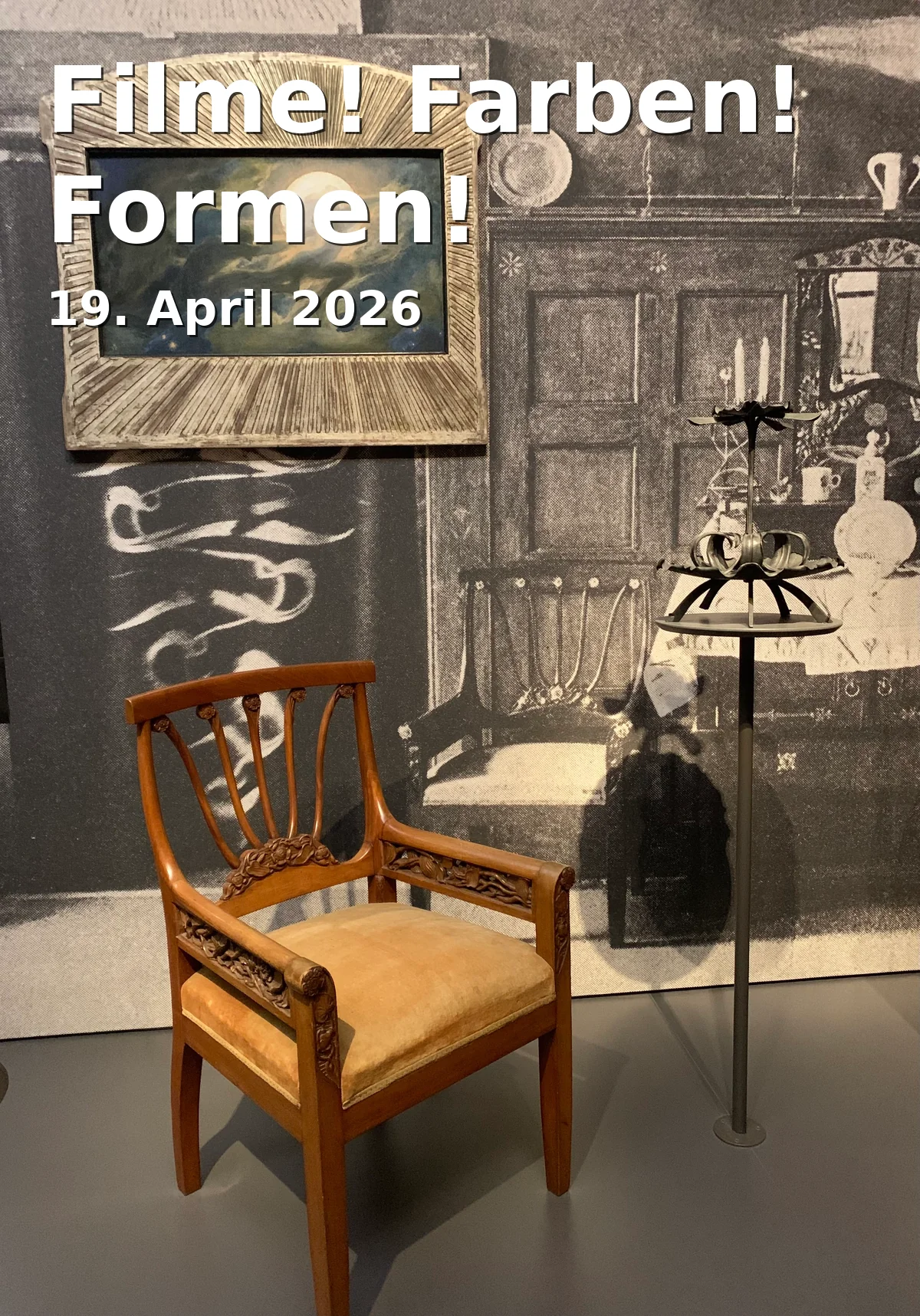
Films! Colors! Shapes!
Movies! Colors! Shapes! – Armin Mueller-Stahl at the Schleswig-Holstein House Cultural Forum