Startups & Innovation Events in Ansbach – Startup Scene
Startups & Innovation Events in Ansbach (2026/2027): Where Ideas Learn to Walk
In Ansbach, a particularly accessible mix of startup consulting, pitch formats, workshops, and networking evenings will emerge in the coming months and semesters. This overview shows which types of events you can expect in the future, how to find suitable dates, and how to prepare well.
For whom: Aspiring founders, students, self-employed individuals, those interested in business succession, companies, creatives, and anyone who wants to experience innovation locally.
Founding in Ansbach: What to Expect in the Future
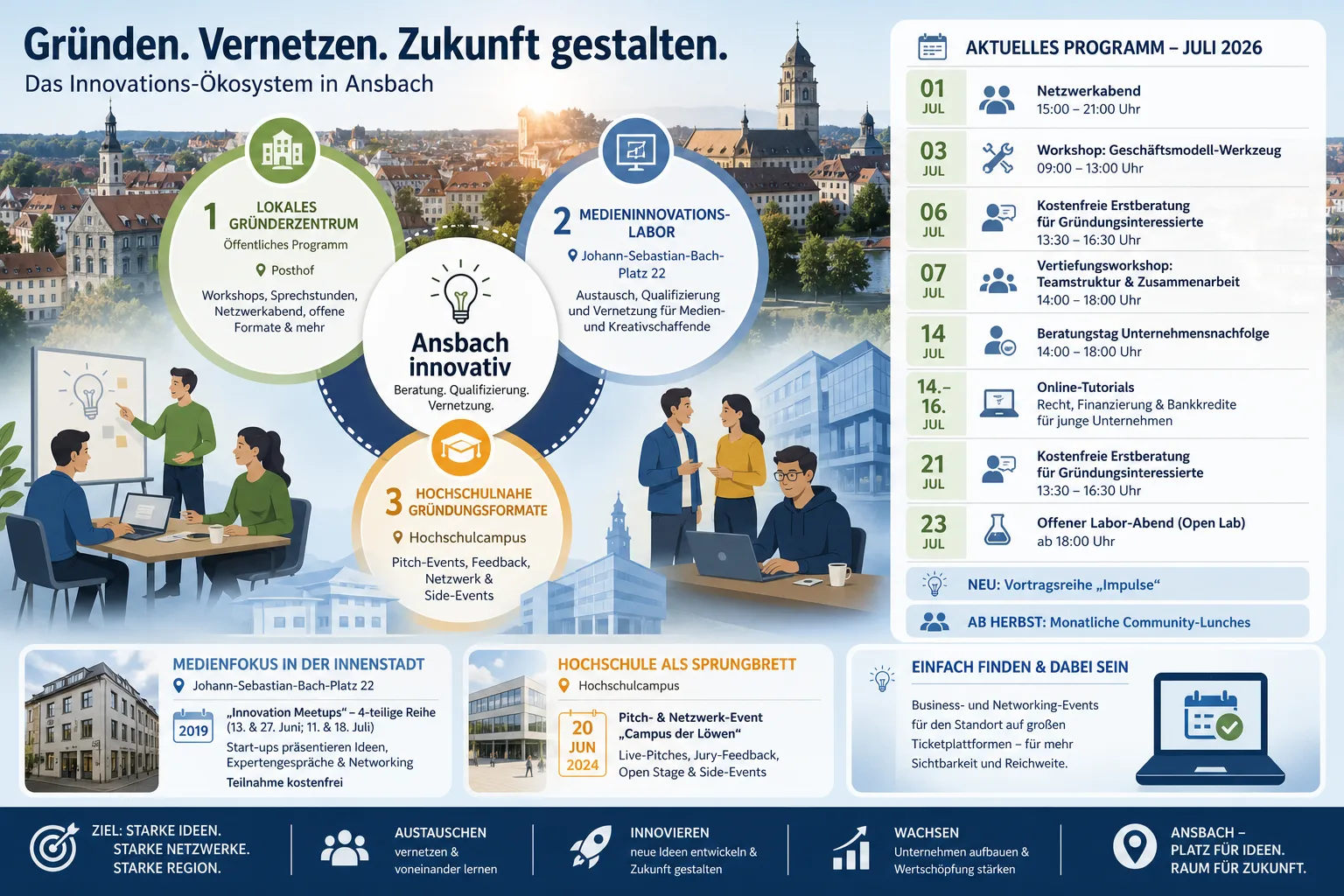
Anyone looking at Ansbach in 2026/2027 will find a scene that grows more through continuous formats than through individual large-scale events: regular consulting services, thematic workshops (e.g., business model, financing, law), open networking evenings, as well as pitch opportunities in educational institutions and innovation settings. This very mix makes it easy to get started: You can participate without long lead times, make initial contacts, and concretize your project step by step.
Important: Dates, content, and access requirements can change at short notice. For binding information, you should always check the official calendars of the respective organizers (see Sources).
Startup Center & Startup Consulting: Typical Event Formats
In the coming months, startup offerings in the region will typically be bundled in recurring formats. If you want to start a business (or take over a company) in Ansbach, these formats are particularly relevant:
1) Open Info and Orientation Sessions
- Initial Consultation & Office Hours for classifying your idea (e.g., target group, value proposition, next steps).
- Orientation Workshops on the structure of a business plan: problem, solution, competition, pricing logic, sales.
2) Practical Workshops for the "Next Step"
- Business Model & Validation: How to test assumptions, gather feedback, and reduce risks early.
- Financing & Funding: Basics on capital requirements, funding logic, bank meetings, and documents (without guarantee of approval).
- Law & Formalities: Overview of legal forms, obligations, data protection basics, and typical contract components (not legal advice, but good preparation for specialist appointments).
3) Succession Formats (for Takeover Instead of New Foundation)
For 2026/2027, the topic of business succession is a focus in many regions. Watch out for special consultation days or info evenings that explain how the search process, evaluation, succession planning, and financing typically work in practice. Official introductory information can be found, among others, at the Chamber of Industry and Commerce (see Sources).
4) Networking Evenings & Community Meetings
Regular networking events are often the fastest lever to:
- Find co-founders,
- Build mentoring contacts,
- Meet cooperation partners (e.g., design, development, sales),
- Explain your own project understandably in 60 seconds.
Media & Digital Innovation: Meetups, Pitches, Exchange
If you are interested in digital products, content formats, communication, marketing technology, or creative business models, suitable formats will likely also be offered in Ansbach and the surrounding area in 2026/2027, which are deliberately low-threshold:
- Innovation Meetups with short impulses and discussions on trends (e.g., distribution, community building, product development).
- Pitch Slots for early ideas: a few minutes of presentation, followed by questions and feedback.
- Open exchange formats (e.g., moderated rounds, "Bring your problem" sessions) that address concrete hurdles.
For the quality of your learning success, it is crucial that you go in with a clear question (e.g., "Which customer benefit is most convincing to you?" or "How would you test this pricing logic?"). This way, you get actionable feedback instead of general opinions.
Campus & University: Stages for Pitches and Team Building
Even in the coming semesters, the campus in Ansbach will remain an important place where ideas can be tested in a relatively protected environment. Typical future formats to watch for:
- Pitch and Demo Days, where teams present in front of an audience and receive structured feedback.
- Team-building events that bring together students from different disciplines (e.g., business, technology, design).
- Workshops on prototyping, presentation, market analysis, and go-to-market.
If you (still) don't want to start a business, these events are still valuable: You learn how ideas are evaluated, what questions investors or juries typically ask, and how to present a project clearly and concisely.
How to Find the Right Events in the Future (Step-by-Step)
- Choose your goal: Orientation (still unsure) or implementation (already have idea/MVP) or succession (interest in takeover).
- Use official entry points: e.g., Federal Startup Portal or Chamber of Commerce offerings as reliable basics (see Sources).
- Check regional calendars: University websites, regional startup initiatives, municipal economic development, event platforms. Look for "startup," "pitch," "network," "succession."
- Start with an open format: Networking or info evening is ideal if you don't know anyone.
- Then go deeper: Book a workshop or consultation as soon as you can name your topic (e.g., financing, sales, legal form).
Note on planning: If you only want to invest one evening, choose an event with "Pitch + Networking." If you want concrete progress, choose "Workshop + Working Phase" (e.g., canvas, financial plan basics).
Short Checklist: How to Prepare for Pitch & Networking
For Networking Evenings
- 30-second intro: Problem, target group, what you are looking for (e.g., feedback, co-founder, pilot customers).
- One concrete question: "How would you test this?" leads to better conversations than "What do you think of this?"
- Contactability: Business card or QR code to a profile/project link (if available).
For Pitch Formats
- One-sentence value proposition that even non-experts can understand.
- One piece of evidence (e.g., interview insights, click or test data), if already available.
- Clear next steps: Pilot, prototype, partner search, funding/financing check.
To avoid getting bogged down in legal details during discussions, a basic understanding of legal form, taxes, and financing from official introductory sources helps (see Sources). For binding decisions, you should then seek qualified advice (e.g., tax/legal advice).
Sources
- Startup Portal (BMWK) — Official introductory information on founding, business plan, financing, and formalities (accessed 2026-07-29)
- Chambers of Industry and Commerce (IHK) – Overview — Regional information and consulting services on founding and business succession, among others (accessed 2026-07-29)
- Ansbach University — Official contact point for campus-related events, semester dates, and innovation/startup offerings (accessed 2026-07-29)
- Gründerland Bayern — Network and overview page for startup support in Bavaria (accessed 2026-07-29)