Public Transport in Ansbach: Comfortable to Every Event
Public Transport in Ansbach: How to Get Comfortably to Future Events
Whether it's a concert evening, sports event, or city festival: With a good plan, you can usually reach event venues in Ansbach reliably by bus and train – and also get home later in the evening.
Stress-Free to Ansbach's Event Life by Bus and Train
For most upcoming events in Ansbach, the following applies: If you know the two most important transfer points, use real-time information, and plan for demand-responsive transport for late journeys home, public transport becomes a comfortable alternative to the car.
This guide explains the interplay between train, city bus, regional bus, and demand-responsive transport – focusing on a plannable arrival and departure for upcoming dates.
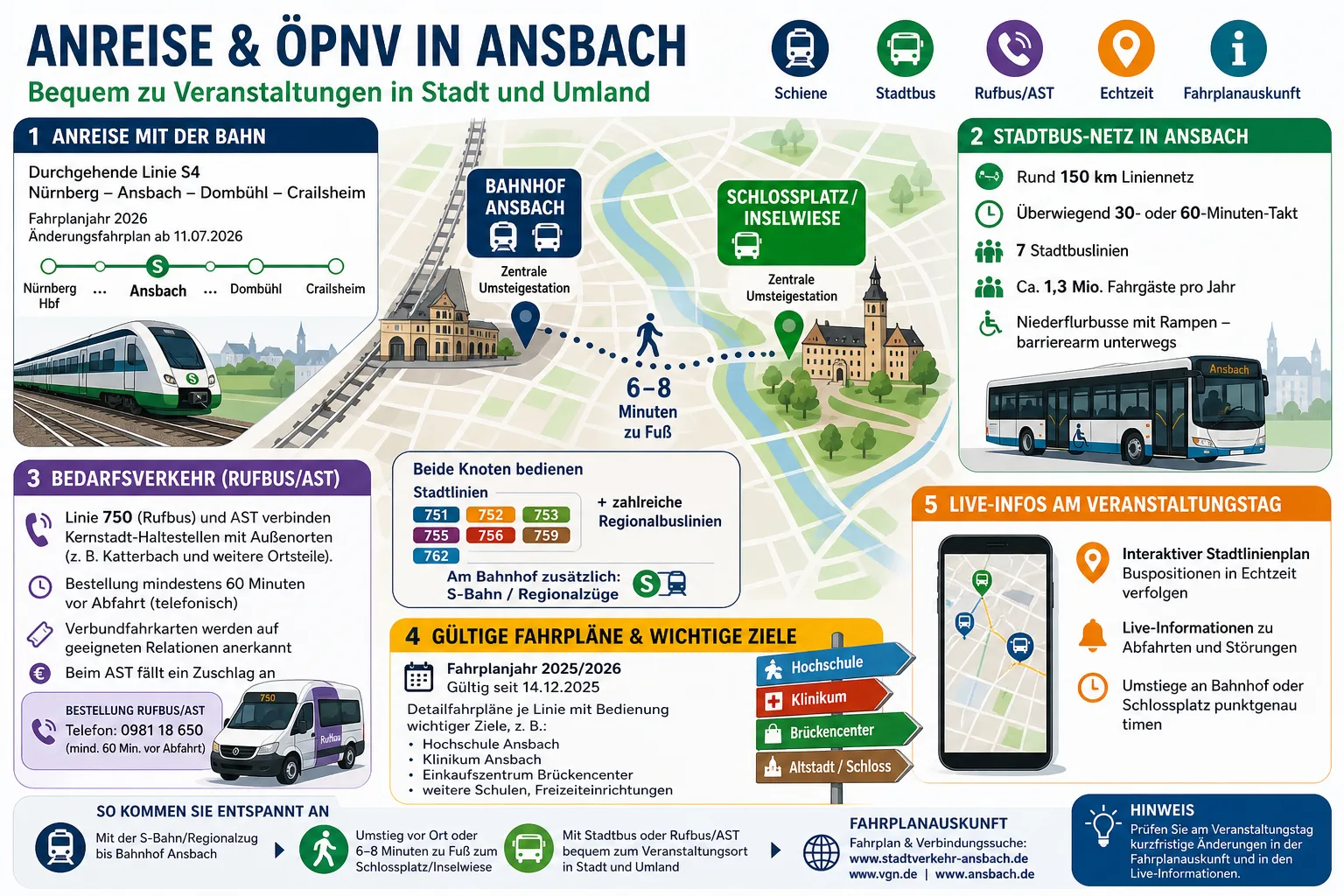
Train Station and Schlossplatz/Inselwiese: The Two Most Important Hubs
1) Ansbach Train Station
The Ansbach train station is the most important entry point for many visitors: Here, regional trains (and, depending on the connection, S-Bahn/regional services from the metropolitan region) meet bus lines. For event days, this means: You can usually continue from the train towards the city center or districts with just one transfer.
2) Schlossplatz/Inselwiese (close to city center)
Close to the city center is the Schlossplatz/Inselwiese area, which in practice often serves as a second "center" for routes to event venues. From here – depending on the location – you can reach many destinations in the city center, around the residence/castle area, and in adjacent areas easily on foot.
How to Use Both Points Cleverly
- Arrival: Plan your arrival at the train station so that you either continue directly or factor in the short walk to the city center.
- Return: Decide early whether you will return after the event via the train station (train connection) or via a central bus hub.
- For tight transfers: Don't rely solely on the paper timetable, but check the real-time situation shortly before departure (see section "Real-Time").
City Bus & Regional Bus: The Backbone for Event Routes
For journeys within Ansbach, the city bus network is usually the first choice. Additionally, regional buses connect the city with surrounding towns – practical if you are traveling to an event or don't need to go home to the city center after the event.
What You Should Know for Events
- Frequency & last departures: For event evenings, the last departures are more important than the "normal frequency" during the day. Check these in advance and again on the day of the event.
- Barrier-free journeys: Many lines use barrier-free vehicles (e.g., low-floor technology). However, the information from the respective transport companies and the timetable information is always binding.
- Choice of stops: Don't just choose the "nearest" stop, but the one that gives you the safest return journey (better connection, later departure, fewer transfers).
Note on accuracy: Line numbers, diversion routes, and service times may change. Always use the official network/line maps and the current timetable information for planning (sources in the reference section).
Timetables, Destinations, Real-Time: How to Plan Your Upcoming Event Evening
Step 1: Set Your Destination (Location + Desired Arrival Time)
Plan so that you build in a 10–20 minute buffer before admission/start. For major events, routes, queues, and short-term stop relocations are more likely.
Step 2: Search for a Connection Using Official Information
Find your connection using an official timetable information service (e.g., transport association/statewide information). Pay particular attention to:
- Transfer time (better 5–10 minutes more than a sprint)
- Platform/stand information (if available)
- Walking distances between stops and the event venue
Step 3: Secure Your Return Trip First (Then "Optimize" the Outbound Journey)
For evening events, the most important trick is: Plan the return trip first. If the last direct connection leaves early, a slightly earlier departure, a different transfer point, or demand-responsive transport can be the more relaxed solution.
Step 4: Check Real-Time on the Event Day
On the day of the event, construction work, delays, or short-term adjustments may occur. Check shortly before departure:
- Live departures of your line
- Disruptions/diversions
- Connection risk for tight transfers
Getting Home Later: Demand-Responsive Transport as Plan B (and Often Plan A)
When regular buses run less frequently in the evening, demand-responsive transport (e.g., call bus or call-collective taxi – depending on the offer) can be especially crucial for outlying areas. Typically: The trip only takes place if you order it in advance and meet the conditions.
This Is How You Proceed for Upcoming Evening Events
- Check in the timetable information whether demand-responsive transport is offered on your route (often with notes on registration).
- Read the ordering rules (deadlines, phone number/online booking, service area, stops).
- Calculate additional costs if a surcharge applies (stated in the conditions of the respective offer).
- Order early as soon as it is foreseeable that you will need demand-responsive transport – especially on popular event evenings.
This makes public transport reliable even when the evening lasts longer: You combine train/city bus to the central hub and use demand-based return transport for the "last mile" to your district.
Practical Route Tips for Upcoming Events in Ansbach
- Arrival from the region: Travel to Ansbach train station and then decide depending on the location: continue by bus or walk towards the city center.
- City center events: Expect more pedestrian traffic on event days. A short walk between hubs can be faster than an additional transfer.
- Events outside the old town: Use the timetable information with the exact destination address and check alternative stops (e.g., "one stop further," but with a better return journey).
- Late end times: Set yourself a reminder (e.g., 30–45 minutes before the end) to check the return trip live and, if necessary, activate demand-responsive transport.
- Groups: If you are traveling in pairs or threes, demand-responsive transport can become more attractive in terms of price – but the official fare and surcharge rules always apply.
Why Public Transport Is Worthwhile for Future Event Visits
Well planned, public transport means: no parking stress, reliable routes to central points, and often a more relaxed return journey – especially if you already know in advance which connection or demand-responsive transport will get you home.
If you regularly attend events, it is worth saving two to three "standard routes" (e.g., train station ↔ city center hub ↔ home/district) and only confirming them with a real-time check on the event day.