How Ansbach Is Changing – Discover New Cultural Venues
How Ansbach Will Change – New Cultural Venues and Ideas by 2030
Ansbach is set for further development: In the coming years, culture is to become more integrated into everyday life, more visible in the urban space, and invite more people to participate in shaping it. This outlook summarizes the key directions that could become defining by 2030 – from experimental spaces to new leadership formats and the future use of historic buildings as open cultural venues.
Why Now? Culture as a Driver for Urban Life
Ansbach combines baroque city history with contemporary questions: How does a residential city remain vibrant when leisure habits, communication, and mobility change? In the coming years, culture is expected to play a dual role: as a program (concerts, exhibitions, theater) and as infrastructure (places, networks, funding logics) that enables encounters in everyday life.
It is crucial that the transformation should not only be driven by individual major events. In the future, low-threshold formats, collaborations, and better orientation for locals and guests will be more central.
Cultural Strategy by 2030: What Is Likely to Change in Ansbach
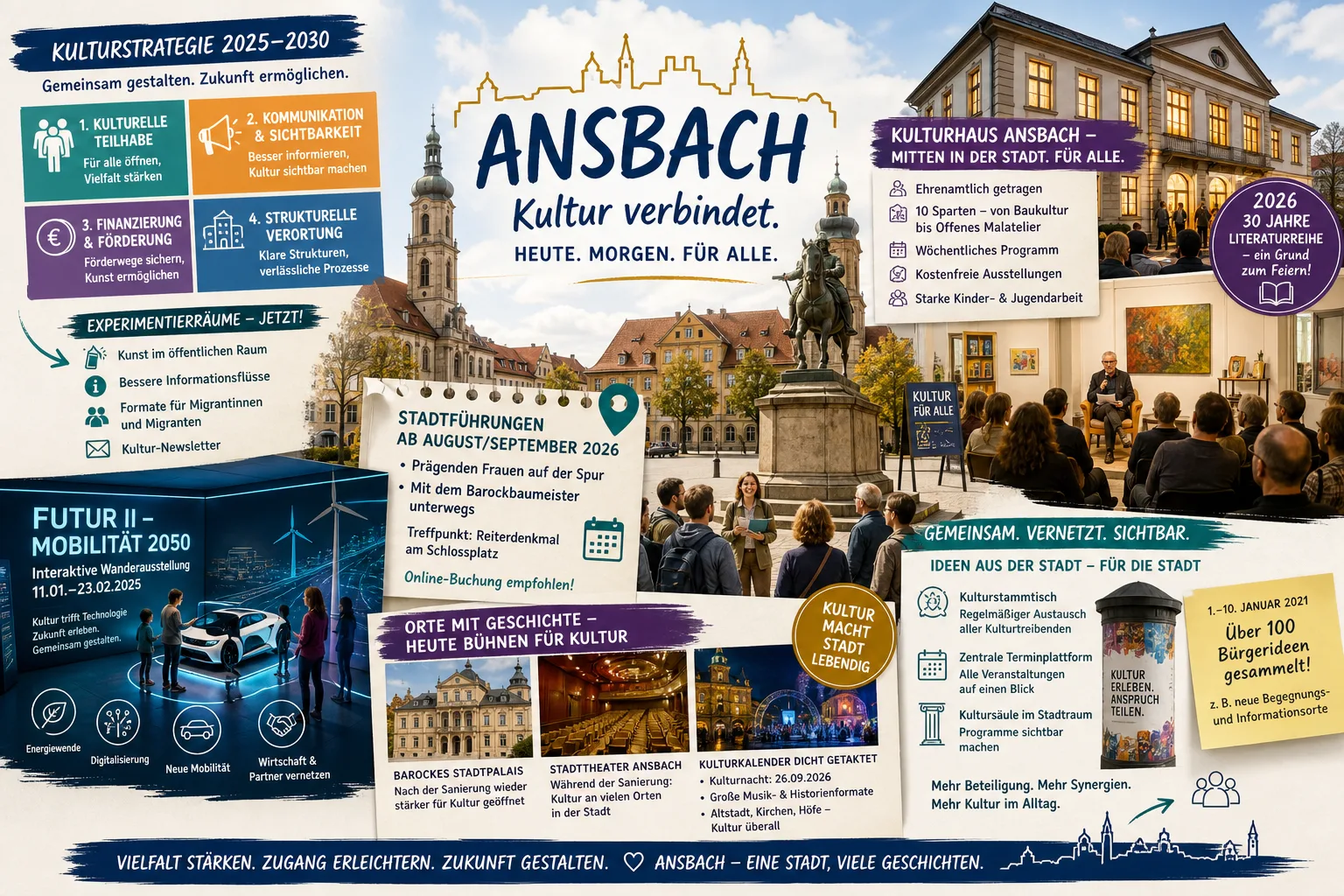
A long-term cultural strategy up to 2030 sets the framework for how cultural offerings can be planned, communicated, and supported in the future. For visitors, what matters most is how this will change the cityscape and accessibility.
Four Areas of Development That Could Have an Impact by 2030
- Cultural Participation: Offerings should be designed so that as many groups as possible can participate – regardless of age, income, or origin.
- Communication and Visibility: Cultural information should become more consolidated, faster, and more user-friendly to find (digitally and in the urban space).
- Financing and Funding: Funding structures should become more predictable so that initiatives can work more long-term.
- Structures and Responsibilities: Clear contacts and processes should simplify cooperation and speed up implementation.
“Experimental Spaces”: Culture Will Take Place More in Public Spaces
A central lever is so-called experimental spaces. These are time-limited, learning-oriented formats that test how culture can become more visible and accessible in the urban space. In the coming years, three directions in particular can gain importance:
- Art in Public Spaces: Temporary installations, artistic interventions, and formats that enable encounters outside of traditional venues.
- New Information Channels: Regular digital updates (e.g., newsletters or central event calendars) as well as additional analog orientation points in the urban space.
- Formats for Diversity and Arrival: Programs that make multilingualism, diverse biographies, and intercultural perspectives visible and promote exchange.
Practical Benefit for Visitors: Those who visit Ansbach in the future will likely be able to “accidentally” discover culture more often – on paths, squares, and in in-between spaces, not just in the classic evening program.
Cultural Center as a Hub: Participation, Volunteering, and Open Formats
In the city center, a cultural center will continue to play a key role in the coming years: as a place where different disciplines come together and new formats can be tried out relatively quickly. Where many programs thrive on engagement and cooperation, particularly low-threshold entry points typically emerge.
What You Can Especially Expect There in the Future
- Regular exhibitions, concerts, readings, and workshops with short planning and attendance hurdles.
- Open participation formats (e.g., studios, introductory courses, discussion groups) that do not require prior knowledge.
- Stronger cultural education for children and young people, because long-term urban development is hardly possible without youth work.
Orientation Tip: If you are planning a trip, it is worth checking the official event pages of the city and the program information of the venues shortly before your visit, as open formats are often scheduled at short notice.
Future Formats: When Culture Creates Spaces for Debate
By 2030, it can be expected that cultural venues in Ansbach will increasingly function as spaces for discussion – for example, on mobility, climate adaptation, digitalization, or urban development. Such formats combine information, experience, and participation: exhibition elements, workshops, dialogue evenings, and interactive stations help make complex topics understandable and locally tangible.
Culture will act less as a “side program” and more as a method for negotiating the future together: visible, public, and in a language that also reaches non-experts.
New City Tours: Perspectives That Will Tell Ansbach's Story Differently
In the coming years, city tours are likely to become more thematically differentiated: In addition to classic routes, perspective tours that combine biographies, architecture, and social issues will gain importance. This not only changes the perspective of guests but also the city's self-image.
Topics That Particularly Suit Ansbach's Profile
- Women's and Social History: Tours that make life paths, engagement, and educational biographies visible.
- Architecture & Baroque: Tours that explain architecture as a reflection of power, urban planning, and everyday life.
- Contemporary Issues in Urban Space: Walks that connect cultural venues, new uses, and participation projects.
Planning Note: Since booking systems and meeting points may vary depending on the provider, the most reliable source for travelers is the official tourism or city tour page of the city of Ansbach (see sources).
Historic Buildings as Open Cultural Venues: What Is More Likely by 2030
A defining trend in the coming years will be the cultural activation of historic buildings: less as mere backdrops, more as usable spaces. Especially in a city with a baroque heritage, the combination of monument preservation, contemporary use, and good mediation can create new reasons to visit.
Which Types of Use May Become More Common in the Future
- Exhibitions and discussion formats in representative spaces that consciously bring together history and the present.
- Temporary stages in smaller halls, courtyards, or unusual inner-city spaces, when productions are flexibly designed.
- Citywide cultural evenings where venues “participate”: open doors, short programs, lighting concepts, wayfinding.
Important for Visitors: Especially with temporary venues, the current security and logistics situation (access, accessibility, capacity) is often decisive. Therefore, check the information from the respective organizer in advance.
Citizen Ideas & Networking: What Will Support the Transformation
To ensure that cultural development by 2030 is not only driven by administration, networking and participation will be crucial. In Ansbach, three very practical building blocks are likely to prove effective, as they increase predictability and visibility:
- Open networking meetings for cultural workers, initiatives, and interested parties to enable cooperation.
- A central event overview that bundles events and simplifies the search for suitable offerings.
- Additional analog information points in the urban space, so that cultural information remains findable even without a smartphone.
When these elements work together, several sides benefit at once: initiatives are easier to find, visitors can plan more easily, and the city center gains in frequency and quality of stay.
How to Plan Future Culture Days in Ansbach (Without Surprises)
- 4–8 weeks before: Check official culture and tourism websites; choose thematic focuses (Baroque/Architecture, contemporary culture, family offerings).
- 1–2 weeks before: Check program updates (last-minute additional dates are common for open formats).
- On the day of your visit: Plan your routes in the city center so you can combine both fixed venues (buildings) and urban space formats (art in public spaces).
This way, you will experience the city not just as a sequence of individual events, but as a coherent cultural space.
Sources & Further Information
- City of Ansbach (official website) — Information on culture, urban development, dates, and offerings (accessed 2026-09-30)
- Bavarian State Ministry for Science and the Arts — Background on cultural funding and cultural policy framework in Bavaria (accessed 2026-09-30)
- Bavarian State Office for Monument Preservation — Classification on the use and preservation of historic buildings (accessed 2026-09-30)
- UNESCO: Recommendation on the Historic Urban Landscape (2011) — Guidelines for the development of historic cities between heritage and future (accessed 2026-09-30)