How Ansbach is Becoming the Smart City of the Future
How Ansbach is Becoming a Smart City: Roadmap for Human-Centered Digitalization
This outlook describes the next steps Ansbach can plan on its path to becoming a Smart City – with a focus on climate protection, mobility, data, and participation.
Note: This article is an editorial look into the future (not an official announcement). Binding decisions, budgets, and timelines are determined by the responsible committees and official publications of the city.
Digital Development Concept: “Smart” but Not Technology-Blind
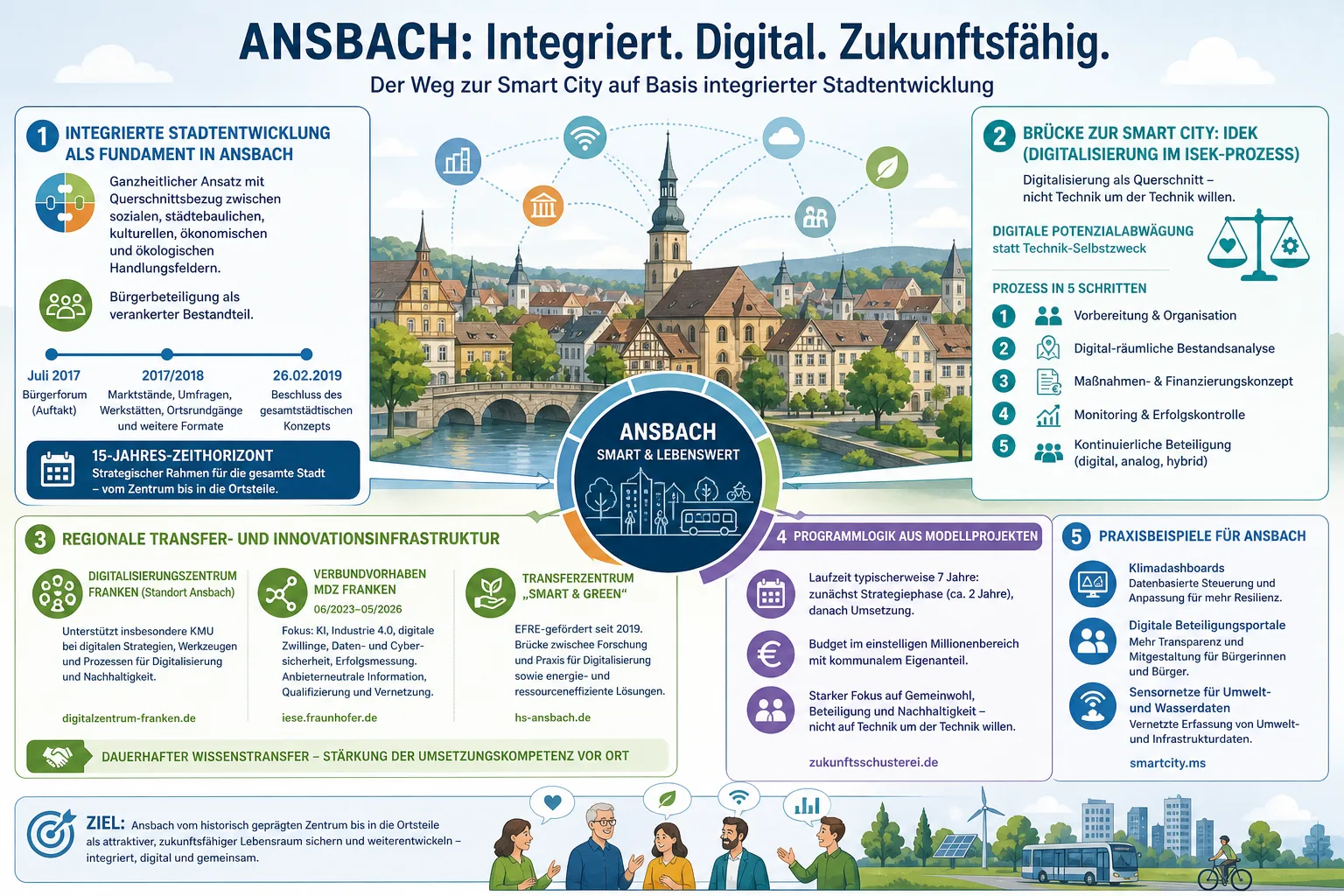
To make digitalization plannable, verifiable, and compatible with urban development, Ansbach can use a digital-urban development concept. Such a concept will connect spatial goals (districts, city center, localities, industrial areas) with a digital perspective and prioritize what truly creates value.
The core idea will be a digital potential assessment: Not every technically possible solution will automatically make sense. Instead, decisions will be prepared along clear questions:
- Who does this concretely help? (Residents, visitors, businesses, administration)
- Which problem measurably improves? (e.g., travel time, energy consumption, quality of stay, downtime)
- Which data are needed? (and how are they minimized, protected, and explained)
- What follow-up costs arise? (operation, maintenance, personnel, training)
Process That Can Take Effect Next
- Setting up governance: Responsibilities, data protection and IT security roles, participation and communication plan.
- Digital-spatial inventory: Networks, data flows, existing services, interfaces, barriers (e.g., media discontinuities in administrative processes).
- Project portfolio & financing: Prioritized measures with target images, resource requirements, funding logic, and realistic implementation stages.
- Monitoring: Key figures, impact control, and regular updates so that projects are not “built once and forgotten.”
Digital Infrastructure & Data as Backbone
For smart city applications in Ansbach to function reliably, the coming years will depend on three fundamentals:
- Network infrastructure: High-performance connections and mobile coverage so that services are stably available even outside the city center.
- Data and platform capability: Standardized interfaces, clear data responsibility, understandable documentation, and practical access for administration and the public.
- Capacity building: Training, process design, and change management so that digitalization does not fail due to staff shortages or unclear procedures.
It will be important to understand data as a means, not as an end in itself. Only when data are collected transparently, processed sparingly, and explained clearly does trust arise – and only then will digital solutions be accepted in everyday life.
Concrete Fields of Action That May Soon Become Tangible
Which projects will make smart city development in Ansbach most visible to residents and guests? The following fields of action typically create quick benefits if they are properly prioritized and implemented in compliance with data protection.
1) Making Climate and Environmental Data Understandable
In the coming years, Ansbach can build a climate dashboard that clearly bundles selected key figures: heat, heavy rainfall risks, green space effects, or water levels (depending on available data). The benefit will be to make decisions and measures understandable – for administration and the public.
So that such a dashboard does not just “look nice,” it will need clear accompanying rules: Which data sources are used, how up-to-date are they, what uncertainties exist, and how are measurement or model limits explained?
2) Connecting Mobility: Inform, Relieve, Facilitate Switching
Another focus can be connected mobility: reliable real-time information for public transport, better transfer information, transparent notices in case of disruptions, and digital support for parking or sharing offers – provided appropriate partners and data agreements exist.
The impact will be especially noticeable when Ansbach combines digital measures with spatial planning: safe routes, attractive stops, clear signage, and low-barrier access will be considered together with digital information.
3) Managing Infrastructure & Operations “Smarter” – With Clear Limits
In the coming years, Ansbach can examine where sensors and operational data help in everyday life: for example, in demand-based irrigation of green spaces, monitoring critical infrastructures, or more efficient maintenance.
It will be crucial that such systems are planned robustly: clear responsibilities, maintenance budgets, IT security concepts, and a realistic approach to measurement errors.
Participation as Compass: How the Urban Community Can Help Shape
A smart city in Ansbach will only function sustainably if participation is not organized as a late “rubber-stamping,” but as a continuous compass. In the future, three levels can interact:
- Analog: District formats, workshops, on-site appointments – important for exchange and trust.
- Digital: Participation platforms, structured online surveys, feedback on prototypes – important for reach and documentation.
- Hybrid: Events where questions, votes, and protocols are available online – important for accessibility.
For participation to be effective, Ansbach will need clear feedback loops in future projects: What was proposed? What will be implemented? What will be discarded – and why? Transparent explanations are often more important than perfect agreement.
Guiding question for upcoming projects: “Which decision is improved by digital means – and how can the city explain this publicly?”
Guardrails: Data Protection, Transparency, Accessibility
Smart city projects will only be trustworthy if they adhere to the following guardrails from the outset:
- Data protection: Personal data are avoided wherever possible; where necessary, they are processed in a legally secure manner and explained clearly.
- IT security: Security requirements are considered already in planning (“security by design”), including permissions, logging, and update strategy.
- Transparency: Goals, data sources, responsibilities, and success criteria are documented and publicly accessible.
- Accessibility & inclusion: Digital offerings are designed to be usable by as many people as possible; analog alternatives remain available where necessary.
Especially for sensitive applications (e.g., video, tracking movement flows, AI-based forecasts), Ansbach will in future need particularly clear purpose definitions, minimization, and public explanations.
Outlook: Milestone Plan for the Coming Years
For Ansbach to become a smart city step by step, a milestone plan that remains ambitious but realistic will prove its worth:
- Stage 1: Fundamentals & Priorities
In the next phase, target images, responsibilities, data and security standards, and a prioritized project portfolio will be defined. - Stage 2: Pilot Projects with Impact Measurement
This will be followed by a few, clearly defined pilots that provide measurable relief (e.g., information services, climate transparency, operational efficiency). Each pilot phase will include criteria for success, termination, or scaling. - Stage 3: Scaling & Consolidation
Only when operation, financing, maintenance, and acceptance are secured will solutions be expanded. In parallel, processes in the administration will be further digitized to reduce media discontinuities.
Thus, Smart City for Ansbach will in the future be less of a single major project and more of a lasting interplay of urban development, data competence, and participation – with the aim of improving quality of life, climate protection, and capacity to act.