Digital Art & NFT Exhibitions in Ansbach
Digital Art & NFT Exhibitions in Ansbach: Preview of Upcoming Formats, Dates, and Program Highlights
Digital art will become more visible in smaller cities in the coming months and years: as projection, screen art, augmented reality (AR) in urban spaces, or as NFT-curated exhibitions. For Ansbach, this mainly means one thing: new future occasions are emerging where baroque cityscapes, contemporary media art, and blockchain technology can meet.
Upcoming Exhibition Formats: from Projection to “Wallet Check-in”
1) Screen and Projection Exhibitions (Loop Art, Video, Generative Animation)
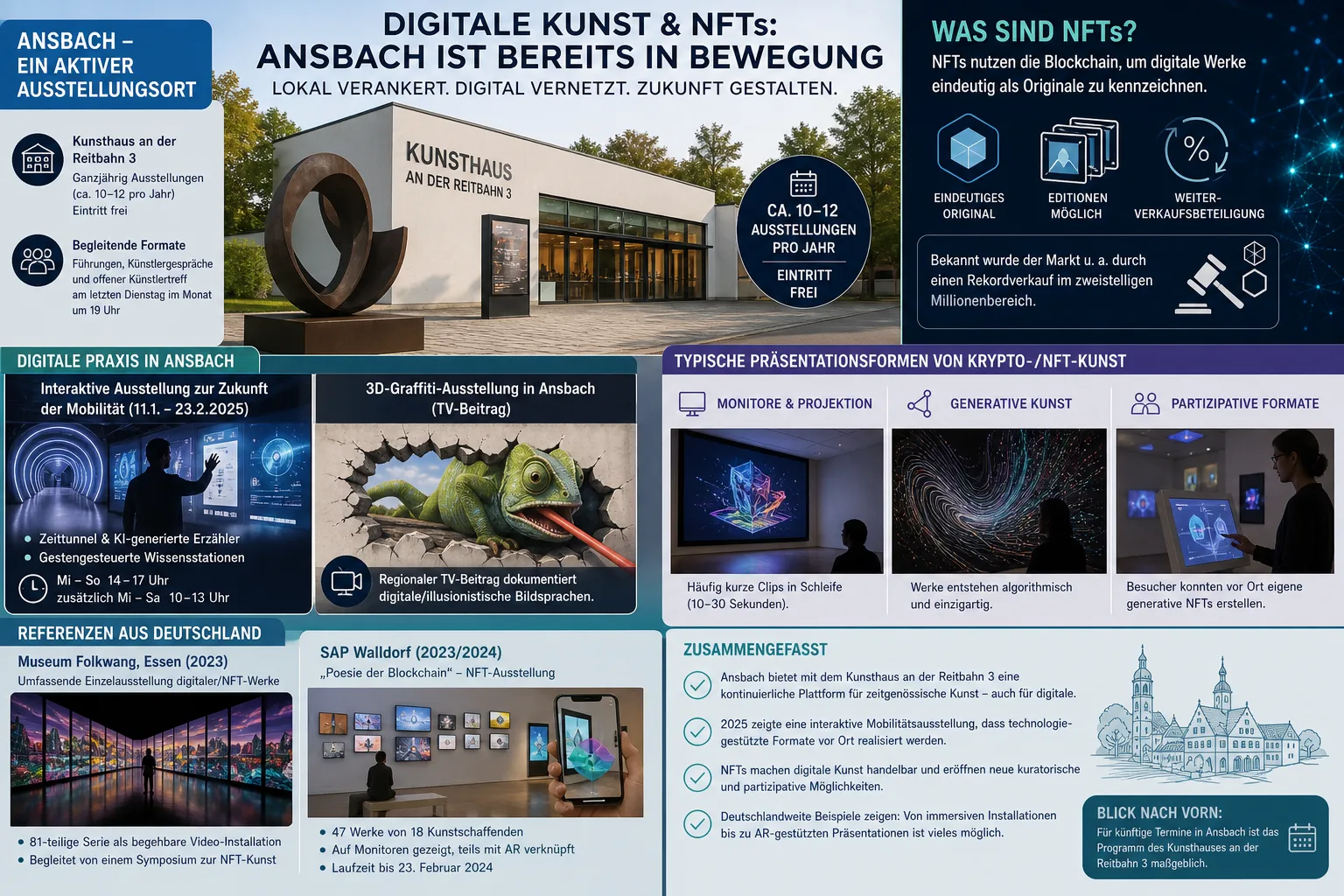
Many digital works are designed as moving images or generative renderings. Future exhibitions can display these works on calibrated monitors, LED walls, or as large-scale projections. It is crucial that curators explain what the work is (file/code/interaction) and how it should be experienced in the space (sound, sightlines, durations).
2) Interactive Installations (Sensors, Gestures, AI Dialogues)
Interactive formats are likely to become more prominent in upcoming programs: works that respond to movement, provide audio feedback, or can be controlled via interfaces. For NFTs, the “auction moment” is less important than the question of how digital works remain verifiably authenticated and accessible in the long term.
3) AR Art in Urban Spaces (Time-Limited Digital City Walks)
A realistically feasible future format is AR routes: visitors see digital sculptures, overlays, or narrative layers at selected locations via smartphone or rental devices. Such formats are particularly suitable for Ansbach because they do not overbuild historical sites but temporarily complement them.
4) NFT-Curated Shows (Token as Certificate, Not as Show Effect)
If NFTs become part of a future exhibition, the token should primarily be understood as proof: an assignment (e.g., to metadata or a work hash) in a distributed ledger. For visitors, it is most important that the exhibition transparently explains what exactly “NFT” means here: proof of ownership, edition, access ticket, collector's certificate, or curatorial format.
Typical Program Highlights of Upcoming NFT and Digital Art Events
- Introductory Lecture to the exhibition (terms: wallet, token, metadata, editions, copyright).
- Artist Talk focusing on workflow (software/tools, rendering, sound, code, output formats).
- Curatorial Tour with a focus on context: media history, net art, generative art, post-internet positions.
- Workshop “Digital Ownership” (practical, but without purchase pressure): How do you verify origin/provenance? What risks are there?
- Low-Barrier Access: Subtitles for video works, clear signage, quiet time slots, comprehensible accompanying texts.
For the quality of future events, it is crucial that program highlights do not just serve the “hype” but provide visitors with concrete orientation: What is art, what is technology, what is market mechanics?
Planning for Visitors: How to Prepare for Upcoming NFT Exhibitions
Checklist for Visiting the Exhibition
- Clarify your goal: Do you mainly want to see art, understand technology, or engage with artists?
- Check device requirements: If AR is planned, clarify in advance whether rental devices are offered or if you need your own smartphone.
- Observe data protection: For interactive installations, organizers should clearly state whether data is stored. Ask if it is unclear.
- No purchase obligation: Reputable exhibitions work without purchase pressure. If purchase options exist, they should be transparent and separate from the educational program.
- Note questions: What is the “work” (file, code, performance, interaction)? How is it preserved? What rights remain with the artist?
If NFTs are offered: what you should pay attention to in the future
- Clarity of terms: Is it a collector's certificate, a ticket, an edition, or proof of ownership of a file/work?
- Transparent fees: Reputable providers explain network fees, platform fees, and possible additional costs.
- Risk notice: Cryptoassets are volatile; an exhibition is not a financial product. Buying art can bring joy, but is not a promise of returns.
Planning for Artists & Curators: Standards, Rights, Sustainability
Technical Minimum Standards for Upcoming Exhibitions
- Archivability: Plan exports/file formats and documentation so that the work can be reconstructed later (versions, dependencies, output parameters).
- Authenticity: Clarify which metadata is relevant (work description, edition, hash, display instructions) and how it remains permanently accessible.
- Security and rights concept: Properly document licenses, usage rights for audio/video/fonts/datasets; for AI elements, handle training data and output rights transparently.
Sustainability & Energy: How the Topic Will Be Addressed Seriously in the Future
For blockchain-related exhibitions, sustainability will likely be a fixed point in future programs. Good practice is to explain transparently which infrastructure is used and which energy-related arguments actually apply (e.g., changes in consensus mechanisms, display/projection runtimes, computing costs for rendering). A reputable exhibition separates facts from marketing and supports key statements with sources.
Communication Without Jargon
For E-E-A-T, what counts in practice is: explain terms in plain language and do not overwhelm visitors with wallet or platform details. In future Ansbach formats, a two-step model can work: a short introduction for everyone and an optional deep-dive format for those interested.
Local Reference: How Ansbach Can Effectively Communicate Future Digital Art Dates
To ensure that upcoming digital art and NFT formats in Ansbach are reliably noticed, clear communication in event announcements is needed. The following have proven effective:
- Clear durations (start/end), plus recurring evening dates for working people.
- Technical information: AR yes/no, rental devices yes/no, audio yes/no, low-barrier alternatives.
- Transparency about costs: Admission, workshop fees, reservation requirements, age restrictions.
- City added value: Can be combined with a visit to the city center (e.g., short distances, clear directions, public transport information).
This way, “Digital Art” does not become a niche topic, but a well-planned cultural offering that can attract audiences from the region and beyond.
Sources
- Ethereum.org: Proof-of-Stake (Consensus) — Background on consensus mechanisms and classification of energy/process issues (accessed 2026-09-02)
- Ethereum Improvement Proposals: EIP-721 (Non-Fungible Token Standard) — Technical standard for NFTs, common basis for editions/ownership models (accessed 2026-09-02)
- Ethereum Improvement Proposals: EIP-1155 (Multi Token Standard) — Standard for editions and combined token models (accessed 2026-09-02)
- W3C: Decentralized Identifiers (DID) Core — Basic knowledge on decentralized identifiers, relevant for authenticity and assignment models (accessed 2026-09-02)
- European Commission: Data Protection (Overview) — Guidance on data protection principles for interactive/AR formats (accessed 2026-09-02)